
In the next two posts, longer than usual, I will explain some ideas of recent works written in collaboration with Patricia Alonso-Ruiz, Li Chen, Luke Rogers, Nageswari Shanmugalingam and Alexander Teplyaev about the study of bounded variation functions in the context of Dirichlet spaces.
A basic motivating geometric question for those works was: What is the good mathematical structure on a space that allows to define an intuitively reasonable notion of perimeter for “good” sets ? The question is of course a little vague, but deeply thinking about it from different viewpoints is certainly fruitful and yields an interesting mathematical adventure.
In our works we argue that Dirichlet spaces provide a good framework in which we can define sets of finite perimeter and prove theorems generalizing in an elegant way classical results from the Euclidean space, like the classical isoperimetric inequality. A key guiding insight which comes from potential theory is to think of the perimeter of a set as a 
The isoperimetric inequality in the plane
Dido was, according to ancient Greek and Roman sources, the founder and first Queen of Carthage (in modern-day Tunisia).
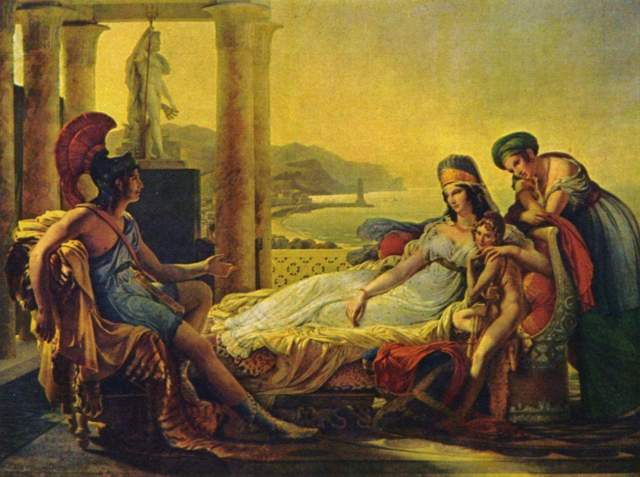
Aeneas recounting the Trojan War to Dido, a painting by Pierre-Narcisse Guérin.
The legend says that when Dido arrived in 814BC on the coast of Tunisia, she asked for a piece of land. Her request was satisfied provided that the land could be encompassed by an ox-hide. This land became Carthage and Dido became the queen. But:
What is the shape of the land chosen by Queen Dido ?
Mathematically, we can first simplify and rephrase this problem as:
In the Euclidean plane, what is the curve which encloses the maximum area 

This is the isoperimetric problem in the plane. If we restrict ourselves to smooth closed curves and understand the perimeter of a set as the length of its boundary, the problem can be solved using basic calculus: the method of Lagrange multipliers. As is intuitively clear, the curve which encloses the maximum area

So the city limits of Carthage formed a (half) circle. We can still visit today the ruins of Carthage, and a small museum there explains the isoperimetric story of Queen Dido.
Modern footprints
As mathematicians, we like to formulate problems at different levels of generality and in a form that can be generalized to different settings. To formulate the isoperimetric problem in the n-dimensional Euclidean space 
Our modern and current understanding of the notion of volume is largely based on the seminal works by H. Lebesgue (1901-1902): Nowadays, one understands volumes in the category of measure spaces.
The notion of perimeter is more elusive and can be understood from different viewpoints, yielding different generalizations. The Italian school in geometric measure theory played a major role in advancing the theory.
A first stepstone: R. Caccioppoli’s basic definitions, 1920’s, 1950’s

The first idea to define the perimeter of a Borel set 


and say that
A (somehow dual) definition for the perimeter of a set which coincides with the previous one is given by

This definition only requires a differential structure and a Riemannian metric to define the divergence of vector fields; it can therefore be extended to any Riemannian manifold.
A second stepstone: E. De Giorgi, 1950’s

If

where 


This characterization of sets of finite perimeter is far reaching, convenient to work with, and may actually serve as a definition in a large class of spaces. It only requires a heat semigroup, an object which is well defined in the category of Dirichlet spaces, and a length of gradient 
A third stepstone: H. Federer, 1960’s

Given a subset

Then, 


This characterization of sets of finite perimeter is striking, it shows that the perimeter of a set can be understood using only a metric and a measure.
A fourth stepstone: M. Ledoux, 1990’s

If

where 

This characterization of sets of finite perimeter, which is due to M. Ledoux for balls and in the general case to M Miranda Jr, D Pallara, F Paronetto & M Preunkert, 2007, only requires a heat semigroup. As noted above, heat semigroups are well-defined in Dirichlet spaces.
Thus, sets of finite perimeter may perfectly be well defined in any Dirichlet space and we do not need a gradient or a distance. This is the point of view we will take on the next post and will explain the associated theory. A key point is the understanding of the normalizing factor 
 Research and Lecture notes