
With Hongyi Chen, Li Chen and Søren Kjærsgaard, we have posted a new paper, Intermittency for the parabolic Anderson model on spaces with sub-Gaussian heat kernel estimates.
This is a sequel to our earlier work on bounded domains of recurrent metric measure spaces, where we assumed strong recurrence, , and considered Dirichlet and Neumann boundary conditions. The new paper treats unbounded spaces and allows critical and transient diffusion. Even in the strongly recurrent setting, it provides stronger moment lower bounds, Hölder regularity, and the existence of long-time moment growth rates for every real order.
1. Geometry and the equation
We study the stochastic heat equation
Throughout, . The underlying Dirichlet space has volume growth and two-sided sub-Gaussian heat kernel estimates with walk dimension . The precise hypotheses are stated in the paper.
The noise is white in time. In space, it is white when and has covariance given by the kernel of when . The admissible parameter range in the Itô–Walsh framework is
In particular, space-time white noise is admissible only when . In Euclidean space, = 2, so this gives the usual dimensional restriction d = 1.
One property we want to understand is intermittency: as time increases, high peaks concentrate in small regions of the space. A useful way to quantify this behavior is through moments. Heuristically, a moment of order p much larger than the pth power of the first moment indicates large fluctuations. This motivates the study of moment Lyapunov exponents.
2. Real-order moment Lyapunov exponents
For bounded initial conditions, the equation has a unique mild solution with finite moments on bounded time intervals. A central result is the existence of the limit
For every real , this limit is finite and independent of and of the bounded nonnegative initial condition , provided is nonzero on a set of positive measure.
For integer moment orders, the Feynman–Kac representation relates the moments to an associated Schrödinger semigroup, and spectral theory can then identify their exponential growth rate. Our argument applies to every real order p ≥ 1. ChatGPT Astra 6 first suggested a rather involved approach, which we subsequently simplified using ideas from The stochastic heat equation with multiplicative Lévy noise: Existence, moments, and intermittency by Quentin Berger, Carsten Chong and Hubert Lacoin.
3. Matching moment bounds and intermittency
For , we prove
The two comparison constants are independent of and . The lower bound holds for every real , including the white-noise case. For , the upper estimate is instead obtained by interpolation:
Moreover, and is strictly increasing on . Thus normalized moments of different orders separate exponentially. This is the moment formulation of full intermittency.
The lower-bound argument adapts the Gaussian exponential test of Chen, Deya, Ouyang and Tindel, combined with estimates for confinement of the diffusion to a ball.
4. Hölder regularity
Suppose the heat semigroup satisfies, for some , the weak Bakry–Émery estimate
The solution has a modification which is locally Hölder continuous away from time zero, with any time and space exponents satisfying
5. The infinite Sierpiński gasket
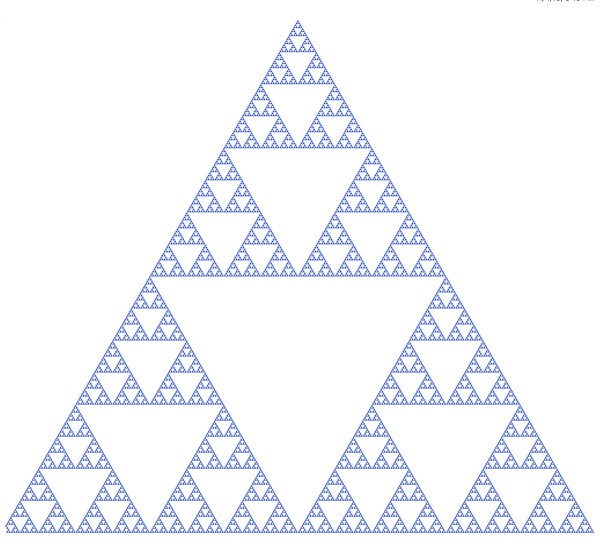
Let be the compact gasket of diameter , rooted at the origin, and consider its unbounded blow-up
Here
For space-time white noise, the moment estimate becomes
At large moment orders, the powers of and are approximately and , respectively. They are determined by the geometry of the gasket.
Since its heat semigroup has exponent , the white-noise solution is locally Hölder continuous with any exponents
In the white-noise case, there is also an exact discrete scaling law. With initial condition and noise intensity indicated by a superscript,
Consequently,
This scaling fixes the power-law scale while allowing a modulation periodic in .
The pictures below show one realization with space-time white noise, and , at times , , and . The observation cell is , of diameter . The computation uses the larger truncation , with mesh ; there are displayed vertices. The two remote corners carry zero Dirichlet conditions, while the origin retains the natural reflecting condition.
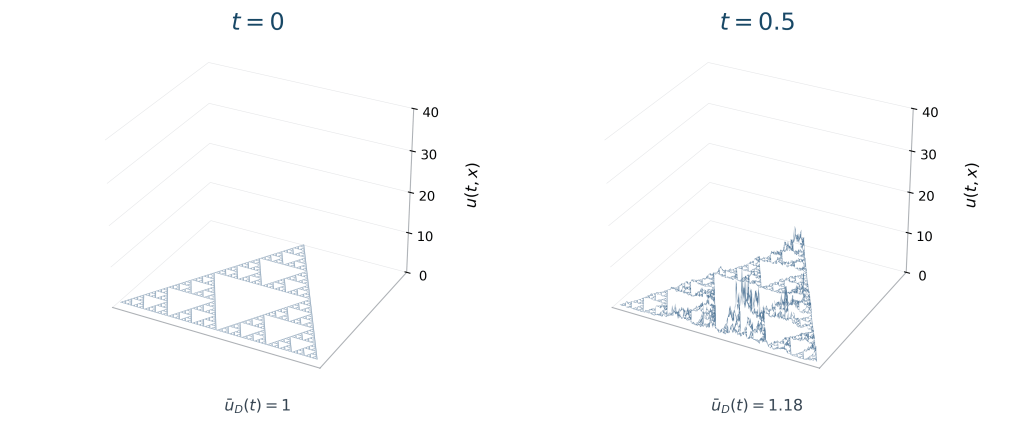
The same realization at times and . Heights represent the unnormalized solution, with a common scale for all four panels.
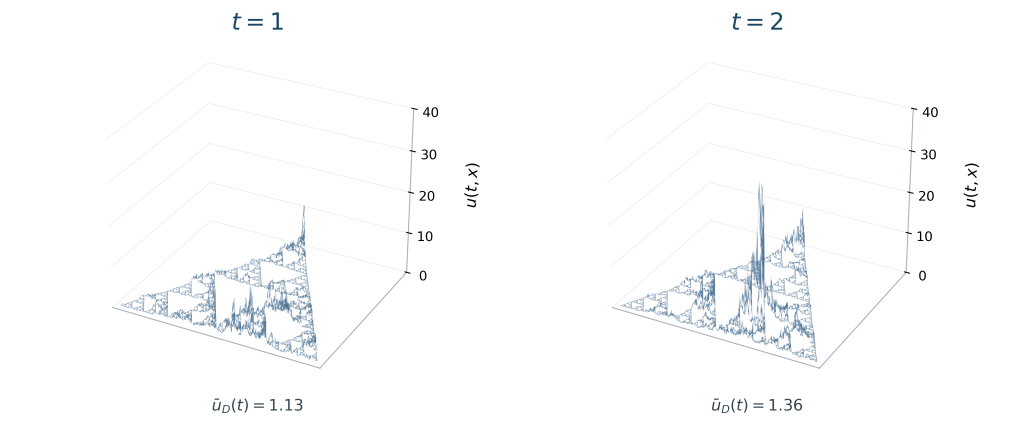
The realization at times and . The numbers below the panels are spatial averages over the observation cell.
These averages approximate
At , the largest displayed value is about , while the spatial average is about . The pictures illustrate spatial concentration in a finite graph approximation. The intermittency theorem concerns the asymptotic growth of ensemble moments.
We also simulated the stronger noise intensity , with the same geometry, and . This is an independent realization. The four panels show actual solution heights on separate vertical scales.
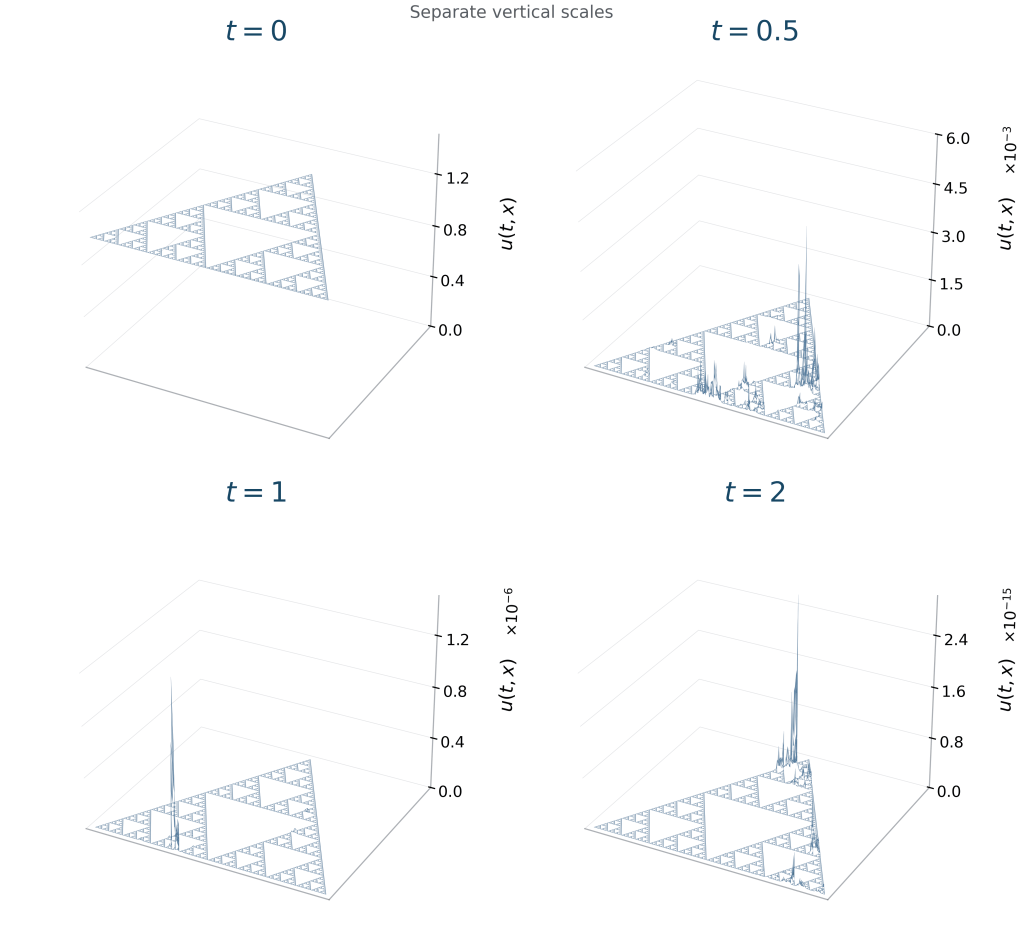
One realization for at times , , and . Note the powers of ten on the vertical axes.
The additional snapshot at shows an early burst: the maximum is approximately , whereas the spatial average is .
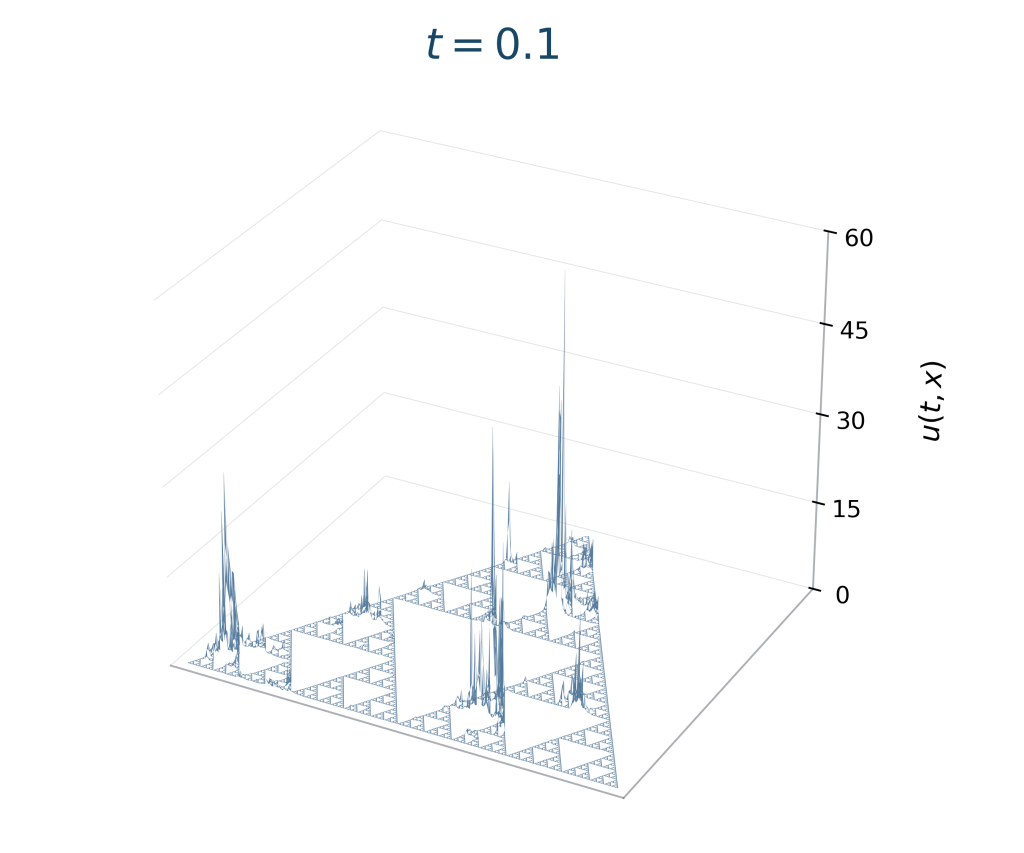
The same realization at .
The displayed solution subsequently becomes very small, while remaining concentrated: at , its maximum is about times the spatial average.
The new paper contains the full statements and proofs, the scaling argument, and the details of the numerical approximation.
AI tools were only used at the end of the project when we already had a substantial manuscript in our hands. They were mostly used for polishing, proofreading, proof presentations and numerical simulations. However, ChatGPT Astra 6 discovered the approach for the existence of moments of real orders, that we then simplified later; we had a proof based on Feynman-Kac formulas that only worked for moments of integer order. ChatGPT Sol 6.1 was used in assisting the writing of this post.
 and boundedness for
  under volume doubling and heat kernel upper bounds which are Gaussian at small times and sub-Gaussian at large times.
 .
. denote the characteristic diffusion time at distance
  . A model case is
 (the Hausdorff measure in most examples) describes volume and is used to integrate functions. The length measure
  is carried by the skeleton
  , the union of the open geodesic arcs, and is used to integrate their weak derivatives
  . The Dirichlet form is
 . The Riesz transform
  is initially defined on
  . The boundedness question asks for which exponents it extends to a bounded map
 , and a compatible pointwise gradient estimate for the heat kernel. Under eventual Gaussian scaling, together with a local Dini condition, we prove
 ,
,
 near zero for some
  , so it includes the model above. Duality then gives the reverse inequality
 is expressed by a rigidity theorem. Assuming uniform volume growth and two-sided heat kernel estimates, boundedness of
  for even one exponent
  , or a reverse inequality for even one exponent
  , forces
 , it is locally fractal and has the large-scale geometry of
  . Write


 , the positive theorem and the rigidity theorem give the complete answer. The comparison with the Vicsek manifolds is:
 , we write
 without Gaussian heat kernel bound
 bounds at the critical exponent is essentially due to ChatGPT 5.5. pro. (After research, it appears that the strategy relies on methods
 the Riesz transform is the operator
  and its
  is related to the two inequalities,
 , by spectral theory, both are identities with
  on any complete Riemannian manifold, since
  . For
. For  geometry enters.
 [CD99], and conjectured that this holds on every complete manifold with no assumption at all [CD03, Conjecture 1.1]. After intermediate steps (notably [CCFR17], which only needs sub-Gaussian bounds and thus covers fractal-like manifolds), the conjecture was recently settled in September 2026 by Rui Chen, Renjin Jiang, Bo Li and Hong-Quan Li [CJLL26]: on every complete non-compact Riemannian manifold, the Riesz transform is of weak type
  under non-negative Ricci curvature (Bakry), it is characterised under doubling and Poincaré by gradient bounds for the heat semigroup [ACDH04], it fails for large
  follows from the Riesz inequality for
  ; for
; for  it needs Poincaré-type hypotheses [AC05, DR22] and fails on Vicsek manifolds and graphs [CCFR17].
 is universal, and the range
  ; we use its unbounded version
  , of Hausdorff dimension
  , with its geodesic distance and Hausdorff measure
  , is a countable union of segments carrying a length measure
  (
( ,
,  ) [BC23] and the Dirichlet form
  on
on  , with Laplacian
  and heat semigroup
  . The heat kernel has sub-Gaussian estimates with walk dimension
  .
. with
with  multiplies
  by
by  and
and  by
by  (the measure scales by
  , the Laplacian by
  ). An inequality between the two, uniform in
  , forces
 , with an exponent that depends on
  holds for every
  and
and  , and fails, even in weak
  .
. the reverse inequality holds in weak
 has a weak-
 for every
  , but the strong
  is not of weak type
  is bounded from
  to
to  but not from
  to
to  . For
. For  only for
  without Gaussian heat kernel bound


![\int_X\phi\, d\Gamma(f)=\frac{1}{2}[2\mathcal{E}(\phi f,f)-\mathcal{E}(\phi, f^2)]](https://s0.wp.com/latex.php?latex=%5Cint_X%5Cphi%5C%2C+d%5CGamma%28f%29%3D%5Cfrac%7B1%7D%7B2%7D%5B2%5Cmathcal%7BE%7D%28%5Cphi+f%2Cf%29-%5Cmathcal%7BE%7D%28%5Cphi%2C+f%5E2%29%5D+&bg=ffffff&fg=333333&s=0&c=20201002)


![\frac{1}{2}[2\mathcal{E}(\phi f,f)-\mathcal{E}(\phi, f^2)]](https://s0.wp.com/latex.php?latex=%5Cfrac%7B1%7D%7B2%7D%5B2%5Cmathcal%7BE%7D%28%5Cphi+f%2Cf%29-%5Cmathcal%7BE%7D%28%5Cphi%2C+f%5E2%29%5D+&bg=ffffff&fg=333333&s=0&c=20201002) .
.
![\left|\frac{1}{2}[2\mathcal{E}(\phi f,f)-\mathcal{E}(\phi, f^2)]\right|\le \|\phi\|_{\infty}\mathcal E(f).](https://s0.wp.com/latex.php?latex=%5Cleft%7C%5Cfrac%7B1%7D%7B2%7D%5B2%5Cmathcal%7BE%7D%28%5Cphi+f%2Cf%29-%5Cmathcal%7BE%7D%28%5Cphi%2C+f%5E2%29%5D%5Cright%7C%5Cle+%5C%7C%5Cphi%5C%7C_%7B%5Cinfty%7D%5Cmathcal+E%28f%29.+&bg=ffffff&fg=333333&s=0&c=20201002)




 means that
  are neighbors in the graph


