Caccioppoli sets, Part II

After the general introduction to the theory of Caccioppoli sets that was presented in the previous post. I will now sketch some elements of the theory that was developed in our works:

Dirichlet spaces

Let X be a good measurable space (like a Polish space) equipped with a \sigma-finite measure \mu.  Let (\mathcal{E},\mathcal{F}=\mathbf{dom}(\mathcal{E})) be a densely defined closed symmetric form on L^2(X,\mu).  A function v on X is called a normal contraction of the function u if for almost every x,y \in X
| v(x)-v(y)| \le |u(x) -u(y)| \text{ and } |v(x)| \le |u(x)|.
The form \mathcal{E} is called a Dirichlet form if it is Markovian, that is, has the property that if u \in \mathcal{F} and v is a normal contraction of u then v \in \mathcal{F} and \mathcal{E}(v,v) \le \mathcal{E} (u,u).

Heat semigroup

Let \{P_{t}\}_{t\in[0,\infty)} denote the self-adjoint heat semigroup on L^2(X,\mu) associated with the Dirichlet space (X,\mu,\mathcal{E},\mathcal{F}):

\mathcal{E}(f,f)=\lim_{t\to 0^+}\frac{1}{t}\langle (I-P_t)f,f\rangle.

As is well-known, P_t: L^2(X,\mu) \cap L^p (X,\mu) \to L^p (X,\mu), 1 \le p \le \infty, can be extended into a contraction semigroup P_t : L^p (X,\mu) \to L^p (X,\mu).

We always assume P_t1=1.

BV space

For \alpha >0, consider the L^1 Besov type space
\mathbf{B}^{1,\alpha}(\mathcal{E})=\left\{ f \in L^1(X,\mu), \limsup_{t\to 0} \frac{1}{t^\alpha} \int_X P_t ( | f - f(y)|) d\mu(y) <+\infty \right\} and \alpha^\#_1(\mathcal{E})=\sup \{ \alpha >0\, :\, \mathbf{B}^{1,\alpha}(\mathcal{E}) \text{ contains non a.e. constant functions} \}.

DefinitionThe space of bounded variation functions associated to the Dirichlet form \mathcal{E} is defined as BV(\mathcal{E})=\mathbf{B}^{1,\alpha^\#}(\mathcal{E}). For f \in BV(\mathcal{E}), one defines its variation as
\mathbf{Var}_\mathcal{E} (f)=\liminf_{t\to 0} \frac{1}{t^\alpha} \int_X P_t ( | f - f(y)|) d\mu(y)
A set E \subset X is called a \mathcal{E}-Caccioppoli set if 1_E \in BV(\mathcal{E}). In that case, its \mathcal{E}-perimeter is defined as P_\mathcal{E}(E)=\mathbf{Var}_\mathcal{E} (1_E).

Examples

Example 1: Euclidean space

The following can be deduced from M. Miranda Jr, D. Pallara, F. Paronetto, M. Preunkert, 2007. Assume that \mathcal{E} is the standard Dirichlet form on \mathbb{R}^n,
\mathcal{E}(f,f)=\int_{\mathbb{R}^n} \| \nabla f \|^2 \, dx, \quad f \in W^{1,2}(\mathbb{R}^n),
then \alpha^\#_1(\mathcal{E})=\frac{1}{2},  BV(\mathcal{E})=\mathbf{BV}(\mathbb{R}^n) and for f \in BV(\mathcal{E}), \mathbf{Var}_\mathcal{E} (f)=\frac{2}{\sqrt{\pi}} \| Df \| (\mathbb{R}^n).

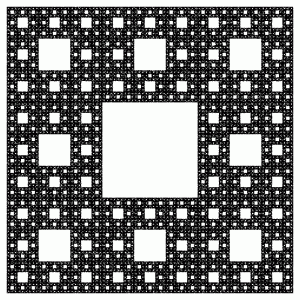
Example 2: Sierpinski triangle

Consider on the Sierpinski triangle  SG the Dirichlet form
\mathcal{E}(f) \simeq \limsup_{r\to 0^+}\frac{1}{r^{d_W}}\int_{SG} \int_{B(x,r)}\frac{|f(y)-f(x)|^2}{ \mu(B(x,r))}\, d\mu(y)\, d\mu(x)
where d_W is the walk dimension of the Sierpinski triangle.

Then \alpha^\#_1(\mathcal{E})=\frac{d_H}{d_W}, where d_H is the Hausdorff dimension of the Sierpinski triangle and
\mathbf{Var}_\mathcal{E} (f) \simeq \liminf_{r\to 0^+}\int_{SG} \int_{B(x,r)}\frac{|f(y)-f(x)|}{r^{d_H} \mu(B(x,r))}\, d\mu(y)\, d\mu(x)
A set E \subset SG is a \mathcal{E}-Caccioppoli set if its boundary is finite.

Example 3: Product of Sierpinski triangles

The space BV behaves nicely with respect to tensorization. Consider the product Dirichlet space (SG^n, \mathcal{E}^{\otimes n}, \mu^{\otimes n}).
Then \alpha^\#_1(\mathcal{E}^{\otimes n})=\frac{d_H(SG)}{d_W(SG)} and
\mathbf{Var}_{\mathcal{E}^{\otimes n}} (f) \simeq \liminf_{r\to 0^+}\int_{SG^n} \int_{B(x,r)}\frac{|f(y)-f(x)|}{r^{d_H(SG)} \mu(B(x,r))}\, d\mu^{\otimes n}(y)\, d\mu^{\otimes n}(x)
Therefore, \mathcal{E}^{\otimes n}-Caccioppoli sets have Hausdorff co-dimension d_H(SG) .

Example 4: Riemannian manifolds

Assume that \mathcal{E} is the standard Dirichlet form on a complete Riemannian manifold \mathbb{M} with Ricci curvature bounded from below
\mathcal{E}(f,f)=\int_{\mathbb{M}} \| \nabla f \|^2 \, dx, \quad f \in W^{1,2}(\mathbb{M}), then \alpha^\#_1(\mathcal{E})=\frac{1}{2},  BV(\mathcal{E})=\mathbf{BV}(\mathbb{M})  and for f \in BV(\mathcal{E}),
\mathbf{Var}_\mathcal{E} (f) \simeq \| Df \| (\mathbb{M}).

In the case of Riemannian manifolds, the space \mathbf{BV}(\mathbb{M}) and the associated notion of variation \| Df \| (\mathbb{M})  we are using are for instance presented in the paper: Heat semigroup and functions of bounded variation on Riemannian manifolds by M. Miranda Jr, D. Pallara, F. Paronetto & M. Preunkert.

Example 5: Carnot groups

The following can be deduced from the paper Two Characterization of BV Functions on Carnot Groups via the Heat Semigroup  by M. Bramanti, M. Miranda Jr. & D. Pallara. Assume that \mathcal{E} is the Dirichlet form associated to a sub-Laplacian on a Carnot group \mathbb{G}
\mathcal{E}(f,f)=\int_{\mathbb{G}} \| \nabla_{\mathcal H} f \|^2 \, dx, \quad f \in W_{\mathcal H}^{1,2}(\mathbb{G}),
then \alpha^\#_1(\mathcal{E})=\frac{1}{2}, BV(\mathcal E)=\mathbf{BV}_\mathcal{H} (\mathbb{G}) and for f \in BV(\mathcal{E}),
\mathbf{Var}_\mathcal{E} (f) =\int_\mathbb{G} \sigma (x) d D_{\mathcal H}f (x) \simeq \| D_{\mathcal H}f \| (\mathbb{G}).

Locality in time property

Let (X,\mu,\mathcal{E},\mathcal{F}) be a Dirichlet space. We consider the following property:
\mathcal{P}_\infty: \quad \quad \quad \quad \mathbf{Var}_{\mathcal{E}} (f) \simeq \sup_{t >0} \frac{1}{t^{\alpha^\#_1(\mathcal{E})}} \int_X P_t ( | f - f(y)|) d\mu(y)


Theorem: (Weak Bakry-Emery estimates I)
Let (X,\mu,\mathcal{E},\mathcal{F}) be a strictly local metric Dirichlet space that is locally doubling and that locally supports a 2-Poincar\’e inequality on balls.
If there exists a constant C>0 such that
\| |\nabla P_t f | \|_{L^\infty (X,\mu)} \le \frac{C}{\sqrt{t}} \| f \|_{L^\infty (X,\mu)}, \quad t >0.
Then, \alpha^\#_1(\mathcal{E})=\frac{1}{2} and \mathcal{P}_\infty is satisfied.
The theorem applies to RCD(0,\infty) spaces, Carnot groups and large classes of sub-Riemannian manifolds with non-negative Ricci curvature in the sense of Baudoin-Garofalo.


Theorem: (Weak Bakry-Emery estimates II)
Let (X,\mu,\mathcal{E},\mathcal{F}) be a metric Dirichlet space with a heat kernel admitting sub-Gaussian estimates.  If there exists a constant C>0 such that
| P_t f(x)-P_tf(y)| \le C \frac{d(x,y)^\kappa}{t^{\kappa/d_W}} \| f \|_{L^\infty (X,\mu)}, \quad t >0.
where \kappa=d_W (1-\alpha^\#_1(\mathcal{E})) then \mathcal{P}_\infty is satisfied.
This applies to the unbounded Sierpinski triangle and their products and large classes of fractals or products of fractals.  This is however a conjecture on the Sierpinski carpet.


L^1-Sobolev inequality and isoperimetric inequality

Let (X,\mu,\mathcal{E},\mathcal{F}) be a Dirichlet space.

Theorem: Assume \mathcal{P}_\infty is satisfied and that P_t admits a measurable heat kernel p_t(x,y) satisfying, for some C>0 and \beta >0,
p_{t}(x,y)\leq C t^{-\beta}, \quad t>0.
Then, if 0<\alpha^\#_1(\mathcal{E}) <\beta , there exists a  constant C>0 such that for every f \in BV(\mathcal{E}),
\| f \|_{L^q(X,\mu)} \le C\mathbf{Var}_{\mathcal{E}} (f),
where q=\frac{\beta}{ \beta- \alpha^\#_1(\mathcal{E})}.

Under the assumptions of this theorem, one therefore obtains the following general isoperimetric inequality for Caccioppoli sets in Dirichlet spaces
\mu(E)^{\frac{ \beta- \alpha^\#_1(\mathcal{E})}{\beta}}\le C P_\mathcal{E} (E).

It generalizes the isoperimetric inequality which was known in Riemannian manifolds or Carnot groups (due to N. Varopoulos) but also applies to new situations like fractals.

This entry was posted in Global analysis in Dirichlet spaces. Bookmark the permalink.

Leave a comment