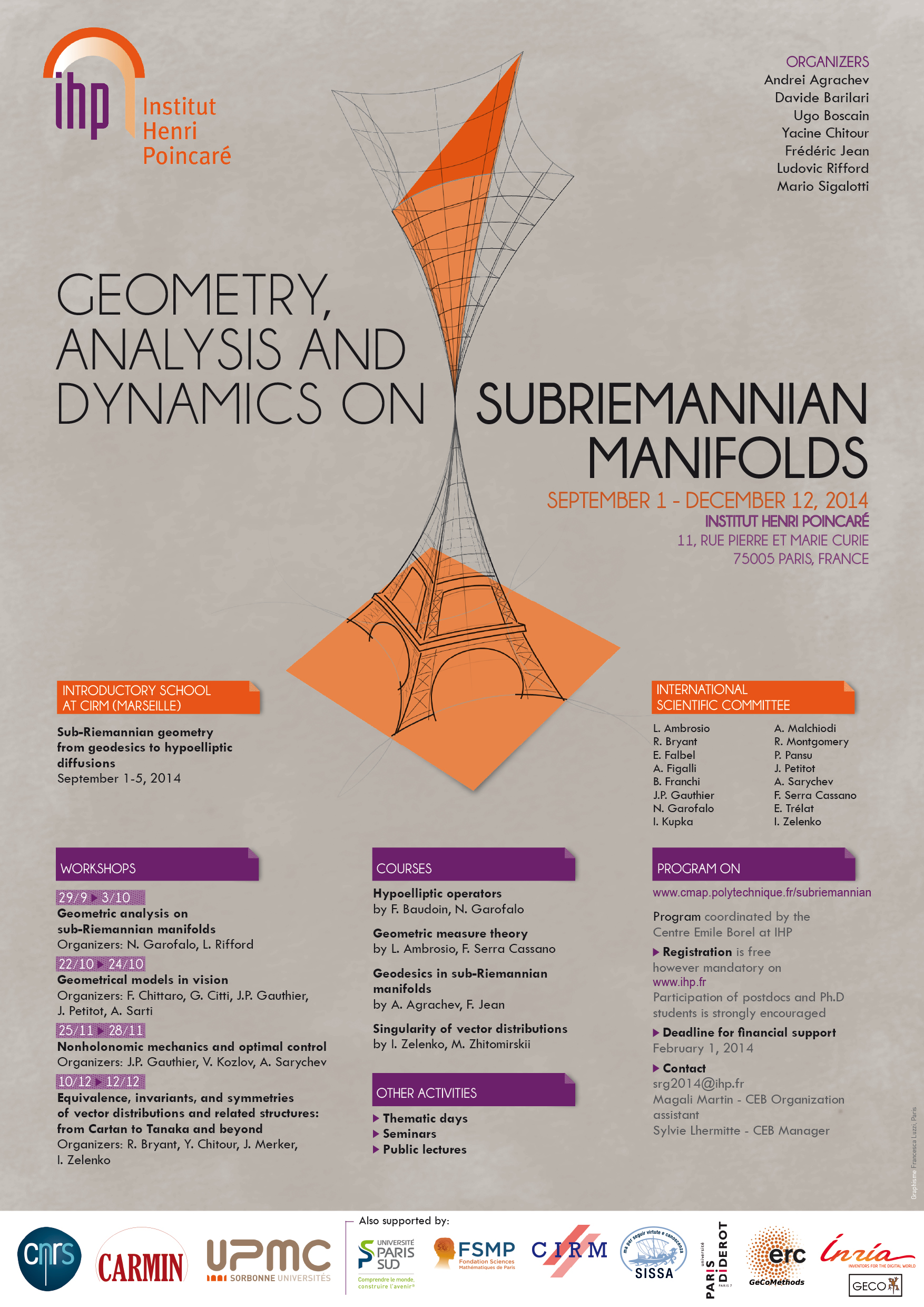
Geometry, Analysis and Dynamics on Sub-Riemannian Manifolds

posterIHP

From September 1 to December 12, the Institut Henri Poincare will organize a thematic semester: Geometry, Analysis and Dynamics on Sub-Riemannian Manifolds.

I look forward to this event. I will be in sabbatical this Fall and it will be the occasion for me to spend two months in Paris participating to the exciting activities of the trimester.

At the beginning of September, I will deliver a 12h course on hypoelliptic diffusion operators. The lectures will be published on this blog.

Sub-Laplacians and Hypoelliptic operators on Riemannian foliations

  • Riemannian foliations with totally geodesic fibers and their Laplacians
  • Examples of Riemannian foliations and their sub-Laplacians: The Hopf fibrations
  • Weitzenbock formulas for the horizontal Laplacian
  • First eigenvalue estimates
  • The horizontal heat semigroup
  • The horizontal Bonnet-Myers theorem
  • Applications of Riemannian foliations to Fokker-Planck type kinetic equations
Posted in Uncategorized | Leave a comment

Diffusion processes and stochastic calculus textbook

My book which is published by the European Mathematical Society is now available.

Diffusion Processes and Stochastic Calculus

cover

The content is partially based on the lecture notes in stochastic calculus and rough paths theory which are posted on this blog but the book contains several topics, specially about diffusion processes and semigroups, which are not covered in the blog. The intended readership are graduate students wishing to learn about continuous stochastic processes.

I will maintain a list of errata on this blog.

Posted in Rough paths theory, Stochastic Calculus lectures | Leave a comment

Marc Yor (1949-2014)

This is with deep sadness that I learnt that my former Phd advisor Marc Yor passed away on Thursday, January 9. I remember him as an extraordinary kind and gentle person with an unlimited amount of patience and energy for his students and collaborators. His knowledge of all aspects of the Brownian motion and of the associated literature was phenomenal. His book, Continuous martingales and Brownian motion, jointly written with Daniel Revuz, formed a generation of probabilists and is certainly one of the most complete expositions of the theory of continuous stochastic processes in continuous time.

His mathematical legacy is very large and includes about 400 research articles written with more than 150 different co-authors.

The first part of his career in the 1970’s and the beginning of the 1980’s was devoted to the general theory of stochastic processes in the spirit of the French school in probability that was led by Paul-Andre Meyer at that time. In this period he already obtained several groundbreaking results. I wish to mention his improvements and extensions of the Burkholder-Davis-Gundy inequalities, and his a simple approach to the Skorokhod embedding problem. Together with Thierry Jeulin, he also founded the theory of enlargement of filtrations which nowadays is widely used in mathematical finance.

In the 1980’s and thereafter, several of his most influential works are related to the study of functionals of the Brownian motion.

  • The study of planar Brownian motion. His 1980 paper on windings of Brownian motions was a milestone in the fine study of the planar Brownian motion and somehow inspired several later developments in the study of conformally invariant processes, like the SLE process.
  • The study of quadratic functionals. He wrote numerous influential papers devoted to the computation of exact distributions of quadratic functionals of the Brownian motion and about Bessel processes and their connections with excursion theory.
  • The study of exponential functionals. In the 1990’s he developed a deep interest for the exponential functionals of the Brownian motion. In particular, motivated by the problem of finding explicitly, as much as possible, a formula for the price of Asian options, he obtains a formula for the Laplace transform in time of the distribution of an exponential functional. Several of his beautiful papers on this topic may be found in his book: Exponential functionals of Brownian motion and related processes. Though motivated by mathematical finance, it is interesting that exponential functionals have been found to have connections with representation theory of Lie groups and integrable systems (see also this paper).
  • More recent interests and important results include the study of penalisation of Brownian motion paths.

    The following video taken at the University of Bristol in December 2008, shows him as he was: humble, expert and passionate on his subject.

    The following video (in French, January 2008) shows him explaining a piece of history of modern probability theory.

    Links:

  • Webpage of the Paris 6 mathematics department
  • Jim Pitman’s webpage about Marc Yor
  • Zhan Shi webpage about Marc Yor
  • IMS bulletin obituary
  • Une excursion avec Marc Yor
Posted in Mathematicians | 1 Comment

Eugene Dynkin Collection of mathematics interviews

I would like to point out to the website: Eugene Dynkin Collection of mathematics interviews. It is an unvaluable source of informations full of anecdotes about several influential contemporary mathematicians. I particularly enjoyed the interview by Joseph Doob where he explains how the names martingale, submartingale and supermartingale were chosen.

Posted in Mathematicians | Leave a comment

Differential topology with John Milnor

John Milnor is a renowned mathematician who made fundamental contributions to differential topology and was awarded the Fields medal in 1962. One of his most fundamental discoveries is the existence of several distinct differentiable structures on the 7 dimensional sphere.

The following videos are introductory lectures to differential topology given in 1965. Besides the beautiful mathematics I like the particularly nice introductory music !

Posted in Mathematicians | Leave a comment

Lecture 25. The Sobolev inequality proof of the Myer’s diameter theorem

It is a well-known result that if \mathbb{M} is a complete n-dimensional Riemannian manifold with \mathbf{Ricci} \ge \rho, for some \rho  > 0, then \mathbb{M} has to be compact with diameter less than \pi \sqrt{\frac{n-1}{\rho} }. The proof of this fact can be found in any graduate book about Riemannian geometry and classically relies on the study of Jacobi fields. We propose here an alternative proof of the diameter theorem that relies on the sharp Sobolev inequality proved in the previous Lecture. The beautiful argument goes back to Bakry and Ledoux. We only sketch the main arguments and refer the readers to the original article.

The theorem by Bakry and Ledoux is the following:

Theorem: Assume that for some p > 2, we have the inequality,
\| f \|_p^2 \le \| f \|_2^2 + A \int_\mathbb{M} \Gamma(f) d\mu, \quad f \in C_0^\infty(\mathbb{M}),
then \mathbb{M} is compact with diameter less than \pi \frac{ \sqrt{2pA}}{p-2}.

Combining this with the inequality
\frac{n \rho}{(n-1)(p-2)} \left( \left(  \int_{\mathbb{M}} | f |^p d\mu\right)^{2/p}-\int_\mathbb{M} f^2 d\mu \right) \le \int_\mathbb{M} \Gamma(f) d\mu,
that was proved in the previous Lecture gives \mathbf{diam} (\mathbb{M}) \le \pi \sqrt{\frac{2p}{p-2} } \sqrt{\frac{n-1}{n\rho}}. When n=2 we conclude then by letting p \to \infty and when n  > 2, we conclude by choosing p=\frac{2n}{n-2}.

By using a scaling argument it is easy to see that it is enough to prove that if for some n > 2,
\| f \|_{\frac{2n}{n-2}}^2 \le \| f \|_2^2 + \frac{4}{n(n-2)} \int_\mathbb{M} \Gamma(f) d\mu,
then \mathbf{diam} (\mathbb{M}) \le \pi .

The main idea is to apply the Sobolev inequality to the functions which are the extremals functions on the sphere. Such extremals are solutions of the fully non linear PDE
f^{(n+2)/(n-2)} -f =- \frac{4}{n(n-2)} Lf
and on the spheres the extremals are explicitly given by
f=(1+\lambda \sin d)^{1-n/2}
where -1 > \lambda  > 1 and d is the distance to a fixed point. So, on our manifold \mathbb{M}, that satisfies the inequality
\| f \|_{\frac{2n}{n-2}}^2 \le \| f \|_2^2 + \frac{4}{n(n-2)} \int_\mathbb{M} \Gamma(f) d\mu,
we consider the functional
F(\lambda) =\int_\mathbb{M} ( 1+\lambda \sin (f) )^{2-n} d\mu, \quad -1 < \lambda <1,
where f is a function on \mathbb{M} that satisfies \| \Gamma(f) \|_\infty \le 1. The first step is to prove a differential inequality on F. For k > 0, we denote by D_k the differential operator on (-1,1) defined by
D_k=\frac{1}{k} \lambda \frac{\partial}{\partial \lambda} +I.

Lemma: Denoting G=D_{n-1} F, we have
(D_{n-2} G)^{(n-2)/n} +\frac{n-2}{n} (1-\lambda^2) D_{n-2}G \le \left( 1+\frac{n-2}{n}\right)G.

Proof: We denote \alpha=\frac{n-2}{n} and f_\lambda=(1+\lambda \sin f)^{1-n/2}, -1 <  \lambda <  1. By the chain-rule and the hypothesis that \Gamma(f) \le 1, we get
\int_\mathbb{M} \Gamma(f_\lambda) d\mu \le \left( \frac{n}{2} -1 \right)^2 \int_\mathbb{M} (1+\lambda \sin f)^{-n} (1-\sin^2 f) d\mu.
From the Sobolev inequality applied to f_\lambda, we thus have,
\left( \int_\mathbb{M} ( 1+\lambda \sin (f) )^{-n} d\mu  \right)^\alpha \le \int_\mathbb{M} ( 1+\lambda \sin (f) )^{2-n} d\mu +\alpha \lambda^2 \int_\mathbb{M} (1+\lambda \sin f)^{-n} (1-\sin^2 f) d\mu.
It is then an easy calculus exercise to deduce our claim \square

The next idea is then to use a comparison theorem to bound F in terms of solutions of the equation
(D_{n-2} H)^{(n-2)/n} +\frac{n-2}{n} (1-\lambda^2) D_{n-2}H \le \left( 1+\frac{n-2}{n}\right)H.
Actually, such solutions are given by
H_c(\lambda)=\frac{1}{1+\alpha} U_c(\lambda) ^{\frac{2\alpha}{1-\alpha}} +\frac{\alpha}{1+\alpha}  (1-\lambda^2) U_c(\lambda)^{\frac{2}{1-\alpha}},
where c \in \mathbb{R}, \alpha=\frac{n-2}{n} and
U_c(\lambda)=\frac{ c\lambda +\sqrt{c^2 \lambda^2 +(1-\lambda^2) }}{1-\lambda^2}.
We have then the following comparison result:

Lemma: Let G be such that
(D_{n-2} G)^{(n-2)/n} +\frac{n-2}{n} (1-\lambda^2) D_{n-2}G \le \left( 1+\frac{n-2}{n}\right)G,
and assume that G(\lambda_0) < H_c (\lambda_0) for some \lambda_0 \in [0,1). Then for every \lambda_0 \le \lambda < 1,
G(\lambda) \le H_c(\lambda).

Using the previous lemma, we see (again we refer to the original article for the details) that \int_{\mathbb{M}}  \sin f d\mu > 0 implies that \int_{\mathbb{M}}  (1+\sin f )^{n-1}d\mu < +\infty  and \int_{\mathbb{M}}  \sin f d\mu <  0 implies that \int_{\mathbb{M}}  (1-\sin f )^{n-1}d\mu < \infty  . Iterating this result on the basis of the Sobolev inequality again, we actually have
\| (1 \pm \sin f)^{-1} \|_{\infty} < + \infty.
from which the conclusion easily follows.

Posted in Curvature dimension inequalities | Leave a comment

Lecture 24. Sharp Sobolev inequalities

In this Lecture, we are interested in sharp Sobolev inequalities in positive curvature. Let (\mathbb{M},g) be a complete and n-dimensional Riemannian manifold such that \mathbf{Ricci} \ge \rho where \rho > 0. We assume n > 2. As we already know from Lecture 15 , we have \mu (\mathbb{M}) < +\infty, but as we already stressed we do not want to use Bonnet-Myers theorem, since one of our goals will be to recover it by using heat kernel techniques. Without loss of generality, and to simplify the constants, we assume that \mu(\mathbb{M}) =1. Our goal is to prove the following sharp result:

Theorem: For every 1 \le p \le \frac{2n}{n-2} and f \in C^\infty_0(\mathbb{M}),
\frac{n \rho}{(n-1)(p-2)} \left( \left(  \int_{\mathbb{M}} | f |^p d\mu\right)^{2/p}-\int_\mathbb{M} f^2 d\mu \right) \le \int_\mathbb{M} \Gamma(f) d\mu.

Our proof follows an argument due to Bakry. We observe that for p=1, the inequality becomes
\frac{n \rho}{(n-1)}  \left( \int_\mathbb{M} f^2 d\mu -  \left( \int_{\mathbb{M}} | f | d\mu\right)^{2} \right) \le \int_\mathbb{M} \Gamma(f) d\mu.
which is the Poincare inequality with optimal Lichnerowicz constant. For p=2, we get the log-Sobolev inequality
\frac{n \rho}{2(n-1)} \left( \int_\mathbb{M} f^2 \ln f^2 d\mu -\int_\mathbb{M} f^2 d\mu \ln\int_\mathbb{M} f^2 d\mu \right) \le \int_\mathbb{M} \Gamma(f) d\mu.
We prove our Sobolev inequality in several steps.

Lemma: For every 1 \le  p \le \frac{2n}{n-2}, there exists a constant C_p > 0 such that for every f \in C^\infty_0(\mathbb{M}),
C_p \left( \left(  \int_{\mathbb{M}} | f |^p d\mu\right)^{2/p}-\int_\mathbb{M} f^2 d\mu \right) \le \int_\mathbb{M} \Gamma(f) d\mu.

Proof: Using Jensen’s inequality, it is enough to prove the result for p= \frac{2n}{n-2}. We already proved the following Li-Yau inequality: For f \in C^\infty_0(\mathbb{M}), f \neq 0, t  > 0, and x \in \mathbb{M},
\| \nabla \ln P_t f (x) \|^2 \le e^{-\frac{2\rho t}{3}}  \frac{  L P_t f (x)}{P_t f (x)} +\frac{n\rho}{3} \frac{e^{-\frac{4\rho t}{3}}}{ 1-e^{-\frac{2\rho t}{3}}}.
As a consequence we have
\frac{  L P_t f (x)}{P_t f (x)} \ge-  \frac{n\rho}{3} \frac{e^{-\frac{2\rho t}{3}}}{ 1-e^{-\frac{2\rho t}{3}}},
which yields,
\int_t^{+\infty} \partial_t \ln P_sf (x) ds  \ge-  \frac{n\rho}{3} \int_t^{+\infty} \frac{e^{-\frac{2\rho s}{3}}}{ 1-e^{-\frac{2\rho s}{3}}} ds.
We obtain then
P_tf(x)  \le  \left( \frac{1}{1-e^{-\frac{2\rho t}{3}} }\right)^{n/2} \int_\mathbb{M} f d\mu.
This of course implies the following upper bound on the heat kernel,
p(x,y,t) \le \left( \frac{1}{1-e^{-\frac{2\rho t}{3}} }\right)^{n/2}.
Using Varopoulos theorem, we deduce therefore that there is constant C_p' such that for every f \in C^\infty_0(\mathbb{M}),
\|  f \|^2_{p} \le C'_p \left(  \| \sqrt{\Gamma(f)} \|^2_2 + \| f \|^2_2 \right).
We now use the following inequality which is easy to see:
\left( \int_{\mathbb{M}} | f |^p d\mu \right)^{2/p} \le \left( \int_{\mathbb{M}}  f  d\mu \right)^{2}+\left( \int_{\mathbb{M}} \left| f -\int_{\mathbb{M}}  f  d\mu \right|^p d\mu \right)^{2/p}
This yields
\left( \int_{\mathbb{M}} | f |^p d\mu \right)^{2/p} \le \left( \int_{\mathbb{M}}  f  d\mu \right)^{2} +(p-1)C'_p  \left(  \| \sqrt{\Gamma(f)} \|^2_2 + \left\| f-\int_{\mathbb{M}}  f  d\mu \right\|^2_2 \right).
We can now bound
\left\| f-\int_{\mathbb{M}}  f  d\mu \right\|^2_2 \le \frac{1}{\lambda_1} \int_\mathbb{M} \Gamma(f) d\mu,
using the Poincare inequality \square

We now want to prove that the optimal C_p in the previous inequality satisfies C_p \ge \frac{n \rho}{(n-1)(p-2)} . We assume p > 2 and consider the functional
\frac{\left(  \int_{\mathbb{M}} | f |^p d\mu\right)^{2/p}-\int_\mathbb{M} f^2 d\mu}{ \int_\mathbb{M} \Gamma(f) d\mu}.
Classical non linear variational principles on the functional provide then a positive non trivial solution of the equation
C_p(f^{p-1}-f)=-Lf.
Set f=u^r where r is a constant to be later chosen. By the chain rule for diffusion operators, we get
C_p ( u^{r(p-1)}-u^r)=-ru^{r-1}Lu -r(r-1)u^{r-2} \Gamma(u).
Multiplying by u^{-r} \Gamma(u) and integrating yields
C_p \left( \int_{\mathbb{M}} u^{r(p-2)} \Gamma(u) d\mu -\int_{\mathbb{M}} \Gamma (u) d\mu \right)=-r \int_{\mathbb{M}} \frac{Lu}{u} \Gamma(u) d\mu -r (r-1) \int_{\mathbb{M}} \frac{\Gamma(u)^2}{u^2} d\mu.
Now, integrating by parts,
\int_{\mathbb{M}} u^{r(p-2)} \Gamma(u) d\mu=-\frac{1}{r(p-2)+1}  \int_{\mathbb{M}} u^{r(p-2)+1} Lu d\mu.
On the other hand, multiplying
C_p ( u^{r(p-1)}-u^r)=-ru^{r-1} -r(r-1)u^{r-2} \Gamma(u),
by u^{1-r} Lu and integrating with respect to \mu yields
C_p \left( \int_{\mathbb{M}} u^{r(p-2)+1} Lu d\mu - \int_{\mathbb{M}} uLu d\mu \right)=-r \int_{\mathbb{M}} (Lu)^2 d\mu -r(r-1)  \int_{\mathbb{M}} \frac{Lu}{u} \Gamma(u) d\mu.
Combining the previous computations gives
C_p \left( r(p-2) +1\right) \int_{\mathbb{M}} u^{r(p-2)} \Gamma(u) d\mu = r  \int_{\mathbb{M}} (Lu)^2 d\mu +r(r-1)  \int_{\mathbb{M}} \frac{Lu}{u} \Gamma(u) d\mu +C_p  \int_{\mathbb{M}} \Gamma(u) d\mu
Hence, we have
C_p (p-2)  \int_{\mathbb{M}} \Gamma(u) d\mu= \int_{\mathbb{M}} (Lu)^2 d\mu + \int_{\mathbb{M}} \frac{Lu}{u} \Gamma(u) d\mu +(r-1)  \left( r(p-2) +1\right)  \int_{\mathbb{M}} \frac{\Gamma(u)^2}{u^2} d\mu
We have from Bochner’s inequality,
\Gamma_2 (u^s)\ge \frac{1}{n} ( L u^s)^2 +\rho \Gamma(u^s).
Once again, s is a parameter that will be later decided. Using the chain, to rewrite the previous inequality, leads after tedious computations to
\Gamma_2(u) +(s-1) \frac{1}{u} \Gamma ( u , \Gamma(u)) +(s-1)^2 \frac{\Gamma(u)^2}{u^2} \ge \rho \Gamma(u) +\frac{1}{n} (Lu)^2 +\frac{2}{n} (s-1) \frac{1}{u} Lu \Gamma (u) +\frac{1}{n} (s-1)^2 \frac{1}{u^2} \Gamma(u)^2.
After integration and integration by parts, we see that
\rho \int_{\mathbb{M}} \Gamma(u) d\mu \le \left( 1 -\frac{1}{n} \right) \int_{\mathbb{M}} (Lu)^2 d\mu-s' \left( 1+\frac{2}{n} \right) \int_{\mathbb{M}}  \frac{1}{u} Lu \Gamma (u) d\mu+s'\left( 1+s'\left( 1-\frac{1}{n} \right) \right) \int_{\mathbb{M}} \frac{\Gamma(u)^2}{u^2} d\mu,
where s'=s-1. Combining the previous inequalities we can eliminate the term \int_{\mathbb{M}}  \frac{1}{u} Lu \Gamma (u) d\mu. Chosing
\frac{s'}{r}=(p-1) \frac{n-1}{n+2},
we see that the coefficient in front of \int_{\mathbb{M}} (Lu)^2 d\mu is zero and we are left with
\left( C_p \frac{(p-2)(n-1)}{n} -\rho \right)\int_\mathbb{M} \Gamma(u) d\mu \ge K(s',r) \int_{\mathbb{M}} \frac{\Gamma(u)^2}{u^2} d\mu,
for some constant K(s',r) which is seen to be non-negative as soon as 2 <  p \le \frac{2n}{n-2}. We conclude
C_p \frac{(p-2)(n-1)}{n} -\rho \ge 0.

Posted in Curvature dimension inequalities | Leave a comment

Lecture 23. The isoperimetric inequality

In this Lecture, we study in further details the connection between volume growth of metric balls, heat kernel upper bounds and the L^1 Sobolev inequality. As we shall see, on a manifold with non negative Ricci curvature, all these properties are equivalent one to each other and equivalent to the isoperimetric inequality as well. We start with some preliminaries about geometric measure theory on Riemannian manifolds.

Let (\mathbb{M},g) be a complete and non compact Riemannian manifold.

In what follows, given an open set \Omega \subset \mathbb{M} we will indicate with \mathcal F(\Omega) the set of C^1 vector fields V‘s, on \Omega such that \| V \|_\infty \le 1.

Given a function f\in L^1_{loc}(\Omega) we define the total variation of f in \Omega as
\text{Var} (f;\Omega) = \underset{\phi\in \mathcal{F}(\Omega)}{\sup} \int_\Omega f \mathbf{div} \phi d\mu.
The space BV (\Omega) = \{f\in L^1(\Omega)\mid \text{Var}(f;\Omega)<\infty\}, endowed with the norm
||f||_{BV(\Omega)} = ||f||_{L^1(\mathbb{M})} + \text{Var} (f;\Omega),
is a Banach space. It is well-known that W^{1,1}(\Omega) = \{f\in L^1(\Omega)\mid \| \nabla f \| \in L^1(\Omega )\} is a strict subspace of BV(\Omega). It is important to note that when f\in W^{1,1}(\Omega), then f\in BV(\Omega), and one has in fact \text{Var}(f;\Omega) = ||\sqrt{\Gamma(f)}||_{L^1(\Omega)}. Given a measurable set E\subset \mathbb{M} we say that it has finite perimeter in \Omega if \mathbf 1_E\in BV(\Omega). In such case the horizontal perimeter of E relative to \Omega is by definition
P(E;\Omega) = \text{Var}(\mathbf 1_E;\Omega).
We say that a measurable set E\subset \mathbb{M} is a Caccioppoli set if P(E;\Omega) < \infty for any \Omega \subset \mathbb{M}. For instance, if O is an open relatively compact set in \mathbb{M} whose boundary E is n-1 dimensional sub manifold of \mathbb{M}, then it is a Caccioppoli set and P(E;\mathbb{M})=\mu_{n-1} (E) where \mu_{n-1} is the Riemannian measure on E. We will need the following approximation result.

Proposition: Let f\in BV(\Omega), then there exists a sequence \{f_n\}_{n\in \mathbb N} of functions in C^\infty(\Omega) such that:

  • (i) ||f_n - f||_{L^1(\Omega)} \to 0;
  • (ii) \int_\Omega \sqrt{\Gamma(f_n)} d\mu \to \text{Var}(f;\Omega).

If \Omega = \mathbb{M}, then the sequence \{f_n\}_{n\in \mathbb N} can be taken in C^\infty_0(\mathbb{M}).

Our main result of the Lecture is the following result.

Theorem: Let n > 1. Let us assume that \mathbf{Ric} \ge 0. then the following assertions are equivalent:

  • (1) There exists a constant C_1 > 0 such that for every x \in \mathbb{M}, r \ge 0,
    \mu (B(x,r)) \ge C_1 r^n.
  • (2) There exists a constant C_2 > 0 such that for x \in \mathbb{M}, t > 0,
    p(x,x,t) \le \frac{C_2}{t^{\frac{n}{2}}}.
  • (3) There exists a constant C_3 > 0 such that for every Caccioppoli set E\subset \mathbb{M} one has
    \mu(E)^{\frac{n-1}{n}} \le C_3 P(E;\mathbb{M}).
  • (4) With the same constant C_3 > 0 as in (3), for every f \in BV(\mathbb{M}) one has
    \left( \int_\mathbb{M} |f|^{\frac{n}{n-1}} d\mu\right)^{\frac{n-1}{n}}  \le C_3 \emph{Var}(f;\mathbb{M}).

Proof:

That (1) \rightarrow (2) follows immediately from the Li-Yau upper Gaussian bound.

The proof that (2) \rightarrow (3) is not straightforward, it relies on the Li-Yau inequality. Let f \in C_0(\mathbb{M}) with f\ge 0. By Li-Yau inequality, we obtain
\Gamma (P_t f) - P_tf  \frac{\partial P_tf}{\partial t} \le \frac{d}{2t}(P_tf)^2.
This gives in particular, ,
\left(\frac{\partial P_tf}{\partial t}\right)^- \le \frac{d}{2t} P_tf,
where we have denoted a^+ = \sup\{a,0\}, a^- = \sup\{-a,0\}. Since \int_\mathbb{M} \frac{\partial P_tf}{\partial t} d\mu=0, we deduce
||\frac{\partial P_tf}{\partial t}||_{L^1(\mathbb{M})} \le \frac{d}{t} ||f||_{L^1(\mathbb{M})},\ \ \ \ t > 0.
By duality, we deduce that for every f \in C^\infty_0(\mathbb{M}), f\ge 0,
\|\frac{\partial P_tf}{\partial t} \|_{L^\infty(\mathbb{M})} \le \frac{d}{t} \| f\|_{L^\infty(\mathbb{M})}.
Once we have this crucial information we can return to the Li-Yau inequality and infer
\Gamma (P_t f)  \le \frac{1}{t} \frac{3d}{2} \| f\|^2_{L^\infty(\mathbb{M})}.
Thus,
\| \sqrt{\Gamma (P_t f)} \|_{L^\infty(\mathbb{M})} \le \sqrt{\frac{3d}{2t} }\| f\|_{L^\infty(\mathbb{M})}.
Applying this inequality to g \in C_0^\infty(\mathbb{M}), with g\ge 0 and ||g||_{L^\infty(\mathbb{M})}\le 1, if f \in C_0^1(\mathbb{M}) we have
\int_\mathbb{M}g(f-P_tf) d\mu  = \int_0^t \int_\mathbb{M} g \frac{\partial P_sf}{\partial s} d\mu ds
= \int_0^t \int_\mathbb{M} g L P_sf d\mu ds =  \int_0^t \int_\mathbb{M} L g P_sf d\mu ds
= \int_0^t \int_\mathbb{M} P_sLg f d\mu ds = \int_0^t \int_\mathbb{M} L P_sg f d\mu ds
= - \int_0^t \int_\mathbb{M} \Gamma(P_sg,f) d\mu ds
\le \int_0^t  \| \sqrt{\Gamma(P_sg)} \|_{L^\infty(\mathbb{M})}\int_\mathbb{M} \sqrt{\Gamma(f)} d\mu ds  \le \sqrt{6d} \sqrt{t} \int_\mathbb{M} \sqrt{\Gamma(f)} d\mu.
We thus obtain the following basic inequality: for f \in C_0^1(\mathbb{M}),
\|P_tf - f\|_{L^1(\mathbb{M})} \le \sqrt{6d}\ \ \sqrt{t}\ \| \sqrt{\Gamma(f)} \|_{L^1(\mathbb{M})}.
Suppose now that E\subset \mathbb{M} is a bounded Caccioppoli set. But then, \mathbf 1_E\in BV(\Omega), for any bounded open set \Omega \supset E. It is easy to see that \text{Var}(\mathbf 1_E;\Omega) = \text{Var}(\mathbf 1_E;\mathbb{M}), and therefore \mathbf 1_E\in BV(\mathbb{M}). There exists a sequence \{f_n\}_{n\in \mathbb N} in C^\infty_0(\mathbb{M}) satisfying (i) and
(ii) above. Applying the previous inequality to f_n we obtain
\|P_tf_n - f_n\|_{L^1(\mathbb{M})} \le \sqrt{6d} \ \sqrt{t}\ \| \sqrt{\Gamma(f_n)} \|_{L^1(\mathbb{M})} = \sqrt{6d} \sqrt{t}\ Var(f_n,\mathbb{M}).
Letting n\to \infty in this inequality, we conclude
\|P_t \mathbf 1_E - \mathbf 1_E\|_{L^1(\mathbb{M})} \le \sqrt{6d}  \sqrt{t}\ Var(\mathbf 1_E,\mathbb{M}) = \sqrt{6d} \ \sqrt{t}\ P(E;\mathbb{M})
Observe now that, using P_t 1 = 1, we have
||P_t \mathbf 1_E - \mathbf 1_E||_{L^1(\mathbb{M})}  = 2\left(\mu(E) - \int_E P_t \mathbf 1_E d\mu\right).
On the other hand,
\int_E  P_t \mathbf 1_E d\mu  = \int_\mathbb{M} \left(P_{t/2}\mathbf 1_\mathbb{M}\right)^2 d\mu.
We thus obtain
||P_t \mathbf 1_E - \mathbf 1_E||_{L^1(\mathbb{M})} = 2 \left(\mu(E) - \int_\mathbb{M} \left(P_{t/2}\mathbf 1_E\right)^2 d\mu\right).
We now observe that the assumption (1) implies
p(x,x,t)  \le \frac{C_4}{t^{n/2}},\ \ \ x\in \mathbb{M}, t > 0.
This gives
\int_\mathbb{M} (P_{t/2} \mathbf 1_E)^2 d\mu  \le \left(\int_E \left(\int_\mathbb{M} p(x,y,t/2)^2 d\mu(y)\right)^{\frac{1}{2}}d\mu(x)\right)^2
= \left(\int_E p(x,x,t)^{\frac{1}{2}}d\mu(x)\right)^2 \le \frac{C_4}{t^{n/2}} \mu(E)^2.
Combining these equations we reach the conclusion
\mu(E)  \le \frac{\sqrt{6d}}{2} \ \sqrt{t}\ P(E;\mathbb{M}) + \frac{C_4}{t^{n/2}} \mu(E)^2
Now the absolute minimum of the function g(t) = A t^\alpha + B t^{-\beta}, t > 0, where A, B, \alpha, \beta > 0, is given by
g_{\min} = \left[\left(\frac{\alpha}{\beta}\right)^{\frac{\beta}{\alpha + \beta}} + \left(\frac{\beta} {\alpha}\right)^{\frac{\alpha}{\alpha + \beta}}\right] A^{\frac{\beta}{\alpha + \beta}} B^{\frac{\alpha}{\alpha + \beta}}
Applying this observation with \alpha = \frac{1}{2}, \beta = \frac{n}{2}, we conclude
\mu(E)^{\frac{n-1}{n}} \le C_3 P(E,\mathbb{M}).
The fact that 3) implies 4) is classical geometric measure theory. It relies on the co-area formula that we recall: For every f,g \in C_0^\infty(\mathbb{M}),
\int_\mathbb{M} g \| \nabla f \| d\mu=\int_{-\infty}^{+\infty} \left( \int_{f(x)=t} g(x) d\mu_{n-1}(x) \right) dt.
Let now f \in C_0^\infty(\mathbb{M}). We have
f(x)=\int_0^{+\infty} \mathbf{1}_{f(x) > t} (t) dt.
By using Minkowski inequality, we get then
\| f \|_{\frac{n}{n-1}}  \le \int_0^\infty \| \mathbf{1}_{f(\cdot) > t} \|_{\frac{n}{n-1}}dt
\le \int_0^\infty \mu ( f > t )^{\frac{n}{n-1}}dt
\le C_3 \int_0^\infty \mu_{n-1} ( f=t) dt =C_3 \int_\mathbb{M} \sqrt{\Gamma(f)} d\mu

Finally, we show that (4) \rightarrow (1). In what follows we let \nu = n/(n-1). Let p,q\in (0,\infty) and 0 < \theta\le 1 be such that
\frac{1}{p} = \frac{\theta}{\nu} + \frac{1-\theta}{q}.
Holder inequality, combined with assumption (4), gives for any f\in Lip_d(\mathbb{M}) with compact support
||f||_{L^p(\mathbb{M})} \le ||f||^\theta_{L^{\nu}(\mathbb{M})} ||f||^{1-\theta}_{L^q(\mathbb{M})}\le \left(C_3 ||\sqrt{\Gamma(f)}||_{L^1(\mathbb{M})}\right)^\theta ||f||^{1-\theta}_{L^q(\mathbb{M})}.
For any x\in \mathbb{M} and r > 0 we now let f(y) = (r-d(y,x))^+. Clearly such f\in Lip_d(\mathbb{M}) and supp\ f = \overline B(x,r). Since with this choice ||\sqrt{\Gamma(f)}||_{L^1(\mathbb{M})}^\theta \le \mu(B(x,r))^{\theta}, the above inequality implies
\frac{r}{2} \mu(B(x,\frac{r}{2})^{\frac{1}{p}} \le r^{1-\theta} \left(C_3 \mu(B(x,r)\right)^\theta \mu(B(x,r))^{\frac{1-\theta}{q}},
which, noting that \frac{1-\theta}{q} + \theta = \frac{n+\theta p}{pn}, we can rewrite as follows
\mu(B(x,r)) \ge \left(\frac{1}{2C_3^\theta}\right)^{pa} \mu(B(x,\frac{r}{2}))^a r^{\theta p a},
where we have let a = \frac{n}{n+\theta p}. Notice that 0 < a < 1.
Iterating the latter inequality we find
\mu(B(x,r)) \ge \left(\frac{1}{2C_3^\theta}\right)^{p\sum_{j=1}^k a^j} r^{\theta p \sum_{j=1}^k a^j} 2^{-\theta p \sum_{j=1}^k  (j-1)a^j}\mu(B(x,\frac{r}{2^k}))^{a^k},\ \ \ k\in \mathbb N.
From the doubling property for any x\in \mathbb{M} there exist constants C, R > 0 such that with Q = \log_2 C one has
\mu(B(x,tr)) \ge C^{-1} t^{Q} \mu(B(x,r)),\ \ \ 0\le t\le 1,  0<r\le R.
This estimate implies that
\underset{k\to \infty}{\liminf}\ \mu(B(x,\frac{r}{2^k}))^{a^k}\ge  1,\ \ \ x\in \mathbb{M}, r > 0.
Since on the other hand \sum_{j=1}^\infty a^j = \frac{n}{\theta p}, and \sum_{j=1}^\infty (j-1) a^j = \frac{n^2}{\theta^2p^2}, we conclude that
\mu(B(x,r)) \ge \left(2^{-\frac{1}{\theta}(1+\frac{n}{p})} C_3^{-1}\right)^n r^n,\ \ \ x\in \mathbb{M}, r > 0.
This establishes (1), thus completing the proof \square

Posted in Curvature dimension inequalities | Leave a comment

Lecture 22. Sobolev inequality and volume growth

In this Lecture, we show how Sobolev inequalities on a Riemannian manifold are related to the volume growth of metric balls. The link between the Hardy-Littlewood-Sobolev theory and heat kernel upper bounds is due to Varopoulos, but the proof I give below I learnt it from my colleague Bañuelos. It bypasses the Marcinkiewicz interpolation theorem by using the Stein’s maximal ergodic lemma.

Let (\mathbb{M},g) be a complete Riemannian manifold and let L be the Laplace-Beltrami operator of \mathbb{M}. As usual, we denote by P_t the semigroup generated by P_t and we assume P_t 1=1.

We have the following so-called maximal ergodic lemma, which was first proved by Stein. We give here the probabilistic proof since it comes with a nice constant but you can find the original (non probabilistic) proof here.

Lemma:(Stein’s maximal ergodic theorem) Let p > 1. For f \in L^p_\mu(\mathbb{M}), denote f^*(x)=\sup_{t \ge 0} |P_t f(x)|. We have
\| f^* \|_{L^p_\mu(\mathbb{M})} \le \frac{p}{p-1} \| f \|_{L^p_\mu(\mathbb{M})}.

Proof: For x \in \mathbb{M}, we denote by (X_t^x)_{t \ge 0} the Markov process with generator L and started at x. We fix T > 0. By construction, for t \le T, we have,
P_{T-t}f (X_T^x) =\mathbb{E} \left( f (X_{2T-t}^x) | X_T^x \right),
and thus
P_{2(T-t)}f (X_T^x) =\mathbb{E} \left( (P_{T-t} f) (X_{2T-t}^x) | X_T^x \right).
As a consequence, we obtain
\sup_{0 \le t \le T} | P_{2(T-t)}f (X_T^x) | \le \mathbb{E} \left(\sup_{0 \le t \le T} | (P_{T-t} f) (X_{2T-t}^x) | \mid X_T^x\right) .
Jensen’s inequality yields then
\sup_{0 \le t \le T} | P_{2(T-t)}f (X_T^x) |^p  \le \mathbb{E} \left(\sup_{0 \le t \le T} | (P_{T-t} f) (X_{2T-t}^x) |^p \mid X_T^x\right).
We deduce
\mathbb{E} \left( \sup_{0 \le t \le T} | P_{2(T-t)}f (X_T^x) |^p \right)  \le \mathbb{E} \left(\sup_{0 \le t \le T} | (P_{T-t} f) (X_{2T-t}^x) |^p \right).
Integrating the inequality with respect to the Riemannian measure \mu, we obtain
\left\|  \sup_{0 \le t \le T} | P_{2(T-t)}f  | \right\|_p   \le \left( \int_\mathbb{M} \mathbb{E} \left(\sup_{0 \le t \le T} | (P_{T-t} f) (X_{2T-t}^x) |^p \right)d\mu(x)\right)^{1/p}.
By reversibility, we get then
\left\|  \sup_{0 \le t \le T} | P_{2(T-t)}f  | \right\|_p   \le \left( \int_\mathbb{M} \mathbb{E} \left(\sup_{0 \le t \le T} | (P_{T-t} f) (X_t^x) |^p \right)d\mu(x)\right)^{1/p}.
We now observe that the process (P_{T-t} f) (X_t^x) is martingale and thus Doob’s maximal inequality gives
\mathbb{E} \left(\sup_{0 \le t \le T} | (P_{T-t} f) (X_t^x) |^p \right)^{1/p} \le \frac{p}{p-1}  \mathbb{E} \left( | f(X_T^x)|^p \right)^{1/p}.
The proof is complete. \square

We now turn to the theorem by Varopoulos.

Theorem: Let n > 0, 0 < \alpha < n, and 1 < p< \frac{n}{\alpha}. If there exists C > 0 such that for every t > 0, x,y \in \mathbb{M},
p(x,y,t) \le \frac{C}{t^{n/2}},
then for every f \in L^p_\mu(\mathbb{M}),
\| (-L)^{-\alpha/2} f \|_{\frac{np}{n-p\alpha}} \le \left( \frac{p}{p-1} \right)^{1-\alpha/n} \frac{ 2n C^{\alpha / n}}{ \alpha (n-p\alpha) \Gamma(\alpha /2)} \|f \|_p

Proof: We first observe that the bound
p(x,y,t) \le \frac{C}{t^{n/2}},
implies that |P_t f(x)| \le  \frac{C^{1/p}}{t^{n/2p}} \| f \|_p. Denote I_\alpha f (x)=(-L)^{-\alpha/2} f (x). We have
I_\alpha f (x)=\frac{1}{\Gamma(\alpha /2) } \int_0^{+\infty} t^{\alpha /2 -1 }P_t f (x) dt
Pick \delta > 0, to be later chosen, and split the integral in two parts:
I_\alpha f (x)=J_\alpha f(x) +K_\alpha f (x),
where J_\alpha f (x)=\frac{1}{\Gamma(\alpha /2) } \int_0^{\delta} t^{\alpha /2 -1 }P_t f (x) dt and K_\alpha f (x)=\frac{1}{\Gamma(\alpha /2) } \int_\delta^{+\infty} t^{\alpha /2 -1 }P_t f (x) dt. We have
| J_\alpha f (x) | \le \frac{1}{\Gamma(\alpha /2) } \int_0^{+\infty} t^{\alpha /2 -1 }dt | f^* (x) | =\frac{2}{\alpha \Gamma(\alpha /2) } \delta^{\alpha /2}  | f^* (x) |.
On the other hand,
| K_\alpha f(x)|  \le \frac{1}{\Gamma(\alpha /2) } \int_\delta^{+\infty} t^{\alpha /2 -1 } | P_t f  (x)| dt
\le  \frac{C^{1/p}}{\Gamma(\alpha /2) } \int_\delta^{+\infty} t^{\frac{\alpha} {2}-\frac{n}{2p} -1 } dt \| f \|_p
\le   \frac{C^{1/p}}{\Gamma(\alpha /2) } \frac{1}{-\frac{\alpha} {2}+\frac{n}{2p} }\delta^{\frac{\alpha} {2}-\frac{n}{2p} }  \| f \|_p .
We deduce
| I_\alpha f (x) | \le \frac{2}{\alpha \Gamma(\alpha /2) } \delta^{\alpha /2}  | f^* (x) |+ \frac{C^{1/p}}{\Gamma(\alpha /2) } \frac{1}{-\frac{\alpha} {2}+\frac{n}{2p} }\delta^{\frac{\alpha} {2}-\frac{n}{2p} }  \| f \|_p.
Optimizing the right hand side of the latter inequality with respect to \delta yields
| I_\alpha f (x) |\le \frac{ 2n C^{\alpha / n}}{ \alpha (n-p\alpha) \Gamma(\alpha /2)} \|f \|^{\alpha p /n}_p |f^*(x)|^{1-p\alpha/n}.
The proof is then completed by using Stein’s maximal ergodic theorem \square

A special case, of particular interest, is when \alpha =1 and p=2. We get in that case the following Sobolev inequality:

Theorem: Let n > 2. If there exists C > 0 such that for every t > 0, x,y \in \mathbb{M},
p(x,y,t) \le \frac{C}{t^{n/2}},
then for every f \in C^\infty_0(\mathbb{M}),
\|  f \|_{\frac{2n}{n-2}} \le 2^{1-1/n} \frac{ 2n C^{1 / n}}{  (n-2) \sqrt{\pi}} \| \sqrt{\Gamma(f)} \|_2.

We mention that the constant in the above Sobolev inequality is not sharp even in the Euclidean case.

Combining the above with the Li-Yau upper bound for the heat kernel, we deduce the following theorem:

Theorem: Assume that \mathbf{Ric} \ge 0 and that there exists a constant C > 0 such that for every x \in \mathbb{M} and r \ge 0, \mu (B(x,r)) \ge C r^n, then there exists a constant C'=C'(n) > 0 such that for every f \in C^\infty_0(\mathbb{M}),
\|  f \|_{\frac{2n}{n-2}} \le C' \| \sqrt{\Gamma(f)} \|_2

In many situations, heat kernel upper bounds with a polynomial decay are only available in small times the following result is thus useful:

Theorem: Let n > 0, 0 < \alpha < n, and 1 < p < \frac{n}{\alpha}. If there exists C > 0 such that for every 0 < t \le 1, x,y \in \mathbb{M},
p(x,y,t) \le \frac{C}{t^{n/2}},
then, there is constant C' such that for every f \in L^p_\mu(\mathbb{M}),
\| (-L+1)^{-\alpha/2} f \|_{\frac{np}{n-p\alpha}} \le C' \|f \|_p

Proof: We apply the Varopoulos theorem to the semigroup Q_t=e^{-t} P_t. Details are let to the reader \square

The following corollary shall be later used:

Corollary: Let n > 2. If there exists C > 0 such that for every 0 < t \le 1, x,y \in \mathbb{M},
p(x,y,t) \le \frac{C}{t^{n/2}},
then there is constant C' such that for every f \in C^\infty_0(\mathbb{M}),
\|  f \|_{\frac{2n}{n-2}} \le C' \left(  \| \sqrt{\Gamma(f)} \|_2 + \| f \|_2 \right)

Posted in Curvature dimension inequalities | Leave a comment

Lecture 21. The Poincaré inequality on domains

Let (\mathbb{M},g) be a complete Riemannian manifold and \Omega \subset \mathbb{M} be a non empty bounded set. Let \mathcal{D}^\infty be the set of smooth functions f \in C^\infty(\bar{\Omega}) such that for every g \in C^\infty(\bar{\Omega}), \int_\Omega g Lf d\mu=-\int_\Omega \Gamma(f,g) d\mu.
It is easy to see that L is essentially self-adjoint on \mathcal{D}^\infty . Its Friedrichs extension, still denoted L, is called the Neumann Laplacian on \Omega and the semigroup it generates, the Neumann semigroup. If the boundary \partial \Omega is smooth, then it is known from the Green’s formula that
\int_\Omega g Lf d\mu=-\int_\Omega \Gamma(f,g) d\mu+\int_{\partial \Omega} g Nf d\mu,
where N is the normal unit vector. As a consequence, f \in \mathcal{D}^\infty if and only if Nf=0. However, we stress that no regularity assumption on the boundary \partial \Omega is needed to define the Neumann Laplacian and the Neumann semigroup.

Since \bar{\Omega} is compact, the Neumann semigroup is a compact operator and -L has a discrete spectrum 0 =\lambda_0 <\lambda_1 \le \cdots. We get then, the so-called Poincaré inequality on \Omega: For every f \in C^\infty(\bar{\Omega}),
\int_\Omega (f-f_\Omega)^2 d\mu \le \frac{1}{\lambda_1} \int_\Omega \Gamma(f) d\mu.
Our goal is in this lecture will be to try to understand how the constant \lambda_1 depends on the size of the set \Omega. A first step in that direction was made by Poincaré himself in the Euclidean case.

Theorem: If \Omega \subset \mathbb{R}^n is a bounded open convex set then for a smooth f : \bar{ \Omega} \to \mathbb{R} with \int_\Omega f(x) dx=0,
\frac{C_n}{\mathbf{diam}(\Omega)^2} \int_\Omega f^2 (x)dx \le  \int_\Omega \| \nabla f (x) \|^2 dx.
where C_n is a constant depending on n only.

Proof: The argument of Poincare is beautifully simple.
\frac{1}{\mu( \Omega )}  \int_\Omega f^2 (x)dx  =\frac{1}{2} \frac{1}{\mu( \Omega )}  \int_\Omega f^2 (x)dx+\frac{1}{2} \frac{1}{\mu( \Omega )}  \int_\Omega f^2 (y)dy
=\frac{1}{2} \frac{1}{\mu( \Omega )^2} \int_\Omega \int_\Omega (f(x)-f(y))^2 dx dy.
We now have
f(x)-f(y)=\int_0^1 (x-y)\cdot \nabla f(tx +(1-t)y) dt,
which implies
(f(x)-f(y))^2 \le \mathbf{diam}(\Omega)^2\int_0^1 \| \nabla f \|^2 (tx +(1-t)y) dt.
By a simple change of variables, we see that
\int_\Omega \int_\Omega  \| \nabla f \|^2 (tx +(1-t)y) dxdy =\frac{1}{t^n}  \int_\Omega \int_{t \Omega+(1-t)y}   \| \nabla f \|^2 (u) dudy
=\frac{1}{t^n}  \int_\Omega \int_{ \Omega}  \mathbf{1}_{t \Omega+(1-t)y} (u) \| \nabla f \|^2 (u) dudy.
Now, we compute
\int_{ \Omega}  \mathbf{1}_{t \Omega+(1-t)y} (u) dy=\mu \left( \Omega \cap \frac{1}{1-t} (u-t\Omega) \right)\le \min \left( 1, \frac{t^n}{(1-t)^n} \right) \mu(\Omega).
As a consequence we obtain
\frac{1}{\mu( \Omega )}  \int_\Omega f^2 (x)dx \le \frac{ \mathbf{diam}(\Omega)^2}{2\mu( \Omega )}\int_0^1  \min \left( 1, \frac{t^n}{(1-t)^n} \right)\frac{dt}{t^n}  \int_\Omega \| \nabla f (x) \|^2 dx
\square

It is known (Payne-Weinberger) that the optimal constant C_n is \pi^2.

In this Lecture, we extend the above inequality to the case of Riemannian manifolds with non negative Ricci curvature. The key point is a lower bound on the Neumann heat kernel of \Omega. From now on we assume that \mathbf{Ric} \ge 0 and consider an open set in \mathbb{M} that has a smooth and convex boundary in the sense the second fundamental form of \partial \Omega is non negative. Due to the convexity of the boundary, all the results we obtained so far may be extended to the Neumann semigroup. In particular, we have the following lower bound on the Neumann heat kernel:

Theorem:
Let p^N (x,y,t) be the Neumann heat kernel of \Omega. There exists a constant C depending only on the dimension of \mathbb{M} such that for every t > 0, x,y \in \mathbb{M},
p^N (x,y,t) \ge \frac{C}{\mu( B(x,\sqrt{t}))} \exp \left(-\frac{d(x,y)^2}{3t}\right).

As we shall see, this directly implies the following Poincare inequality:

Theorem: For a smooth f : \bar{ \Omega} \to \mathbb{R} with \int_\Omega f  d\mu=0,
\frac{C_n}{\mathbf{diam}(\Omega)^2} \int_\Omega f^2 d\mu \le  \int_\Omega \Gamma(f) d\mu.
where C is a constant depending on the dimension of \mathbb{M} only.

Proof: We denote by R the diameter of \Omega. From the previous lower bound on the Neumann kernel of \Omega, we have
p^N (x,y,R^2) \ge \frac{C}{\mu( \Omega )},
where C only depends on n. Denote now by P_t^N the Neumann semigroup. We have for f \in \mathcal{D}^\infty
P^N_{R^2} (f^2)-(P^N_{R^2} f)^2 =\int_0^{R^2} \frac{d}{dt}  P^N_{t} ((P^N_{R^2 -t} f)^2) dt.
By integrating over \Omega, we find then,
\int_\Omega P^N_{R^2} (f^2)-(P^N_{R^2} f)^2 d\mu   =-\int_0^{R^2} \int_\Omega  \frac{d}{dt}  (P^N_{t} f)^2 d\mu dt
=2 \int_0^{R^2} \int_\Omega  \Gamma( P^N_{t} f, P^N_{t} f ) d\mu dt
\le 2 R^2 \int_\Omega \Gamma(f) d\mu.
But on the other hand, we have
P^N_{R^2} (f^2)(x)-(P^N_{R^2} f)^2(x) =P^N_{R^2}\left[ \left( f -(P^N_{R^2} f)(x) \right)^2 \right](x)
\ge \frac{C}{\mu(\Omega)} \int_\Omega (f(y)- (P^N_{R^2} f)(x) )^2 d\mu(y)
which gives
\int_\Omega P^N_{R^2} (f^2)-(P^N_{R^2} f)^2 d\mu \ge C \int_\Omega \left( f(x) -\frac{1}{\mu(\Omega)}  \int_\Omega f d\mu \right)^2 d\mu(x)
The proof is complete \square

In applications, it is often interesting to have a scale invariant Poincare inequality on balls. If the manifold \mathbb{M} has conjugate points, the geodesic spheres may not be convex and thus the previous argument does not work. However the following result still holds true:

Theorem: There exists a constant C_n > 0 depending only on the dimension of \mathbb{M} such that for every r > 0 and every smooth f :B(x,r) \to \mathbb{R} with \int_{B(x,r)} f  d\mu=0,
\frac{C_n}{r^2} \int_{B(x,r)}  f^2 d\mu \le  \int_{B(x,r)} \Gamma(f) d\mu.

We only sketch the argument. By using the global lower bound
p (x,y,t) \ge \frac{C}{\mu( B(x,\sqrt{t}))} \exp \left(-\frac{d(x,y)^2}{3t}\right),
for the heat kernel, it is possible to prove a lower bound for the Neuman heat kernel on the ball B(x_0,r): For x,y \in B(x_0.r/2),
p^N (x,y,r^2) \ge \frac{C}{\mu( B(x_0,r))},
Arguing as before, we get
\frac{C_n}{r^2} \int_{B(x_0,{r/2})}  f^2 d\mu \le  \int_{B(x_0,r)} \Gamma(f) d\mu.
and show then that the integral on the left hand side can be taken on B(x_0,{r}) by using a Whitney’s type covering argument.

Posted in Curvature dimension inequalities | Leave a comment