In this Lecture we introduce a canonical distance on a Carnot group. This distance is naturally associated to the sub-Riemannian structure which is carried by a Carnot group. It plays a fundamental role in the rough paths topology. Let  be the free Carnot group over
  . Remember that if
 ![x \in C^{1-var}([0,T],\mathbb{R}^d)](https://s0.wp.com/latex.php?latex=x+%5Cin+C%5E%7B1-var%7D%28%5B0%2CT%5D%2C%5Cmathbb%7BR%7D%5Ed%29&bg=ffffff&fg=333333&s=0&c=20201002) , then we denote by
, then we denote by  the lift of
  in . The first important concept is the notion of horizontal curve.
Definition: A curve ![y: [0,1] \to \mathbb{G}_N(\mathbb{R}^d)](https://s0.wp.com/latex.php?latex=y%3A+%5B0%2C1%5D+%5Cto+%5Cmathbb%7BG%7D_N%28%5Cmathbb%7BR%7D%5Ed%29&bg=ffffff&fg=333333&s=0&c=20201002) is said to be horizontal if there exists such that
is said to be horizontal if there exists such that  .
.
It is remarkable that any two points of can be connected by a horizontal curve.
Proposition: Given two points  and
and  , there is at least one such that
  .
.
Proof: Let us denote by  the subgroup of diffeomorphisms
  generated by the one-parameter subgroups corresponding to
  . The Lie algebra of can be identified with the Lie algebra generated by , i.e.
  . We deduce that can be identified with itself, so that it acts transitively on
  . It means that for every
  , the map
  ,
,  is surjective. Thus, every two points in can be joined by a piecewise smooth horizontal curve where each piece is a segment of an integral curve of one of the vector fields

In the above proof, the horizontal curve constructed to join the two points is not smooth. Nevertheless, it can be shown that it is always possible to connect two points with a smooth horizontal curve.
Let us also remark that this theorem is a actually a very special case of the so-called Chow-Rashevski theorem which is one of the cornerstones of sub-Riemannian geometry. We now are ready for the definition of the Carnot-Carathéodory distance.
Definition For  , we define
![d(g_1,g_2)=\inf_{\mathcal{S}(g_1,g_2)} \| x \|_{1-var,[0,1]},](https://s0.wp.com/latex.php?latex=d%28g_1%2Cg_2%29%3D%5Cinf_%7B%5Cmathcal%7BS%7D%28g_1%2Cg_2%29%7D+%5C%7C+x+%5C%7C_%7B1-var%2C%5B0%2C1%5D%7D%2C&bg=ffffff&fg=333333&s=0&c=20201002)
where
![\mathcal{S}(g_1,g_2)=\{ x \in C^{1-var}([0,1],\mathbb{R}^d), g_1S_N(x)(1)=g_2 \}.](https://s0.wp.com/latex.php?latex=%5Cmathcal%7BS%7D%28g_1%2Cg_2%29%3D%5C%7B+x+%5Cin+C%5E%7B1-var%7D%28%5B0%2C1%5D%2C%5Cmathbb%7BR%7D%5Ed%29%2C+g_1S_N%28x%29%281%29%3Dg_2+%5C%7D.&bg=ffffff&fg=333333&s=0&c=20201002)
 is called the Carnot-Carathéodory distance between and
  .
.
The first thing to prove is that  is indeed a distance.
Lemma: The Carnot-Carathéodory distance is indeed a distance.
Proof: The symmetry and the triangle inequality are easy to check and we let the reader find the arguments. The last thing to prove is that  implies
  . From the definition of it clear that
  where
where  is the Riemmanian measure on . It follows that implies
We then observe the following properties of :
Proposition:
- For ,

- Let
 be the one parameter family of dilations on . For , and
  ,
,  .
.
Proof: The first part of the proposition stems from the fact that for every ,  , so that is equivalent to
  which also equivalent to
  . For the second part, we observe that for ,
The Carnot-Carathéodory distance is pretty difficult to explicitly compute in general. It is often much more convenient to estimate using a so-called homogeneous norm.
Definition: A homogeneous norm on is a continuous function  , such that:
-
 ,
,  , ;
, ;
-
 , ;
, ;
-
 if and only if
  .
.
It turns out that the Carnot-Carathéodory distance is equivalent to any homogeneous norm in the following sense:
Theorem: Let  be a homogeneous norm on . There exist two positive constants
  and
and  such that for every
  ,
,

By using the left invariance of , it is of course enough to prove that for every ,

We first prove that the function  is bounded on compact sets (of the Riemannian topology of the Lie group ). As we have seen before, every can be written as a product:

From the very definition of the distance, we have then

It is not difficult to see that  can uniformly be bounded on compact sets, therefore
  is bounded on compact sets. Consider now the compact set

Since is bounded on  , we deduce that there exists a constant
  such that for every
  ,
,

Since , where is the Riemannian distance, we deduce that there exists a constant  such that for every ,

Now, for every ,  , we deduce that

This yields the expected result
Let us give an example of a homogeneous norm which is particularly adapted to rough paths theory. Write the stratification of as:
 and denote by
  the projection onto
  . Let us denote by
  the norm on that comes from the norm on formal series. Then, it is easily checked that

is an homogeneous norm on . This homogeneous norm is particulary adapted to the study of paths because if ![x \in C^{1-var}([0,T], \mathbb{R}^d)](https://s0.wp.com/latex.php?latex=x+%5Cin+C%5E%7B1-var%7D%28%5B0%2CT%5D%2C+%5Cmathbb%7BR%7D%5Ed%29&bg=ffffff&fg=333333&s=0&c=20201002) , then one has:
, then one has:
![\rho\left( (S_N(x)(s))^{-1} S_N(x)(t) \right)=\sum_{k=1}^N \left\| \int_{\Delta^k [s,t]} dx^{\otimes k} \right\|^{1/k}](https://s0.wp.com/latex.php?latex=%5Crho%5Cleft%28+%28S_N%28x%29%28s%29%29%5E%7B-1%7D+S_N%28x%29%28t%29+%5Cright%29%3D%5Csum_%7Bk%3D1%7D%5EN+%5Cleft%5C%7C++%5Cint_%7B%5CDelta%5Ek+%5Bs%2Ct%5D%7D++dx%5E%7B%5Cotimes+k%7D+%5Cright%5C%7C%5E%7B1%2Fk%7D&bg=ffffff&fg=333333&s=0&c=20201002)
We finally quote the following result, not difficult to prove which is often referred to as the ball-box estimate.
Proposition: There exists a constant  such that for every ,

and

In particular, for every compact set  , there is a constant
  such that for every
  ,
,

Proof: See the book by Friz-Victoir, page 152


a.s.;
, the process
is a standard Brownian motion;
, the random variable
is independent of the
-algebra
.
, the process
has the same law as the process
.


![\| B\|_{p-var,[0,T]} < +\infty.](https://s0.wp.com/latex.php?latex=%5C%7C+B%5C%7C_%7Bp-var%2C%5B0%2CT%5D%7D+%3C+%2B%5Cinfty.&bg=ffffff&fg=333333&s=0&c=20201002)

![\| B\|_{p-var,[0,T]}=+\infty.](https://s0.wp.com/latex.php?latex=%5C%7C+B%5C%7C_%7Bp-var%2C%5B0%2CT%5D%7D%3D%2B%5Cinfty.&bg=ffffff&fg=333333&s=0&c=20201002)
![[0,t]](https://s0.wp.com/latex.php?latex=%5B0%2Ct%5D&bg=ffffff&fg=333333&s=0&c=20201002)
![\Delta_n [0,t]=\left\{ 0=t^n_0 \le t^n_1 \le ...\le t^n_n=t \right\}](https://s0.wp.com/latex.php?latex=%5CDelta_n+%5B0%2Ct%5D%3D%5Cleft%5C%7B+0%3Dt%5En_0+%5Cle+t%5En_1+%5Cle+...%5Cle+t%5En_n%3Dt+%5Cright%5C%7D&bg=ffffff&fg=333333&s=0&c=20201002)
![\mid\Delta_n [0,t] \mid=\max \{ \mid t^n_{k+1}-t^n_k \mid , k=0,...,n-1 \},](https://s0.wp.com/latex.php?latex=%5Cmid%5CDelta_n+%5B0%2Ct%5D+%5Cmid%3D%5Cmax+%5C%7B+%5Cmid+t%5En_%7Bk%2B1%7D-t%5En_k+%5Cmid+%2C+k%3D0%2C...%2Cn-1+%5C%7D%2C&bg=ffffff&fg=333333&s=0&c=20201002)

![\Delta_n [0,t]](https://s0.wp.com/latex.php?latex=%5CDelta_n+%5B0%2Ct%5D&bg=ffffff&fg=333333&s=0&c=20201002)

![\lim_{n \rightarrow +\infty}\mid\Delta_n [0,t]\mid=0,](https://s0.wp.com/latex.php?latex=%5Clim_%7Bn+%5Crightarrow+%2B%5Cinfty%7D%5Cmid%5CDelta_n+%5B0%2Ct%5D%5Cmid%3D0%2C&bg=ffffff&fg=333333&s=0&c=20201002)


![\le 2t\mid\Delta_n [0,t]\mid \rightarrow_{n \rightarrow +\infty} 0.](https://s0.wp.com/latex.php?latex=%5Cle+2t%5Cmid%5CDelta_n+%5B0%2Ct%5D%5Cmid+%5Crightarrow_%7Bn+%5Crightarrow+%2B%5Cinfty%7D+0.&bg=ffffff&fg=333333&s=0&c=20201002)
![\| B \|_{p-var,[0,t]} \le M](https://s0.wp.com/latex.php?latex=%5C%7C+B+%5C%7C_%7Bp-var%2C%5B0%2Ct%5D%7D+%5Cle+M+&bg=ffffff&fg=333333&s=0&c=20201002)
![\Delta_n [0,t]](https://s0.wp.com/latex.php?latex=%5CDelta_n++%5B0%2Ct%5D&bg=ffffff&fg=333333&s=0&c=20201002)


![\| B \|_{2-var,[0,T]} = +\infty.](https://s0.wp.com/latex.php?latex=%5C%7C+B+%5C%7C_%7B2-var%2C%5B0%2CT%5D%7D+%3D+%2B%5Cinfty.&bg=ffffff&fg=333333&s=0&c=20201002)
 . An element
 ![x \in C_0^{p-var} ([0,T], \mathbb{G}_{[p]} (\mathbb{R}^d))](https://s0.wp.com/latex.php?latex=x+%5Cin+C_0%5E%7Bp-var%7D+%28%5B0%2CT%5D%2C+++%5Cmathbb%7BG%7D_%7B%5Bp%5D%7D+%28%5Cmathbb%7BR%7D%5Ed%29%29&bg=ffffff&fg=333333&s=0&c=20201002) is called a geometric
is called a geometric ![x_n \in C_0^{1-var} ([0,T], \mathbb{G}_{[p]} (\mathbb{R}^d))](https://s0.wp.com/latex.php?latex=x_n+%5Cin+C_0%5E%7B1-var%7D+%28%5B0%2CT%5D%2C++%5Cmathbb%7BG%7D_%7B%5Bp%5D%7D+%28%5Cmathbb%7BR%7D%5Ed%29%29&bg=ffffff&fg=333333&s=0&c=20201002) that converges to
that converges to ![\mathbf{\Omega G}^p([0,T],\mathbb{R}^d)](https://s0.wp.com/latex.php?latex=%5Cmathbf%7B%5COmega+G%7D%5Ep%28%5B0%2CT%5D%2C%5Cmathbb%7BR%7D%5Ed%29&bg=ffffff&fg=333333&s=0&c=20201002) .
.![x \in C_0^{p-var}([0,T],\mathbb{R}^d)](https://s0.wp.com/latex.php?latex=x+%5Cin+C_0%5E%7Bp-var%7D%28%5B0%2CT%5D%2C%5Cmathbb%7BR%7D%5Ed%29&bg=ffffff&fg=333333&s=0&c=20201002) . We say that
. We say that ![x_n \in C_0^{1-var}([0,T],\mathbb{R}^d)](https://s0.wp.com/latex.php?latex=x_n+%5Cin++C_0%5E%7B1-var%7D%28%5B0%2CT%5D%2C%5Cmathbb%7BR%7D%5Ed%29&bg=ffffff&fg=333333&s=0&c=20201002) such that
such that  in
in  , there exists
  such that for
  ,
,![\sum_{j=1}^{[p]} \left\| \int dx_n^{\otimes j}- \int dx_m^{\otimes j} \right\|^{1/j}_{\frac{p}{j}-var, [0,T]} \le \varepsilon.](https://s0.wp.com/latex.php?latex=%5Csum_%7Bj%3D1%7D%5E%7B%5Bp%5D%7D+%5Cleft%5C%7C++%5Cint+dx_n%5E%7B%5Cotimes+j%7D-+++%5Cint++dx_m%5E%7B%5Cotimes+j%7D+%5Cright%5C%7C%5E%7B1%2Fj%7D_%7B%5Cfrac%7Bp%7D%7Bj%7D-var%2C+%5B0%2CT%5D%7D+%5Cle+%5Cvarepsilon.&bg=ffffff&fg=333333&s=0&c=20201002)
![\mathbf{\Omega}^p([0,T],\mathbb{R}^d)](https://s0.wp.com/latex.php?latex=%5Cmathbf%7B%5COmega%7D%5Ep%28%5B0%2CT%5D%2C%5Cmathbb%7BR%7D%5Ed%29&bg=ffffff&fg=333333&s=0&c=20201002) .
.![y \in C_0^{p-var} ([0,T], \mathbb{G}_{[p]} (\mathbb{R}^d))](https://s0.wp.com/latex.php?latex=y+%5Cin+C_0%5E%7Bp-var%7D+%28%5B0%2CT%5D%2C+++%5Cmathbb%7BG%7D_%7B%5Bp%5D%7D+%28%5Cmathbb%7BR%7D%5Ed%29%29&bg=ffffff&fg=333333&s=0&c=20201002) be a geometric
be a geometric  onto
onto ![y_n \in C_0^{1-var} ([0,T], \mathbb{G}_{[p]} (\mathbb{R}^d))](https://s0.wp.com/latex.php?latex=y_n+%5Cin+C_0%5E%7B1-var%7D+%28%5B0%2CT%5D%2C++%5Cmathbb%7BG%7D_%7B%5Bp%5D%7D+%28%5Cmathbb%7BR%7D%5Ed%29%29&bg=ffffff&fg=333333&s=0&c=20201002) that converges to
that converges to  the projection of
  . From a previous theorem
 ![y_n=S_{[p]}(x_n)](https://s0.wp.com/latex.php?latex=y_n%3DS_%7B%5Bp%5D%7D%28x_n%29&bg=ffffff&fg=333333&s=0&c=20201002) . It is clear that
. It is clear that ![d_{p-var; [s,t]}(y_n,y_m)=\left(\sup_{ \Pi \in \mathcal{D}[s,t]} \sum_{k=0}^{n-1} d( y_n(t_k)^{-1}y_n(t_{k+1}) , y_m(t_k)^{-1}y_m(t_{k+1}))^{p}\right)^{1/p}.](https://s0.wp.com/latex.php?latex=d_%7Bp-var%3B+%5Bs%2Ct%5D%7D%28y_n%2Cy_m%29%3D%5Cleft%28%5Csup_%7B+%5CPi+%5Cin+%5Cmathcal%7BD%7D%5Bs%2Ct%5D%7D+%5Csum_%7Bk%3D0%7D%5E%7Bn-1%7D+d%28+y_n%28t_k%29%5E%7B-1%7Dy_n%28t_%7Bk%2B1%7D%29+%2C+y_m%28t_k%29%5E%7B-1%7Dy_m%28t_%7Bk%2B1%7D%29%29%5E%7Bp%7D%5Cright%29%5E%7B1%2Fp%7D.&bg=ffffff&fg=333333&s=0&c=20201002)
![\omega(s,t)=\left( \frac{ d_{p-var; [s,t]}(y_n,y_m)}{d_{p-var; [0,T]}(y_n,y_m) } \right)^p+\left( \frac{ d_{p-var; [s,t]}(0,y_m)}{d_{p-var; [0,T]}(0,y_m) } \right)^p.](https://s0.wp.com/latex.php?latex=%5Comega%28s%2Ct%29%3D%5Cleft%28+%5Cfrac%7B+d_%7Bp-var%3B+%5Bs%2Ct%5D%7D%28y_n%2Cy_m%29%7D%7Bd_%7Bp-var%3B+%5B0%2CT%5D%7D%28y_n%2Cy_m%29+%7D+%5Cright%29%5Ep%2B%5Cleft%28+%5Cfrac%7B+d_%7Bp-var%3B+%5Bs%2Ct%5D%7D%280%2Cy_m%29%7D%7Bd_%7Bp-var%3B+%5B0%2CT%5D%7D%280%2Cy_m%29+%7D+%5Cright%29%5Ep.&bg=ffffff&fg=333333&s=0&c=20201002)
![\left\| \int dx_n^{\otimes k}- \int dx_m^{\otimes k} \right\|_{\frac{p}{k}-var, [0,T]}](https://s0.wp.com/latex.php?latex=%5Cleft%5C%7C++%5Cint+dx_n%5E%7B%5Cotimes+k%7D-+++%5Cint++dx_m%5E%7B%5Cotimes+k%7D+%5Cright%5C%7C_%7B%5Cfrac%7Bp%7D%7Bk%7D-var%2C+%5B0%2CT%5D%7D++&bg=ffffff&fg=333333&s=0&c=20201002)
![= \left(\sup_{ \Pi \in \mathcal{D}[0,T]} \sum_{j=0}^{n-1} \left\| \int_{\Delta^k [t_j,t_{j+1}]} dx_n^{\otimes k}- \int _{\Delta^k [t_j,t_{j+1}]} dx_m^{\otimes k} \right\|^{p/k}\right)^{k/p}](https://s0.wp.com/latex.php?latex=%3D+%5Cleft%28%5Csup_%7B+%5CPi+%5Cin+%5Cmathcal%7BD%7D%5B0%2CT%5D%7D+%5Csum_%7Bj%3D0%7D%5E%7Bn-1%7D+%5Cleft%5C%7C+%5Cint_%7B%5CDelta%5Ek+%5Bt_j%2Ct_%7Bj%2B1%7D%5D%7D+dx_n%5E%7B%5Cotimes+k%7D-+++%5Cint+_%7B%5CDelta%5Ek+%5Bt_j%2Ct_%7Bj%2B1%7D%5D%7D+dx_m%5E%7B%5Cotimes+k%7D++%5Cright%5C%7C%5E%7Bp%2Fk%7D%5Cright%29%5E%7Bk%2Fp%7D+&bg=ffffff&fg=333333&s=0&c=20201002)
![\le \left( \sup_{0 \le s \le t \le T} \frac{ \left\| \int_{\Delta^k [s,t]} dx_n^{\otimes k}- \int _{\Delta^k [s,t]} dx_m^{\otimes k} \right\|}{\omega(s,t)^{k/p} } \right) \omega(0,T)^{k/p}](https://s0.wp.com/latex.php?latex=%5Cle+%5Cleft%28+%5Csup_%7B0+%5Cle+s+%5Cle+t+%5Cle+T%7D+%5Cfrac%7B++%5Cleft%5C%7C+%5Cint_%7B%5CDelta%5Ek+%5Bs%2Ct%5D%7D+dx_n%5E%7B%5Cotimes+k%7D-+++%5Cint+_%7B%5CDelta%5Ek+%5Bs%2Ct%5D%7D+dx_m%5E%7B%5Cotimes+k%7D++%5Cright%5C%7C%7D%7B%5Comega%28s%2Ct%29%5E%7Bk%2Fp%7D+%7D+%5Cright%29+%5Comega%280%2CT%29%5E%7Bk%2Fp%7D&bg=ffffff&fg=333333&s=0&c=20201002)
![x,y \in \mathbb{G}_{[p]}(\mathbb{R}^d)](https://s0.wp.com/latex.php?latex=x%2Cy+%5Cin+%5Cmathbb%7BG%7D_%7B%5Bp%5D%7D%28%5Cmathbb%7BR%7D%5Ed%29&bg=ffffff&fg=333333&s=0&c=20201002) :
:![\frac{ \left\| \int_{\Delta^k [s,t]} dx_n^{\otimes k}- \int _{\Delta^k [s,t]} dx_m^{\otimes k} \right\|}{\omega(s,t)^{k/p} }](https://s0.wp.com/latex.php?latex=%5Cfrac%7B++%5Cleft%5C%7C+%5Cint_%7B%5CDelta%5Ek+%5Bs%2Ct%5D%7D+dx_n%5E%7B%5Cotimes+k%7D-+++%5Cint+_%7B%5CDelta%5Ek+%5Bs%2Ct%5D%7D+dx_m%5E%7B%5Cotimes+k%7D++%5Cright%5C%7C%7D%7B%5Comega%28s%2Ct%29%5E%7Bk%2Fp%7D+%7D+&bg=ffffff&fg=333333&s=0&c=20201002)
![\le C \max \left\{ d_{p-var; [0,T]}(y_n,y_m) \max \{ 1, d_{p-var; [0,T]}(0,y_m)^{N-1} \}, d_{p-var; [0,T]}(y_n,y_m)^N \right\}](https://s0.wp.com/latex.php?latex=%5Cle++C+%5Cmax+%5Cleft%5C%7B+++d_%7Bp-var%3B+%5B0%2CT%5D%7D%28y_n%2Cy_m%29+%5Cmax+%5C%7B+1%2C++d_%7Bp-var%3B+%5B0%2CT%5D%7D%280%2Cy_m%29%5E%7BN-1%7D+%5C%7D%2C+d_%7Bp-var%3B+%5B0%2CT%5D%7D%28y_n%2Cy_m%29%5EN+%5Cright%5C%7D+&bg=ffffff&fg=333333&s=0&c=20201002)
![\left\| \int dx_n^{\otimes k}- \int dx_m^{\otimes k} \right\|_{\frac{p}{k}-var, [0,T]} \le C' d_{p-var; [0,T]}(y_n,y_m)](https://s0.wp.com/latex.php?latex=%5Cleft%5C%7C++%5Cint+dx_n%5E%7B%5Cotimes+k%7D-+++%5Cint++dx_m%5E%7B%5Cotimes+k%7D+%5Cright%5C%7C_%7B%5Cfrac%7Bp%7D%7Bk%7D-var%2C+%5B0%2CT%5D%7D++%5Cle+C%27+d_%7Bp-var%3B+%5B0%2CT%5D%7D%28y_n%2Cy_m%29&bg=ffffff&fg=333333&s=0&c=20201002)
![x \in C_0^{p-var} ([0,T], \mathbb{R}^d)](https://s0.wp.com/latex.php?latex=x+%5Cin+C_0%5E%7Bp-var%7D+%28%5B0%2CT%5D%2C+++%5Cmathbb%7BR%7D%5Ed%29&bg=ffffff&fg=333333&s=0&c=20201002) be a
be a ![y \in \mathbf{\Omega G}^p([0,T],\mathbb{R}^d)](https://s0.wp.com/latex.php?latex=y+%5Cin+%5Cmathbf%7B%5COmega+G%7D%5Ep%28%5B0%2CT%5D%2C%5Cmathbb%7BR%7D%5Ed%29&bg=ffffff&fg=333333&s=0&c=20201002) such that the projection of
such that the projection of ![y_n=S_{[p]} (x_n)](https://s0.wp.com/latex.php?latex=y_n%3DS_%7B%5Bp%5D%7D+%28x_n%29&bg=ffffff&fg=333333&s=0&c=20201002) is a sequence that converges in
is a sequence that converges in ![\omega(s,t)= \left(\frac{ \sum_{j=1}^{[p]} \left\| \int dx_n^{\otimes j}- \int dx_m^{\otimes j} \right\|^{1/j}_{\frac{p}{j}-var, [s,t]}} { \sum_{j=1}^{[p]} \left\| \int dx_n^{\otimes j}- \int dx_m^{\otimes j} \right\|^{1/j}_{\frac{p}{j}-var, [0,T]}} \right)^p+\left( \frac{ d_{p-var; [s,t]}(0,y_m)}{d_{p-var; [0,T]}(0,y_m) } \right)^p.](https://s0.wp.com/latex.php?latex=%5Comega%28s%2Ct%29%3D+%5Cleft%28%5Cfrac%7B+%5Csum_%7Bj%3D1%7D%5E%7B%5Bp%5D%7D+%5Cleft%5C%7C++%5Cint+dx_n%5E%7B%5Cotimes+j%7D-+++%5Cint++dx_m%5E%7B%5Cotimes+j%7D+%5Cright%5C%7C%5E%7B1%2Fj%7D_%7B%5Cfrac%7Bp%7D%7Bj%7D-var%2C+%5Bs%2Ct%5D%7D%7D+%7B++%5Csum_%7Bj%3D1%7D%5E%7B%5Bp%5D%7D+%5Cleft%5C%7C++%5Cint+dx_n%5E%7B%5Cotimes+j%7D-+++%5Cint++dx_m%5E%7B%5Cotimes+j%7D+%5Cright%5C%7C%5E%7B1%2Fj%7D_%7B%5Cfrac%7Bp%7D%7Bj%7D-var%2C+%5B0%2CT%5D%7D%7D+%5Cright%29%5Ep%2B%5Cleft%28+%5Cfrac%7B+d_%7Bp-var%3B+%5Bs%2Ct%5D%7D%280%2Cy_m%29%7D%7Bd_%7Bp-var%3B+%5B0%2CT%5D%7D%280%2Cy_m%29+%7D+%5Cright%29%5Ep.&bg=ffffff&fg=333333&s=0&c=20201002)
![d_{p-var; [0,T]}(y_n,y_m) \le \left( \sup_{0 \le s \le t \le T} \frac{ d \left( y_n(s)^{-1}y_n(t), y_m(s)^{-1}y_m(t) \right) }{\omega(s,t)^{1/p} } \right) \omega(0,T)^{1/p}](https://s0.wp.com/latex.php?latex=d_%7Bp-var%3B+%5B0%2CT%5D%7D%28y_n%2Cy_m%29+%5Cle++%5Cleft%28+%5Csup_%7B0+%5Cle+s+%5Cle+t+%5Cle+T%7D+%5Cfrac%7B+d+%5Cleft%28+y_n%28s%29%5E%7B-1%7Dy_n%28t%29%2C+y_m%28s%29%5E%7B-1%7Dy_m%28t%29+%5Cright%29++%7D%7B%5Comega%28s%2Ct%29%5E%7B1%2Fp%7D+%7D+%5Cright%29+%5Comega%280%2CT%29%5E%7B1%2Fp%7D&bg=ffffff&fg=333333&s=0&c=20201002)
![d_{p-var; [0,T]}(y_n,y_m) \le C \left( \sum_{j=1}^{[p]} \left\| \int dx_n^{\otimes j}- \int dx_m^{\otimes j} \right\|^{1/j}_{\frac{p}{j}-var, [0,T]}\right)^{1/N}](https://s0.wp.com/latex.php?latex=d_%7Bp-var%3B+%5B0%2CT%5D%7D%28y_n%2Cy_m%29+%5Cle+C++%5Cleft%28+%5Csum_%7Bj%3D1%7D%5E%7B%5Bp%5D%7D+%5Cleft%5C%7C++%5Cint+dx_n%5E%7B%5Cotimes+j%7D-+++%5Cint++dx_m%5E%7B%5Cotimes+j%7D+%5Cright%5C%7C%5E%7B1%2Fj%7D_%7B%5Cfrac%7Bp%7D%7Bj%7D-var%2C+%5B0%2CT%5D%7D%5Cright%29%5E%7B1%2FN%7D&bg=ffffff&fg=333333&s=0&c=20201002)
 , then
 ![C_0^{q-var} ([0,T], \mathbb{G}_{[p]} (\mathbb{R}^d)) \subset \mathbf{\Omega G}^p([0,T],\mathbb{R}^d)](https://s0.wp.com/latex.php?latex=C_0%5E%7Bq-var%7D+%28%5B0%2CT%5D%2C+++%5Cmathbb%7BG%7D_%7B%5Bp%5D%7D+%28%5Cmathbb%7BR%7D%5Ed%29%29+%5Csubset++%5Cmathbf%7B%5COmega+G%7D%5Ep%28%5B0%2CT%5D%2C%5Cmathbb%7BR%7D%5Ed%29&bg=ffffff&fg=333333&s=0&c=20201002) .
.![x \in \mathbf{\Omega G}^p([0,T],\mathbb{R}^d)](https://s0.wp.com/latex.php?latex=x++%5Cin+%5Cmathbf%7B%5COmega+G%7D%5Ep%28%5B0%2CT%5D%2C%5Cmathbb%7BR%7D%5Ed%29&bg=ffffff&fg=333333&s=0&c=20201002) if and only if
if and only if![\lim_{\delta \to 0} \sup_{ \Pi \in \Delta[s,t], | \Pi | \le \delta } \sum_{k=0}^{n-1} d( x(t_k), x(t_{k+1}) )^p=0,](https://s0.wp.com/latex.php?latex=%5Clim_%7B%5Cdelta+%5Cto+0%7D+++%5Csup_%7B+%5CPi+%5Cin+%5CDelta%5Bs%2Ct%5D%2C+%7C+%5CPi+%7C+%5Cle+%5Cdelta+%7D+%5Csum_%7Bk%3D0%7D%5E%7Bn-1%7D+d%28+x%28t_k%29%2C+x%28t_%7Bk%2B1%7D%29++%29%5Ep%3D0%2C&bg=ffffff&fg=333333&s=0&c=20201002)
![x \in C_0^{q-var} ([0,T], \mathbb{G}_{[p]} (\mathbb{R}^d))](https://s0.wp.com/latex.php?latex=x+%5Cin+C_0%5E%7Bq-var%7D+%28%5B0%2CT%5D%2C+++%5Cmathbb%7BG%7D_%7B%5Bp%5D%7D+%28%5Cmathbb%7BR%7D%5Ed%29%29&bg=ffffff&fg=333333&s=0&c=20201002)
![y(t)=1+\sum_{k=1}^{[p]} \int_{\Delta^k[0,t]} dx^{\otimes k}.](https://s0.wp.com/latex.php?latex=y%28t%29%3D1%2B%5Csum_%7Bk%3D1%7D%5E%7B%5Bp%5D%7D++%5Cint_%7B%5CDelta%5Ek%5B0%2Ct%5D%7D+dx%5E%7B%5Cotimes+k%7D.&bg=ffffff&fg=333333&s=0&c=20201002)
![N \ge [p]](https://s0.wp.com/latex.php?latex=N+%5Cge+%5Bp%5D&bg=ffffff&fg=333333&s=0&c=20201002) we can then define the lift of
we can then define the lift of ![\mathbf{\Omega G}^N([0,T],\mathbb{R}^d)](https://s0.wp.com/latex.php?latex=%5Cmathbf%7B%5COmega+G%7D%5EN%28%5B0%2CT%5D%2C%5Cmathbb%7BR%7D%5Ed%29&bg=ffffff&fg=333333&s=0&c=20201002) as:
as:![S_N(y)(t) =1+\sum_{k=1}^{N} \int_{\Delta^k[0,t]} dx^{\otimes k}.](https://s0.wp.com/latex.php?latex=S_N%28y%29%28t%29+%3D1%2B%5Csum_%7Bk%3D1%7D%5E%7BN%7D++%5Cint_%7B%5CDelta%5Ek%5B0%2Ct%5D%7D+dx%5E%7B%5Cotimes+k%7D.&bg=ffffff&fg=333333&s=0&c=20201002)
 such that for every
 ![\| y \|_{p-var,[0,T]} \le \| S_{N} (y) \|_{p-var; [0,T]} \le C_2 \| y \|_{p-var,[0,T]}.](https://s0.wp.com/latex.php?latex=%5C%7C+y+%5C%7C_%7Bp-var%2C%5B0%2CT%5D%7D+%5Cle+%5C%7C+S_%7BN%7D+%28y%29+%5C%7C_%7Bp-var%3B+%5B0%2CT%5D%7D+%5Cle+C_2++%5C%7C+y+%5C%7C_%7Bp-var%2C%5B0%2CT%5D%7D.&bg=ffffff&fg=333333&s=0&c=20201002)
![x : [s,t] \to \mathbb{G}_N(\mathbb{R}^d)](https://s0.wp.com/latex.php?latex=x+%3A+%5Bs%2Ct%5D+%5Cto++%5Cmathbb%7BG%7D_N%28%5Cmathbb%7BR%7D%5Ed%29&bg=ffffff&fg=333333&s=0&c=20201002) is said to have a bounded variation on
is said to have a bounded variation on ![[s,t]](https://s0.wp.com/latex.php?latex=%5Bs%2Ct%5D&bg=ffffff&fg=333333&s=0&c=20201002) , if the 1-variation of
, if the 1-variation of ![\| x \|_{1-var; [s,t]} :=\sup_{ \Pi \in \mathcal{D}[s,t]} \sum_{k=0}^{n-1} d( x(t_{k+1}) , x(t_k)),](https://s0.wp.com/latex.php?latex=%5C%7C+x+%5C%7C_%7B1-var%3B+%5Bs%2Ct%5D%7D+%3A%3D%5Csup_%7B+%5CPi+%5Cin+%5Cmathcal%7BD%7D%5Bs%2Ct%5D%7D+%5Csum_%7Bk%3D0%7D%5E%7Bn-1%7D+d%28+x%28t_%7Bk%2B1%7D%29+%2C+x%28t_k%29%29%2C&bg=ffffff&fg=333333&s=0&c=20201002)
![x : [s,t] \to \mathbb{R}^d](https://s0.wp.com/latex.php?latex=x+%3A+%5Bs%2Ct%5D+%5Cto+%5Cmathbb%7BR%7D%5Ed&bg=ffffff&fg=333333&s=0&c=20201002) , will be denoted by
, will be denoted by ![C^{1-var} ([s,t], \mathbb{G}_N(\mathbb{R}^d))](https://s0.wp.com/latex.php?latex=C%5E%7B1-var%7D+%28%5Bs%2Ct%5D%2C++%5Cmathbb%7BG%7D_N%28%5Cmathbb%7BR%7D%5Ed%29%29&bg=ffffff&fg=333333&s=0&c=20201002) .
.![x,y \in C^{1-var} ([s,t], \mathbb{G}_N(\mathbb{R}^d))](https://s0.wp.com/latex.php?latex=x%2Cy+%5Cin+C%5E%7B1-var%7D+%28%5Bs%2Ct%5D%2C++%5Cmathbb%7BG%7D_N%28%5Cmathbb%7BR%7D%5Ed%29%29&bg=ffffff&fg=333333&s=0&c=20201002) is then defined as
is then defined as![d_{1-var; [s,t]}=\sup_{ \Pi \in \mathcal{D}[s,t]} \sum_{k=0}^{n-1} d( x(t_k)^{-1}x(t_{k+1}), y(t_k)^{-1}y(t_{k+1})).](https://s0.wp.com/latex.php?latex=d_%7B1-var%3B+%5Bs%2Ct%5D%7D%3D%5Csup_%7B+%5CPi+%5Cin+%5Cmathcal%7BD%7D%5Bs%2Ct%5D%7D+%5Csum_%7Bk%3D0%7D%5E%7Bn-1%7D+d%28+x%28t_k%29%5E%7B-1%7Dx%28t_%7Bk%2B1%7D%29%2C+y%28t_k%29%5E%7B-1%7Dy%28t_%7Bk%2B1%7D%29%29.&bg=ffffff&fg=333333&s=0&c=20201002)
![x \in C^{1-var} ([0,T], \mathbb{G}_N(\mathbb{R}^d))](https://s0.wp.com/latex.php?latex=x+%5Cin++C%5E%7B1-var%7D+%28%5B0%2CT%5D%2C++%5Cmathbb%7BG%7D_N%28%5Cmathbb%7BR%7D%5Ed%29%29&bg=ffffff&fg=333333&s=0&c=20201002) . The function
. The function ![(s,t)\to \| x \|_{1-var, [s,t]}](https://s0.wp.com/latex.php?latex=%28s%2Ct%29%5Cto+%5C%7C+x+%5C%7C_%7B1-var%2C+%5Bs%2Ct%5D%7D&bg=ffffff&fg=333333&s=0&c=20201002) is additive, i.e for
is additive, i.e for  ,
,![\| x \|_{1-var, [s,t]}+ \| x \|_{1-var, [t,u]}= \| x \|_{1-var, [s,u]},](https://s0.wp.com/latex.php?latex=%5C%7C+x+%5C%7C_%7B1-var%2C+%5Bs%2Ct%5D%7D%2B+%5C%7C+x+%5C%7C_%7B1-var%2C+%5Bt%2Cu%5D%7D%3D+%5C%7C+x+%5C%7C_%7B1-var%2C+%5Bs%2Cu%5D%7D%2C&bg=ffffff&fg=333333&s=0&c=20201002)
![d(x(s),x(t))\le \| x \|_{1-var, [s,t]}.](https://s0.wp.com/latex.php?latex=d%28x%28s%29%2Cx%28t%29%29%5Cle+%5C%7C+x+%5C%7C_%7B1-var%2C+%5Bs%2Ct%5D%7D.&bg=ffffff&fg=333333&s=0&c=20201002)
![s \to \| x \|_{1-var, [0,s]}](https://s0.wp.com/latex.php?latex=s+%5Cto++%5C%7C+x+%5C%7C_%7B1-var%2C+%5B0%2Cs%5D%7D&bg=ffffff&fg=333333&s=0&c=20201002) is moreover continuous and non decreasing.
is moreover continuous and non decreasing.![C_0^{1-var} ([0,T], \mathbb{G}_N(\mathbb{R}^d)](https://s0.wp.com/latex.php?latex=C_0%5E%7B1-var%7D+%28%5B0%2CT%5D%2C++%5Cmathbb%7BG%7D_N%28%5Cmathbb%7BR%7D%5Ed%29&bg=ffffff&fg=333333&s=0&c=20201002) the space of continuous bounded variation paths that start at 0. It turns out that
the space of continuous bounded variation paths that start at 0. It turns out that ![C_0^{1-var} ([0,T], \mathbb{G}_N(\mathbb{R}^d))](https://s0.wp.com/latex.php?latex=C_0%5E%7B1-var%7D+%28%5B0%2CT%5D%2C++%5Cmathbb%7BG%7D_N%28%5Cmathbb%7BR%7D%5Ed%29%29&bg=ffffff&fg=333333&s=0&c=20201002) is always isometric to
is always isometric to ![C_0^{1-var} ([0,T], \mathbb{R}^d)](https://s0.wp.com/latex.php?latex=C_0%5E%7B1-var%7D+%28%5B0%2CT%5D%2C++%5Cmathbb%7BR%7D%5Ed%29&bg=ffffff&fg=333333&s=0&c=20201002) . Remember that for
. Remember that for ![x \in C^{1-var} ([0,T], \mathbb{R}^d)](https://s0.wp.com/latex.php?latex=x+%5Cin+C%5E%7B1-var%7D+%28%5B0%2CT%5D%2C++%5Cmathbb%7BR%7D%5Ed%29&bg=ffffff&fg=333333&s=0&c=20201002) , the lift of
, the lift of ![x \in C_0^{1-var} ([0,T], \mathbb{R}^d)](https://s0.wp.com/latex.php?latex=x+%5Cin+C_0%5E%7B1-var%7D+%28%5B0%2CT%5D%2C++%5Cmathbb%7BR%7D%5Ed%29&bg=ffffff&fg=333333&s=0&c=20201002) , we have
, we have![\| S_N(x) \|_{1-var; [0,T]}=\| x \|_{1-var; [0,T]}.](https://s0.wp.com/latex.php?latex=%5C%7C+S_N%28x%29+%5C%7C_%7B1-var%3B+%5B0%2CT%5D%7D%3D%5C%7C+x+%5C%7C_%7B1-var%3B+%5B0%2CT%5D%7D.&bg=ffffff&fg=333333&s=0&c=20201002)
![y \in C_0^{1-var} ([0,T], \mathbb{G}_N(\mathbb{R}^d)](https://s0.wp.com/latex.php?latex=y+%5Cin+C_0%5E%7B1-var%7D+%28%5B0%2CT%5D%2C++%5Cmathbb%7BG%7D_N%28%5Cmathbb%7BR%7D%5Ed%29&bg=ffffff&fg=333333&s=0&c=20201002) , there exists one and only one
, there exists one and only one 
![d(S_N(x)(s),S_N(x)(t)) \ge \| x \|_{1-var, [s,t]}.](https://s0.wp.com/latex.php?latex=d%28S_N%28x%29%28s%29%2CS_N%28x%29%28t%29%29+%5Cge+%5C%7C+x+%5C%7C_%7B1-var%2C+%5Bs%2Ct%5D%7D.&bg=ffffff&fg=333333&s=0&c=20201002)
![\| S_N(x) \|_{1-var; [0,T]} \ge \| x \|_{1-var; [0,T]}.](https://s0.wp.com/latex.php?latex=%5C%7C+S_N%28x%29+%5C%7C_%7B1-var%3B+%5B0%2CT%5D%7D+%5Cge+%5C%7C+x+%5C%7C_%7B1-var%3B+%5B0%2CT%5D%7D.&bg=ffffff&fg=333333&s=0&c=20201002)

![d\left(S_N(x)(s), S_N(x)(t)\right) \le \int_s^t \| dx(u)\|= \| x \|_{1-var, [s,t]}.](https://s0.wp.com/latex.php?latex=d%5Cleft%28S_N%28x%29%28s%29%2C+S_N%28x%29%28t%29%5Cright%29+%5Cle+%5Cint_s%5Et+%5C%7C+dx%28u%29%5C%7C%3D+%5C%7C+x+%5C%7C_%7B1-var%2C+%5Bs%2Ct%5D%7D.&bg=ffffff&fg=333333&s=0&c=20201002)
 . This is a bounded variation path whose projection on
  . Denote by
  the projection of
  onto
onto  . Again from the equivalence of homogeneous norms, we see that
  . From the equivalence of homogeneous norms, we have then
 -variation for the Euclidean norm. This implies
  . Using the same argument inductively shows that for
  , the projection of
  will be 0. We conclude
  .
.![\| x \|_{p-var; [s,t]} :=\left( \sup_{ \Pi \in \mathcal{D}[s,t]} \sum_{k=0}^{n-1} d( x(t_{k+1}) , x(t_k))^p\right)^{1/p},](https://s0.wp.com/latex.php?latex=%5C%7C+x+%5C%7C_%7Bp-var%3B+%5Bs%2Ct%5D%7D+%3A%3D%5Cleft%28+%5Csup_%7B+%5CPi+%5Cin+%5Cmathcal%7BD%7D%5Bs%2Ct%5D%7D+%5Csum_%7Bk%3D0%7D%5E%7Bn-1%7D+d%28+x%28t_%7Bk%2B1%7D%29+%2C+x%28t_k%29%29%5Ep%5Cright%29%5E%7B1%2Fp%7D%2C&bg=ffffff&fg=333333&s=0&c=20201002)
![C^{p-var} ([s,t], \mathbb{G}_N(\mathbb{R}^d))](https://s0.wp.com/latex.php?latex=C%5E%7Bp-var%7D+%28%5Bs%2Ct%5D%2C++%5Cmathbb%7BG%7D_N%28%5Cmathbb%7BR%7D%5Ed%29%29&bg=ffffff&fg=333333&s=0&c=20201002) .
.![x,y \in C^{p-var} ([s,t], \mathbb{G}_N(\mathbb{R}^d))](https://s0.wp.com/latex.php?latex=x%2Cy+%5Cin+C%5E%7Bp-var%7D+%28%5Bs%2Ct%5D%2C+%5Cmathbb%7BG%7D_N%28%5Cmathbb%7BR%7D%5Ed%29%29&bg=ffffff&fg=333333&s=0&c=20201002) is then defined as
is then defined as![d_{p-var; [s,t]}=\left(\sup_{ \Pi \in \mathcal{D}[s,t]} \sum_{k=0}^{n-1} d( x(t_k)^{-1}x(t_{k+1}) , y(t_k)^{-1}y(t_{k+1}))^p\right)^{1/p}.](https://s0.wp.com/latex.php?latex=d_%7Bp-var%3B+%5Bs%2Ct%5D%7D%3D%5Cleft%28%5Csup_%7B+%5CPi+%5Cin+%5Cmathcal%7BD%7D%5Bs%2Ct%5D%7D+%5Csum_%7Bk%3D0%7D%5E%7Bn-1%7D+d%28+x%28t_k%29%5E%7B-1%7Dx%28t_%7Bk%2B1%7D%29+%2C+y%28t_k%29%5E%7B-1%7Dy%28t_%7Bk%2B1%7D%29%29%5Ep%5Cright%29%5E%7B1%2Fp%7D.&bg=ffffff&fg=333333&s=0&c=20201002)
 needs to be constant. We have then the following theorem that extends the previous result. The proof is somehow similar to the previous result, so we let the reader fill the details.
![y \in C_0^{p-var} ([0,T], \mathbb{G}_N(\mathbb{R}^d)](https://s0.wp.com/latex.php?latex=y+%5Cin+C_0%5E%7Bp-var%7D+%28%5B0%2CT%5D%2C++%5Cmathbb%7BG%7D_N%28%5Cmathbb%7BR%7D%5Ed%29&bg=ffffff&fg=333333&s=0&c=20201002) , there exists one and only one
, there exists one and only one ![x \in C_0^{p-var} ([0,T], \mathbb{R}^d)](https://s0.wp.com/latex.php?latex=x+%5Cin+C_0%5E%7Bp-var%7D+%28%5B0%2CT%5D%2C++%5Cmathbb%7BR%7D%5Ed%29&bg=ffffff&fg=333333&s=0&c=20201002) such that
such that![\| x \|_{p-var; [0,T]} \le \| S_N(x) \|_{p-var; [0,T]}\le C\| x \|_{p-var; [0,T]}.](https://s0.wp.com/latex.php?latex=%5C%7C+x+%5C%7C_%7Bp-var%3B+%5B0%2CT%5D%7D+%5Cle+%5C%7C+S_N%28x%29+%5C%7C_%7Bp-var%3B+%5B0%2CT%5D%7D%5Cle+C%5C%7C+x+%5C%7C_%7Bp-var%3B+%5B0%2CT%5D%7D.&bg=ffffff&fg=333333&s=0&c=20201002)
![x \in C_0^{1-var} ([0,T], \mathbb{G}_N(\mathbb{R}^d)](https://s0.wp.com/latex.php?latex=x+%5Cin+C_0%5E%7B1-var%7D+%28%5B0%2CT%5D%2C++%5Cmathbb%7BG%7D_N%28%5Cmathbb%7BR%7D%5Ed%29&bg=ffffff&fg=333333&s=0&c=20201002) ,
,![C_1 \left( \sum_{j=1}^{[p]} \left\| \int dx^{\otimes j}\right\|^{1/j}_{\frac{p}{j}-var, [s,t]} \right) \le \| S_{N} (x) \|_{p-var; [s,t]} \le C_2 \left( \sum_{j=1}^{[p]} \left\| \int dx^{\otimes j}\right\|^{1/j}_{\frac{p}{j}-var, [s,t]} \right).](https://s0.wp.com/latex.php?latex=C_1+%5Cleft%28+%5Csum_%7Bj%3D1%7D%5E%7B%5Bp%5D%7D+%5Cleft%5C%7C++%5Cint+dx%5E%7B%5Cotimes+j%7D%5Cright%5C%7C%5E%7B1%2Fj%7D_%7B%5Cfrac%7Bp%7D%7Bj%7D-var%2C+%5Bs%2Ct%5D%7D++%5Cright%29+%5Cle+%5C%7C+S_%7BN%7D+%28x%29+%5C%7C_%7Bp-var%3B+%5Bs%2Ct%5D%7D+%5Cle+C_2+%5Cleft%28+%5Csum_%7Bj%3D1%7D%5E%7B%5Bp%5D%7D+%5Cleft%5C%7C++%5Cint+dx%5E%7B%5Cotimes+j%7D%5Cright%5C%7C%5E%7B1%2Fj%7D_%7B%5Cfrac%7Bp%7D%7Bj%7D-var%2C+%5Bs%2Ct%5D%7D++%5Cright%29.&bg=ffffff&fg=333333&s=0&c=20201002)
 ,
,

![k \ge [p]](https://s0.wp.com/latex.php?latex=k+%5Cge+%5Bp%5D&bg=ffffff&fg=333333&s=0&c=20201002) ,
,![\left\| \int_{\Delta^k [s,t]} dx^{\otimes k} \right\| \le \frac{C^k}{\left( \frac{k}{p}\right)!} \left( \sum_{j=1}^{[p]} \left\| \int dx^{\otimes j}\right\|^{1/j}_{\frac{p}{j}-var, [s,t]} \right)^k, \quad 0 \le s \le t \le T.](https://s0.wp.com/latex.php?latex=%5Cleft%5C%7C++%5Cint_%7B%5CDelta%5Ek+%5Bs%2Ct%5D%7D++dx%5E%7B%5Cotimes+k%7D+%5Cright%5C%7C+%5Cle+%5Cfrac%7BC%5Ek%7D%7B%5Cleft%28+%5Cfrac%7Bk%7D%7Bp%7D%5Cright%29%21%7D+%5Cleft%28+%5Csum_%7Bj%3D1%7D%5E%7B%5Bp%5D%7D+%5Cleft%5C%7C++%5Cint+dx%5E%7B%5Cotimes+j%7D%5Cright%5C%7C%5E%7B1%2Fj%7D_%7B%5Cfrac%7Bp%7D%7Bj%7D-var%2C+%5Bs%2Ct%5D%7D++%5Cright%29%5Ek%2C+%5Cquad+0+%5Cle+s+%5Cle+t+%5Cle+T.&bg=ffffff&fg=333333&s=0&c=20201002)
 is a simply connected
![\lbrack \mathcal{V}_{i},\mathcal{V}_{j}]=\mathcal{V}_{i+j}](https://s0.wp.com/latex.php?latex=%5Clbrack+%5Cmathcal%7BV%7D_%7Bi%7D%2C%5Cmathcal%7BV%7D_%7Bj%7D%5D%3D%5Cmathcal%7BV%7D_%7Bi%2Bj%7D&bg=ffffff&fg=333333&s=0&c=20201002)

 is the only commutative Carnot group.
  endowed with the group law
 is the standard symplectic form on
  , that is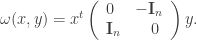
 the Lie bracket is given by
![[ (x,\alpha) , (y, \beta) ]=\left( 0, \omega (x,y) \right),](https://s0.wp.com/latex.php?latex=%5B+%28x%2C%5Calpha%29+%2C+%28y%2C+%5Cbeta%29+%5D%3D%5Cleft%28+0%2C+%5Comega+%28x%2Cy%29+%5Cright%29%2C&bg=ffffff&fg=333333&s=0&c=20201002)
 where
where  and
and  . Therefore
  is a Carnot group of depth 2.
  is isomorphic to the nilpotent
  is the number of
  in the free algebra with
 is the
  ,
,
 , which is called the basis of
  ,
,
 whose first terms are given by
![P (U,V) = U+V+\frac{1}{2} [U,V] +\frac{1}{12} [[U,V],V]-\frac{1}{12}[[U,V],U]](https://s0.wp.com/latex.php?latex=P+%28U%2CV%29++%3D++U%2BV%2B%5Cfrac%7B1%7D%7B2%7D+%5BU%2CV%5D+%2B%5Cfrac%7B1%7D%7B12%7D+%5B%5BU%2CV%5D%2CV%5D-%5Cfrac%7B1%7D%7B12%7D%5B%5BU%2CV%5D%2CU%5D+&bg=ffffff&fg=333333&s=0&c=20201002)
![-\frac{1}{48} [V,[U,[U,V]]]-\frac{1}{48} [U,[V,[U,V]]]+\cdots.](https://s0.wp.com/latex.php?latex=-%5Cfrac%7B1%7D%7B48%7D+%5BV%2C%5BU%2C%5BU%2CV%5D%5D%5D-%5Cfrac%7B1%7D%7B48%7D+%5BU%2C%5BV%2C%5BU%2CV%5D%5D%5D%2B%5Ccdots.&bg=ffffff&fg=333333&s=0&c=20201002)
 ,
,  which act by scalar multiplication
  on
on  . These operators are Lie algebra automorphisms due to the grading. The maps
  induce Lie group automorphisms
  which are called the canonical dilations of
  endowed with a polynomial group law. Indeed, let
  be a basis of
 ‘s. Such basis, which can be made quite explicit, will be referred to as a Hall basis over
  be such a basis. For
  , let
, let ![[X]_\mathcal{B}](https://s0.wp.com/latex.php?latex=%5BX%5D_%5Cmathcal%7BB%7D&bg=ffffff&fg=333333&s=0&c=20201002) be the coordinate vector of
be the coordinate vector of  in the basis
  the dimension of
  on
on  ,
,![[X]_\mathcal{B} \star [Y]_\mathcal{B} =[ P_N(X,Y) ]_\mathcal{B}=[ \ln (e^X e^Y) ]_\mathcal{B}.](https://s0.wp.com/latex.php?latex=%5BX%5D_%5Cmathcal%7BB%7D+%5Cstar+%5BY%5D_%5Cmathcal%7BB%7D+%3D%5B+P_N%28X%2CY%29+%5D_%5Cmathcal%7BB%7D%3D%5B+%5Cln+%28e%5EX+e%5EY%29++%5D_%5Cmathcal%7BB%7D.&bg=ffffff&fg=333333&s=0&c=20201002)
 is a Carnot group of step
 ![[ [X]_\mathcal{B} , [Y]_\mathcal{B}] =[ [X,Y] ]_\mathcal{B}.](https://s0.wp.com/latex.php?latex=%5B+%5BX%5D_%5Cmathcal%7BB%7D+%2C+%5BY%5D_%5Cmathcal%7BB%7D%5D+%3D%5B+%5BX%2CY%5D+%5D_%5Cmathcal%7BB%7D.&bg=ffffff&fg=333333&s=0&c=20201002)
 is isomorphic to
 ![\mathbb{R}[[X_1, \cdots, X_d ]]](https://s0.wp.com/latex.php?latex=%5Cmathbb%7BR%7D%5B%5BX_1%2C+%5Ccdots%2C+X_d+%5D%5D&bg=ffffff&fg=333333&s=0&c=20201002) the set formal series. Let us denote by
the set formal series. Let us denote by ![\mathbb{R}_N[X_1,\cdots,X_d]](https://s0.wp.com/latex.php?latex=%5Cmathbb%7BR%7D_N%5BX_1%2C%5Ccdots%2CX_d%5D&bg=ffffff&fg=333333&s=0&c=20201002) the set of truncated series at order
the set of truncated series at order  if
if  . In this context, the free nilpotent Lie algebra of order
  where the exponential map is the usual exponential of formal series.
![\sum_{k=0}^{N} \int_{\Delta^k [0,t]} dx^{\otimes k}, \quad 0 \le t \le T,](https://s0.wp.com/latex.php?latex=%5Csum_%7Bk%3D0%7D%5E%7BN%7D+%5Cint_%7B%5CDelta%5Ek+%5B0%2Ct%5D%7D++dx%5E%7B%5Cotimes+k%7D%2C+%5Cquad+0+%5Cle+t+%5Cle+T%2C&bg=ffffff&fg=333333&s=0&c=20201002)

 ,
,
 and let
 ![y_n:[0,T] \to \mathbb{R}^n](https://s0.wp.com/latex.php?latex=y_n%3A%5B0%2CT%5D+%5Cto+%5Cmathbb%7BR%7D%5En&bg=ffffff&fg=333333&s=0&c=20201002) be the solution of the differential equation
be the solution of the differential equation
![y(t)=y(0)+ \sum^{+\infty}_{k=1}\sum_{I=(i_1,\cdots,i_k)} M_{i_1}\cdots M_{i_k} \left( \int_{\Delta^{k}[0,t]}dx^{I} \right) y(0).](https://s0.wp.com/latex.php?latex=y%28t%29%3Dy%280%29%2B+%5Csum%5E%7B%2B%5Cinfty%7D_%7Bk%3D1%7D%5Csum_%7BI%3D%28i_1%2C%5Ccdots%2Ci_k%29%7D+M_%7Bi_1%7D%5Ccdots+M_%7Bi_k%7D+%5Cleft%28+%5Cint_%7B%5CDelta%5E%7Bk%7D%5B0%2Ct%5D%7Ddx%5E%7BI%7D+%5Cright%29+y%280%29.&bg=ffffff&fg=333333&s=0&c=20201002)
 such that for
  ,
,
![M_I = [M_{i_1},[M_{i_2},...,[M_{i_{k-1}}, M_{i_{k}}]...],](https://s0.wp.com/latex.php?latex=M_I+%3D+%5BM_%7Bi_1%7D%2C%5BM_%7Bi_2%7D%2C...%2C%5BM_%7Bi_%7Bk-1%7D%7D%2C+M_%7Bi_%7Bk%7D%7D%5D...%5D%2C&bg=ffffff&fg=333333&s=0&c=20201002)
![\Lambda_I (x)_{t}= \sum_{\sigma \in \mathcal{S}_k} \frac{\left(-1\right) ^{e(\sigma )}}{k^{2}\left( \begin{array}{l} k-1 \\ e(\sigma ) \end{array} \right) } \int_{\Delta^k[0,t]} dx^{\sigma^{-1} \cdot I}.](https://s0.wp.com/latex.php?latex=%5CLambda_I+%28x%29_%7Bt%7D%3D+%5Csum_%7B%5Csigma+%5Cin+%5Cmathcal%7BS%7D_k%7D+%5Cfrac%7B%5Cleft%28-1%5Cright%29+%5E%7Be%28%5Csigma+%29%7D%7D%7Bk%5E%7B2%7D%5Cleft%28++%5Cbegin%7Barray%7D%7Bl%7D++k-1+%5C%5C++e%28%5Csigma+%29++%5Cend%7Barray%7D++%5Cright%29+%7D+%5Cint_%7B%5CDelta%5Ek%5B0%2Ct%5D%7D+dx%5E%7B%5Csigma%5E%7B-1%7D+%5Ccdot+I%7D.++&bg=ffffff&fg=333333&s=0&c=20201002)

![\left| \int_{\Delta^k[0,t]} dx^{\sigma^{-1} \cdot I} \right| \le \int_{\Delta^k[0,t]} \| dx^{\sigma^{-1} \cdot I}\| \le \frac{1}{k!} \| x \|^k_{1-var, [0,t]}.](https://s0.wp.com/latex.php?latex=%5Cleft%7C++%5Cint_%7B%5CDelta%5Ek%5B0%2Ct%5D%7D+dx%5E%7B%5Csigma%5E%7B-1%7D+%5Ccdot+I%7D+%5Cright%7C+%5Cle+%5Cint_%7B%5CDelta%5Ek%5B0%2Ct%5D%7D+%5C%7C++dx%5E%7B%5Csigma%5E%7B-1%7D++%5Ccdot+I%7D%5C%7C+%5Cle+%5Cfrac%7B1%7D%7Bk%21%7D+%5C%7C+x+%5C%7C%5Ek_%7B1-var%2C+%5B0%2Ct%5D%7D.&bg=ffffff&fg=333333&s=0&c=20201002)
![\left| \Lambda_I (x)_{t} \right| \le \frac{C}{2^k k^{3/2}} \| x \|^k_{1-var, [0,t]}.](https://s0.wp.com/latex.php?latex=%5Cleft%7C++%5CLambda_I+%28x%29_%7Bt%7D+%5Cright%7C+%5Cle++%5Cfrac%7BC%7D%7B2%5Ek+k%5E%7B3%2F2%7D%7D+++%5C%7C+x+%5C%7C%5Ek_%7B1-var%2C+%5B0%2Ct%5D%7D.&bg=ffffff&fg=333333&s=0&c=20201002)
 so we conclude that for some constant
  ,
,![\left\| \sum_{I \in \{1,\cdots ,d\}^k}\Lambda_I (x)_{t} M_I \right\| \le \frac{\tilde{C}^k}{ k^{3/2}} \| x \|^k_{1-var, [0,t]}.](https://s0.wp.com/latex.php?latex=%5Cleft%5C%7C+%5Csum_%7BI+%5Cin+%5C%7B1%2C%5Ccdots+%2Cd%5C%7D%5Ek%7D%5CLambda_I+%28x%29_%7Bt%7D+M_I++%5Cright%5C%7C+%5Cle++%5Cfrac%7B%5Ctilde%7BC%7D%5Ek%7D%7B+k%5E%7B3%2F2%7D%7D+++%5C%7C+x+%5C%7C%5Ek_%7B1-var%2C+%5B0%2Ct%5D%7D.&bg=ffffff&fg=333333&s=0&c=20201002)
 is such that
 ![\| x \|_{1-var, [0,\tau]} < \frac{1}{\tilde{C}}](https://s0.wp.com/latex.php?latex=%5C%7C+x+%5C%7C_%7B1-var%2C+%5B0%2C%5Ctau%5D%7D+%3C+%5Cfrac%7B1%7D%7B%5Ctilde%7BC%7D%7D&bg=ffffff&fg=333333&s=0&c=20201002) , then the series
, then the series
![[0,\tau]](https://s0.wp.com/latex.php?latex=%5B0%2C%5Ctau%5D&bg=ffffff&fg=333333&s=0&c=20201002) . At this point, we can observe that the Chen's expansion formula is a purely algebraic statement, thus expanding the exponential
. At this point, we can observe that the Chen's expansion formula is a purely algebraic statement, thus expanding the exponential
![y(0)+ \sum^{+\infty}_{k=1}\sum_{I=(i_1,\cdots,i_k)} M_{i_1}\cdots M_{i_k} \left( \int_{\Delta^{k}[0,t]}dx^{I} \right) y(0)](https://s0.wp.com/latex.php?latex=y%280%29%2B+%5Csum%5E%7B%2B%5Cinfty%7D_%7Bk%3D1%7D%5Csum_%7BI%3D%28i_1%2C%5Ccdots%2Ci_k%29%7D+M_%7Bi_1%7D%5Ccdots+M_%7Bi_k%7D+%5Cleft%28+%5Cint_%7B%5CDelta%5E%7Bk%7D%5B0%2Ct%5D%7Ddx%5E%7BI%7D+%5Cright%29+y%280%29&bg=ffffff&fg=333333&s=0&c=20201002)

 , we can define
 is the exponential mapping on the Lie group
  and
and 

 is 0. In that case, the sum in the exponential is finite and the representation is then of course valid on the whole time interval
 ![[0,T]](https://s0.wp.com/latex.php?latex=%5B0%2CT%5D&bg=ffffff&fg=333333&s=0&c=20201002) .
.

![=1+\sum_{k=1}^{+\infty} \int_{\Delta^k[0,T]} dx^{\otimes k}.](https://s0.wp.com/latex.php?latex=%3D1%2B%5Csum_%7Bk%3D1%7D%5E%7B%2B%5Cinfty%7D+%5Cint_%7B%5CDelta%5Ek%5B0%2CT%5D%7D+dx%5E%7B%5Cotimes+k%7D.&bg=ffffff&fg=333333&s=0&c=20201002)
 the group of the permutations of the index set
  and if
  , we denote for a word
  ,
,  the word
  . By commuting
 ![\mathfrak{S} (x)_{s,t} = 1+ \sum_{k=1}^{+\infty} \sum_{I=(i_1,...,i_k)} X_{i_1} ... X_{i_k} \left( \frac{1}{k!} \sum_{\sigma \in \mathcal{S}_k} \int_{\Delta^k [s,t]} dx^{\sigma \cdot I} \right).](https://s0.wp.com/latex.php?latex=%5Cmathfrak%7BS%7D+%28x%29_%7Bs%2Ct%7D+%3D+1%2B+%5Csum_%7Bk%3D1%7D%5E%7B%2B%5Cinfty%7D+%5Csum_%7BI%3D%28i_1%2C...%2Ci_k%29%7D+X_%7Bi_1%7D+...+X_%7Bi_k%7D+%5Cleft%28+%5Cfrac%7B1%7D%7Bk%21%7D+%5Csum_%7B%5Csigma+%5Cin+%5Cmathcal%7BS%7D_k%7D+%5Cint_%7B%5CDelta%5Ek+%5Bs%2Ct%5D%7D++dx%5E%7B%5Csigma+%5Ccdot+I%7D+%5Cright%29.&bg=ffffff&fg=333333&s=0&c=20201002)
![\sum_{\sigma \in \mathcal{S}_k} \int_{\Delta^k [s,t]} dx^{\sigma \cdot I} =(x^{i_1}(t)-x^{i_1}(s)) \cdots (x^{i_k}(t)-x^{i_k}(s)),](https://s0.wp.com/latex.php?latex=%5Csum_%7B%5Csigma+%5Cin+%5Cmathcal%7BS%7D_k%7D+%5Cint_%7B%5CDelta%5Ek+%5Bs%2Ct%5D%7D++dx%5E%7B%5Csigma+%5Ccdot+I%7D+%3D%28x%5E%7Bi_1%7D%28t%29-x%5E%7Bi_1%7D%28s%29%29+%5Ccdots+%28x%5E%7Bi_k%7D%28t%29-x%5E%7Bi_k%7D%28s%29%29%2C&bg=ffffff&fg=333333&s=0&c=20201002)


 is, of course, defined as
 and
and  of
of ![\mathbb{R} [[ X_1 ,\cdots , X_d ]]](https://s0.wp.com/latex.php?latex=%5Cmathbb%7BR%7D+%5B%5B+X_1+%2C%5Ccdots+%2C+X_d+%5D%5D&bg=ffffff&fg=333333&s=0&c=20201002) by
by ![[U,V]=UV-VU](https://s0.wp.com/latex.php?latex=%5BU%2CV%5D%3DUV-VU&bg=ffffff&fg=333333&s=0&c=20201002) . Moreover, if
. Moreover, if  is a word, we denote by
  the iterated Lie bracket which is defined by
![X_I = [X_{i_1},[X_{i_2},...,[X_{i_{k-1}}, X_{i_{k}}]...].](https://s0.wp.com/latex.php?latex=X_I+%3D+%5BX_%7Bi_1%7D%2C%5BX_%7Bi_2%7D%2C...%2C%5BX_%7Bi_%7Bk-1%7D%7D%2C+X_%7Bi_%7Bk%7D%7D%5D...%5D.&bg=ffffff&fg=333333&s=0&c=20201002)

 :
: ;
; is the cardinality of the set
![\Lambda_I (x)_{s,t}= \sum_{\sigma \in \mathcal{S}_k} \frac{\left(-1\right) ^{e(\sigma )}}{k^{2}\left( \begin{array}{l} k-1 \\ e(\sigma ) \end{array} \right) } \int_{\Delta^k[s,t]} dx^{\sigma^{-1} \cdot I}.](https://s0.wp.com/latex.php?latex=%5CLambda_I+%28x%29_%7Bs%2Ct%7D%3D+%5Csum_%7B%5Csigma+%5Cin+%5Cmathcal%7BS%7D_k%7D+%5Cfrac%7B%5Cleft%28-1%5Cright%29+%5E%7Be%28%5Csigma+%29%7D%7D%7Bk%5E%7B2%7D%5Cleft%28++%5Cbegin%7Barray%7D%7Bl%7D++k-1+%5C%5C++e%28%5Csigma+%29++%5Cend%7Barray%7D++%5Cright%29+%7D+%5Cint_%7B%5CDelta%5Ek%5Bs%2Ct%5D%7D+dx%5E%7B%5Csigma%5E%7B-1%7D+%5Ccdot+I%7D.&bg=ffffff&fg=333333&s=0&c=20201002)

![\sum_{I=(i_1,i_2)} \Lambda_I (x)_{s,t} X_I=\frac{1}{2} \sum_{1 \leq i<j \leq d} [X_i , X_j] \int_s^t x^i(u) dx^j(u) - x^j(u) dx^i(u).](https://s0.wp.com/latex.php?latex=%5Csum_%7BI%3D%28i_1%2Ci_2%29%7D+%5CLambda_I+%28x%29_%7Bs%2Ct%7D+X_I%3D%5Cfrac%7B1%7D%7B2%7D+%5Csum_%7B1+%5Cleq+i%3Cj+%5Cleq+d%7D++%5BX_i+%2C+X_j%5D+%5Cint_s%5Et+x%5Ei%28u%29++dx%5Ej%28u%29+-++x%5Ej%28u%29+dx%5Ei%28u%29.&bg=ffffff&fg=333333&s=0&c=20201002)
 ,
,  and
and  . The idea is to prove first the result when the path
 where
where  . And, then, we will use a limiting argument.
 ,
,
![\mathfrak{S} (x)_{0,T}=\prod_{n=0}^{N-1} \left( \mathbf{1} + \sum_{k=1}^{+\infty} \sum_{I=(i_1,...i_k)} X_{i_1} ... X_{i_k} \int_{\Delta^k [t_n,t_{n+1}]} dx^I \right)](https://s0.wp.com/latex.php?latex=%5Cmathfrak%7BS%7D+%28x%29_%7B0%2CT%7D%3D%5Cprod_%7Bn%3D0%7D%5E%7BN-1%7D+%5Cleft%28+%5Cmathbf%7B1%7D+%2B+%5Csum_%7Bk%3D1%7D%5E%7B%2B%5Cinfty%7D++%5Csum_%7BI%3D%28i_1%2C...i_k%29%7D+X_%7Bi_1%7D+...+X_%7Bi_k%7D+%5Cint_%7B%5CDelta%5Ek+%5Bt_n%2Ct_%7Bn%2B1%7D%5D%7D+dx%5EI+%5Cright%29&bg=ffffff&fg=333333&s=0&c=20201002)
 ,
,
![\int_{\Delta^k [t_n,t_{n+1}]} dx^I =a_n^{i_1} \cdots a_n^{i_k} \int_{\Delta^k [t_n,t_{n+1}]} dt_{i_1} \cdots dt_{i_k} =a_n^{i_1} \cdots a_n^{i_k} \frac{(t_{n+1}-t_n)^k}{k!}.](https://s0.wp.com/latex.php?latex=%5Cint_%7B%5CDelta%5Ek+%5Bt_n%2Ct_%7Bn%2B1%7D%5D%7D++dx%5EI+%3Da_n%5E%7Bi_1%7D+%5Ccdots+a_n%5E%7Bi_k%7D+%5Cint_%7B%5CDelta%5Ek+%5Bt_n%2Ct_%7Bn%2B1%7D%5D%7D++dt_%7Bi_1%7D+%5Ccdots+dt_%7Bi_k%7D+%3Da_n%5E%7Bi_1%7D+%5Ccdots+a_n%5E%7Bi_k%7D+%5Cfrac%7B%28t_%7Bn%2B1%7D-t_n%29%5Ek%7D%7Bk%21%7D.&bg=ffffff&fg=333333&s=0&c=20201002)


 then,
then,
 :
: .
.
![\beta_I (t_1 a_0,\cdots,(t_N-t_{N-1})a_{N-1})= \sum_{\sigma \in \mathcal{S}_k} \frac{\left(-1\right) ^{e(\sigma )}}{k^{2}\left( \begin{array}{l} k-1 \\ e(\sigma ) \end{array} \right) } \int_{\Delta^k[0,T]} dx^{\sigma^{-1} \cdot I}.](https://s0.wp.com/latex.php?latex=%5Cbeta_I+%28t_1+a_0%2C%5Ccdots%2C%28t_N-t_%7BN-1%7D%29a_%7BN-1%7D%29%3D+%5Csum_%7B%5Csigma+%5Cin+%5Cmathcal%7BS%7D_k%7D+%5Cfrac%7B%5Cleft%28-1%5Cright%29+%5E%7Be%28%5Csigma+%29%7D%7D%7Bk%5E%7B2%7D%5Cleft%28++%5Cbegin%7Barray%7D%7Bl%7D++k-1+%5C%5C++e%28%5Csigma+%29++%5Cend%7Barray%7D++%5Cright%29+%7D++%5Cint_%7B%5CDelta%5Ek%5B0%2CT%5D%7D+dx%5E%7B%5Csigma%5E%7B-1%7D+%5Ccdot+I%7D.&bg=ffffff&fg=333333&s=0&c=20201002)

![\int_{\Delta^k[0,T]} dx_n^{ I}](https://s0.wp.com/latex.php?latex=%5Cint_%7B%5CDelta%5Ek%5B0%2CT%5D%7D+dx_n%5E%7B+I%7D&bg=ffffff&fg=333333&s=0&c=20201002) will converge to
will converge to ![\int_{\Delta^k[0,T]} dx^{ I}](https://s0.wp.com/latex.php?latex=%5Cint_%7B%5CDelta%5Ek%5B0%2CT%5D%7D+dx%5E%7B+I%7D&bg=ffffff&fg=333333&s=0&c=20201002) (see for instance the proposition 2.7 in the book by Friz-Victoir) and the result follows.
(see for instance the proposition 2.7 in the book by Friz-Victoir) and the result follows.![x \in \mathbf{\Omega}^p([0,T],\mathbb{R}^d)](https://s0.wp.com/latex.php?latex=x+%5Cin+%5Cmathbf%7B%5COmega%7D%5Ep%28%5B0%2CT%5D%2C%5Cmathbb%7BR%7D%5Ed%29&bg=ffffff&fg=333333&s=0&c=20201002) be a
be a ![\sum_{k=0}^{[p]} \int_{\Delta^k [s,t]} dx^{\otimes k},](https://s0.wp.com/latex.php?latex=%5Csum_%7Bk%3D0%7D%5E%7B%5Bp%5D%7D+%5Cint_%7B%5CDelta%5Ek+%5Bs%2Ct%5D%7D++dx%5E%7B%5Cotimes+k%7D%2C&bg=ffffff&fg=333333&s=0&c=20201002) and let
and let ![x_n \in C^{1-var}([0,T],\mathbb{R}^d)](https://s0.wp.com/latex.php?latex=x_n+%5Cin+C%5E%7B1-var%7D%28%5B0%2CT%5D%2C%5Cmathbb%7BR%7D%5Ed%29&bg=ffffff&fg=333333&s=0&c=20201002) be an approximating sequence such that
be an approximating sequence such that![\sum_{j=1}^{[p]} \left\| \int dx^{\otimes j}- \int dx_n^{\otimes j} \right\|^{1/j}_{\frac{p}{j}-var, [0,T]} \to 0.](https://s0.wp.com/latex.php?latex=%5Csum_%7Bj%3D1%7D%5E%7B%5Bp%5D%7D+%5Cleft%5C%7C++%5Cint+dx%5E%7B%5Cotimes+j%7D-+++%5Cint++dx_n%5E%7B%5Cotimes+j%7D+%5Cright%5C%7C%5E%7B1%2Fj%7D_%7B%5Cfrac%7Bp%7D%7Bj%7D-var%2C+%5B0%2CT%5D%7D+%5Cto+0.&bg=ffffff&fg=333333&s=0&c=20201002)

 ,
, ![y \in C^{p-var}([0,T],\mathbb{R}^n)](https://s0.wp.com/latex.php?latex=y+%5Cin++C%5E%7Bp-var%7D%28%5B0%2CT%5D%2C%5Cmathbb%7BR%7D%5En%29+&bg=ffffff&fg=333333&s=0&c=20201002) .
. 

![y_n(t)=y_n(s)+ \sum^{+\infty}_{k=1}\sum_{I=(i_1,\cdots,i_k)} M_{i_1}\cdots M_{i_k} \left( \int_{\Delta^{k}[s,t]}dx_n^{I} \right) y_n(s).](https://s0.wp.com/latex.php?latex=y_n%28t%29%3Dy_n%28s%29%2B+%5Csum%5E%7B%2B%5Cinfty%7D_%7Bk%3D1%7D%5Csum_%7BI%3D%28i_1%2C%5Ccdots%2Ci_k%29%7D+M_%7Bi_1%7D%5Ccdots+M_%7Bi_k%7D+%5Cleft%28+%5Cint_%7B%5CDelta%5E%7Bk%7D%5Bs%2Ct%5D%7Ddx_n%5E%7BI%7D+%5Cright%29+y_n%28s%29.&bg=ffffff&fg=333333&s=0&c=20201002)
 ,
,![y_n(t)-y_p(t)=\sum^{+\infty}_{k=1}\sum_{I=(i_1,\cdots,i_k)} M_{i_1}\cdots M_{i_k} \left( \int_{\Delta^{k}[0,t]}dx_n^{I}- \int_{\Delta^{k}[0,t]}dx_p^{I} \right) y(0),](https://s0.wp.com/latex.php?latex=y_n%28t%29-y_p%28t%29%3D%5Csum%5E%7B%2B%5Cinfty%7D_%7Bk%3D1%7D%5Csum_%7BI%3D%28i_1%2C%5Ccdots%2Ci_k%29%7D+M_%7Bi_1%7D%5Ccdots+M_%7Bi_k%7D+%5Cleft%28+%5Cint_%7B%5CDelta%5E%7Bk%7D%5B0%2Ct%5D%7Ddx_n%5E%7BI%7D-++%5Cint_%7B%5CDelta%5E%7Bk%7D%5B0%2Ct%5D%7Ddx_p%5E%7BI%7D+%5Cright%29+y%280%29%2C&bg=ffffff&fg=333333&s=0&c=20201002)
![\| y_n(t)-y_m(t) \| \le \sum^{+\infty}_{k=1}M^k \left\| \int_{\Delta^{k}[0,t]}dx_n^{\otimes k}- \int_{\Delta^{k}[0,t]}dx_m^{\otimes k} \right\| \| y(0) \|](https://s0.wp.com/latex.php?latex=%5C%7C+y_n%28t%29-y_m%28t%29+%5C%7C+%5Cle+%5Csum%5E%7B%2B%5Cinfty%7D_%7Bk%3D1%7DM%5Ek++%5Cleft%5C%7C++%5Cint_%7B%5CDelta%5E%7Bk%7D%5B0%2Ct%5D%7Ddx_n%5E%7B%5Cotimes+k%7D-++%5Cint_%7B%5CDelta%5E%7Bk%7D%5B0%2Ct%5D%7Ddx_m%5E%7B%5Cotimes+k%7D+%5Cright%5C%7C+%5C%7C+y%280%29+%5C%7C&bg=ffffff&fg=333333&s=0&c=20201002)
 . From the theorems of the previous lectures, there exists a constant
  depending only on
 ![\sup_n \sum_{j=1}^{[p]} \left\| \int dx_n^{\otimes j} \right\|^{1/j}_{\frac{p}{j}-var, [0,T]}](https://s0.wp.com/latex.php?latex=%5Csup_n++%5Csum_%7Bj%3D1%7D%5E%7B%5Bp%5D%7D+%5Cleft%5C%7C++%5Cint+dx_n%5E%7B%5Cotimes+j%7D+%5Cright%5C%7C%5E%7B1%2Fj%7D_%7B%5Cfrac%7Bp%7D%7Bj%7D-var%2C+%5B0%2CT%5D%7D&bg=ffffff&fg=333333&s=0&c=20201002)
 and
and  big enough:
![\left\| \int_{\Delta^k [0,\cdot]} dx_n^{\otimes k}- \int_{\Delta^k [0,\cdot]} dx_m^{\otimes k} \right\|_{p-var, [0,T]} \le \left( \sum_{j=1}^{[p]} \left\| \int dx_n^{\otimes j}- \int dx_m^{\otimes j} \right\|^{1/j}_{\frac{p}{j}-var, [0,T]} \right) \frac{C^k}{\left( \frac{k}{p}\right)!}.](https://s0.wp.com/latex.php?latex=%5Cleft%5C%7C++%5Cint_%7B%5CDelta%5Ek+%5B0%2C%5Ccdot%5D%7D++dx_n%5E%7B%5Cotimes+k%7D-++%5Cint_%7B%5CDelta%5Ek+%5B0%2C%5Ccdot%5D%7D++dx_m%5E%7B%5Cotimes+k%7D+%5Cright%5C%7C_%7Bp-var%2C+%5B0%2CT%5D%7D++%5Cle+%5Cleft%28+%5Csum_%7Bj%3D1%7D%5E%7B%5Bp%5D%7D+%5Cleft%5C%7C++%5Cint+dx_n%5E%7B%5Cotimes+j%7D-+++%5Cint++dx_m%5E%7B%5Cotimes+j%7D+%5Cright%5C%7C%5E%7B1%2Fj%7D_%7B%5Cfrac%7Bp%7D%7Bj%7D-var%2C+%5B0%2CT%5D%7D++%5Cright%29+%5Cfrac%7BC%5Ek%7D%7B%5Cleft%28+%5Cfrac%7Bk%7D%7Bp%7D%5Cright%29%21%7D.&bg=ffffff&fg=333333&s=0&c=20201002)
![\| y_n(t)-y_m(t) \| \le \tilde{C} \sum_{j=1}^{[p]} \left\| \int dx_n^{\otimes j}- \int dx_m^{\otimes j} \right\|^{1/j}_{\frac{p}{j}-var, [0,T]} .](https://s0.wp.com/latex.php?latex=%5C%7C+y_n%28t%29-y_m%28t%29+%5C%7C+%5Cle+%5Ctilde%7BC%7D+++%5Csum_%7Bj%3D1%7D%5E%7B%5Bp%5D%7D+%5Cleft%5C%7C++%5Cint+dx_n%5E%7B%5Cotimes+j%7D-+++%5Cint++dx_m%5E%7B%5Cotimes+j%7D+%5Cright%5C%7C%5E%7B1%2Fj%7D_%7B%5Cfrac%7Bp%7D%7Bj%7D-var%2C+%5B0%2CT%5D%7D+.&bg=ffffff&fg=333333&s=0&c=20201002)

![=\sum^{+\infty}_{k=1}\sum_{I=(i_1,\cdots,i_k)} M_{i_1}\cdots M_{i_k} \left( \int_{\Delta^{k}[s,t]}dx_n^{I}y_n(s) -\int_{\Delta^{k}[s,t]}dx_m^{I} y_m(s)\right),](https://s0.wp.com/latex.php?latex=%3D%5Csum%5E%7B%2B%5Cinfty%7D_%7Bk%3D1%7D%5Csum_%7BI%3D%28i_1%2C%5Ccdots%2Ci_k%29%7D+M_%7Bi_1%7D%5Ccdots+M_%7Bi_k%7D+%5Cleft%28+%5Cint_%7B%5CDelta%5E%7Bk%7D%5Bs%2Ct%5D%7Ddx_n%5E%7BI%7Dy_n%28s%29+-%5Cint_%7B%5CDelta%5E%7Bk%7D%5Bs%2Ct%5D%7Ddx_m%5E%7BI%7D+y_m%28s%29%5Cright%29%2C&bg=ffffff&fg=333333&s=0&c=20201002)
![\left\| \int_{\Delta^{k}[s,t]}dx_n^{I}y_n(s) -\int_{\Delta^{k}[s,t]}dx_m^{I} y_m(s) \right\|](https://s0.wp.com/latex.php?latex=%5Cleft%5C%7C++%5Cint_%7B%5CDelta%5E%7Bk%7D%5Bs%2Ct%5D%7Ddx_n%5E%7BI%7Dy_n%28s%29+-%5Cint_%7B%5CDelta%5E%7Bk%7D%5Bs%2Ct%5D%7Ddx_m%5E%7BI%7D+y_m%28s%29+%5Cright%5C%7C&bg=ffffff&fg=333333&s=0&c=20201002)
![\le \left\| \int_{\Delta^{k}[s,t]}dx_n^{I} \right\| \| y_n(s)-y_m(s) \|+\| y_m(s) \| \left\| \int_{\Delta^{k}[s,t]}dx_n^{I} - \int_{\Delta^{k}[s,t]}dx_m^{I}\right\|](https://s0.wp.com/latex.php?latex=%5Cle+%5Cleft%5C%7C++%5Cint_%7B%5CDelta%5E%7Bk%7D%5Bs%2Ct%5D%7Ddx_n%5E%7BI%7D+%5Cright%5C%7C+%5C%7C+y_n%28s%29-y_m%28s%29+%5C%7C%2B%5C%7C+y_m%28s%29+%5C%7C+%5Cleft%5C%7C++%5Cint_%7B%5CDelta%5E%7Bk%7D%5Bs%2Ct%5D%7Ddx_n%5E%7BI%7D+-++%5Cint_%7B%5CDelta%5E%7Bk%7D%5Bs%2Ct%5D%7Ddx_m%5E%7BI%7D%5Cright%5C%7C+&bg=ffffff&fg=333333&s=0&c=20201002)
![\le \left\| \int_{\Delta^{k}[s,t]}dx_n^{I} \right\| \| y_n-y_m \|_{\infty, [0,T]} +\| y_m \|_{\infty, [0,T]} \left\| \int_{\Delta^{k}[s,t]}dx_n^{I} - \int_{\Delta^{k}[s,t]}dx_m^{I}\right\|](https://s0.wp.com/latex.php?latex=%5Cle++%5Cleft%5C%7C++%5Cint_%7B%5CDelta%5E%7Bk%7D%5Bs%2Ct%5D%7Ddx_n%5E%7BI%7D+%5Cright%5C%7C+%5C%7C+y_n-y_m+%5C%7C_%7B%5Cinfty%2C+%5B0%2CT%5D%7D+%2B%5C%7C+y_m+%5C%7C_%7B%5Cinfty%2C+%5B0%2CT%5D%7D+%5Cleft%5C%7C++%5Cint_%7B%5CDelta%5E%7Bk%7D%5Bs%2Ct%5D%7Ddx_n%5E%7BI%7D+-++%5Cint_%7B%5CDelta%5E%7Bk%7D%5Bs%2Ct%5D%7Ddx_m%5E%7BI%7D%5Cright%5C%7C+&bg=ffffff&fg=333333&s=0&c=20201002)
 and
and ![\left\| \int_{\Delta^k [s,t]} dx_n^{\otimes k} \right\| \le \frac{C^k}{\left( \frac{k}{p}\right)!} \omega(s,t)^{k/p}, \quad 0 \le s \le t \le T.](https://s0.wp.com/latex.php?latex=%5Cleft%5C%7C++%5Cint_%7B%5CDelta%5Ek+%5Bs%2Ct%5D%7D++dx_n%5E%7B%5Cotimes+k%7D+%5Cright%5C%7C+%5Cle+%5Cfrac%7BC%5Ek%7D%7B%5Cleft%28+%5Cfrac%7Bk%7D%7Bp%7D%5Cright%29%21%7D++%5Comega%28s%2Ct%29%5E%7Bk%2Fp%7D%2C+%5Cquad+0+%5Cle+s+%5Cle+t+%5Cle+T.&bg=ffffff&fg=333333&s=0&c=20201002)
![\left\| \int_{\Delta^k [s,t]} dx_n^{\otimes k}- \int_{\Delta^k [s,t]} dx_m^{\otimes k} \right\| \le \left( \sum_{j=1}^{[p]} \left\| \int dx_n^{\otimes j}- \int dx_m^{\otimes k} \right\|^{1/j}_{\frac{p}{j}-var, [0,T]} \right) \frac{C^k}{\left( \frac{k}{p}\right)!} \omega(s,t)^{k/p} ,](https://s0.wp.com/latex.php?latex=%5Cleft%5C%7C++%5Cint_%7B%5CDelta%5Ek+%5Bs%2Ct%5D%7D++dx_n%5E%7B%5Cotimes+k%7D-++%5Cint_%7B%5CDelta%5Ek+%5Bs%2Ct%5D%7D++dx_m%5E%7B%5Cotimes+k%7D+%5Cright%5C%7C++%5Cle+%5Cleft%28+%5Csum_%7Bj%3D1%7D%5E%7B%5Bp%5D%7D+%5Cleft%5C%7C++%5Cint+dx_n%5E%7B%5Cotimes+j%7D-+++%5Cint++dx_m%5E%7B%5Cotimes+k%7D+%5Cright%5C%7C%5E%7B1%2Fj%7D_%7B%5Cfrac%7Bp%7D%7Bj%7D-var%2C+%5B0%2CT%5D%7D++%5Cright%29+%5Cfrac%7BC%5Ek%7D%7B%5Cleft%28+%5Cfrac%7Bk%7D%7Bp%7D%5Cright%29%21%7D+%5Comega%28s%2Ct%29%5E%7Bk%2Fp%7D+%2C&bg=ffffff&fg=333333&s=0&c=20201002)
 . Consequently, there is a constant
![\le \tilde{C} \left( \| y_n-y_m \|_{\infty, [0,T]} + \sum_{j=1}^{[p]} \left\| \int dx_n^{\otimes j}- \int dx_m^{\otimes k} \right\|^{1/j}_{\frac{p}{j}-var, [0,T]} \right) \omega(s,t)^{1/p}](https://s0.wp.com/latex.php?latex=%5Cle+++%5Ctilde%7BC%7D+%5Cleft%28+%5C%7C+y_n-y_m+%5C%7C_%7B%5Cinfty%2C+%5B0%2CT%5D%7D+%2B++%5Csum_%7Bj%3D1%7D%5E%7B%5Bp%5D%7D+%5Cleft%5C%7C++%5Cint+dx_n%5E%7B%5Cotimes+j%7D-+++%5Cint++dx_m%5E%7B%5Cotimes+k%7D+%5Cright%5C%7C%5E%7B1%2Fj%7D_%7B%5Cfrac%7Bp%7D%7Bj%7D-var%2C+%5B0%2CT%5D%7D+%5Cright%29+%5Comega%28s%2Ct%29%5E%7B1%2Fp%7D&bg=ffffff&fg=333333&s=0&c=20201002)
![\| y_n -y_m \|_{p-var,[0,T]} \le \tilde{C} \left( \| y_n-y_m \|_{\infty, [0,T]} + \sum_{j=1}^{[p]} \left\| \int dx_n^{\otimes j}- \int dx_m^{\otimes k} \right\|^{1/j}_{\frac{p}{j}-var, [0,T]} \right)](https://s0.wp.com/latex.php?latex=%5C%7C+y_n+-y_m+%5C%7C_%7Bp-var%2C%5B0%2CT%5D%7D+%5Cle+++%5Ctilde%7BC%7D+%5Cleft%28+%5C%7C+y_n-y_m+%5C%7C_%7B%5Cinfty%2C+%5B0%2CT%5D%7D+%2B++%5Csum_%7Bj%3D1%7D%5E%7B%5Bp%5D%7D+%5Cleft%5C%7C++%5Cint+dx_n%5E%7B%5Cotimes+j%7D-+++%5Cint++dx_m%5E%7B%5Cotimes+k%7D+%5Cright%5C%7C%5E%7B1%2Fj%7D_%7B%5Cfrac%7Bp%7D%7Bj%7D-var%2C+%5B0%2CT%5D%7D+%5Cright%29+&bg=ffffff&fg=333333&s=0&c=20201002)
![y \in \mathbf{\Omega}^p([0,T],\mathbb{R}^d)](https://s0.wp.com/latex.php?latex=y+%5Cin+%5Cmathbf%7B%5COmega%7D%5Ep%28%5B0%2CT%5D%2C%5Cmathbb%7BR%7D%5Ed%29&bg=ffffff&fg=333333&s=0&c=20201002) and when
and when ![\sum_{j=1}^{[p]} \left\| \int dy^{\otimes j}- \int dy_n^{\otimes j} \right\|^{1/j}_{\frac{p}{j}-var, [0,T]} \to 0.](https://s0.wp.com/latex.php?latex=%5Csum_%7Bj%3D1%7D%5E%7B%5Bp%5D%7D+%5Cleft%5C%7C++%5Cint+dy%5E%7B%5Cotimes+j%7D-+++%5Cint++dy_n%5E%7B%5Cotimes+j%7D+%5Cright%5C%7C%5E%7B1%2Fj%7D_%7B%5Cfrac%7Bp%7D%7Bj%7D-var%2C+%5B0%2CT%5D%7D+%5Cto+0.&bg=ffffff&fg=333333&s=0&c=20201002)
 and
and 
 , we denote


 times we obtain

 we conclude
 ,
,![\| y(t) \| \le p \| y(0)\| e^{ CM \left( \sum_{j=1}^{[p]} \left\| \int dx^{\otimes j} \right\|^{1/j}_{\frac{p}{j}-var, [0,t]} \right)^p},](https://s0.wp.com/latex.php?latex=%5C%7C+y%28t%29+%5C%7C+%5Cle+p+%5C%7C+y%280%29%5C%7C+e%5E%7B+CM++%5Cleft%28++%5Csum_%7Bj%3D1%7D%5E%7B%5Bp%5D%7D+%5Cleft%5C%7C++%5Cint+dx%5E%7B%5Cotimes+j%7D+%5Cright%5C%7C%5E%7B1%2Fj%7D_%7B%5Cfrac%7Bp%7D%7Bj%7D-var%2C+%5B0%2Ct%5D%7D+%5Cright%29%5Ep%7D%2C&bg=ffffff&fg=333333&s=0&c=20201002)
 .
.![y(t)\le \left( 1+ \sum^{+\infty}_{k=1}\sum_{I=(i_1,\cdots,i_k)} M^k \left\| \int_{\Delta^{k}[0,t]}dx^{I} \right\| \right) \| y(0) \|](https://s0.wp.com/latex.php?latex=y%28t%29%5Cle+%5Cleft%28+1%2B+%5Csum%5E%7B%2B%5Cinfty%7D_%7Bk%3D1%7D%5Csum_%7BI%3D%28i_1%2C%5Ccdots%2Ci_k%29%7D+M%5Ek+%5Cleft%5C%7C+%5Cint_%7B%5CDelta%5E%7Bk%7D%5B0%2Ct%5D%7Ddx%5E%7BI%7D+%5Cright%5C%7C+%5Cright%29+%5C%7C+y%280%29+%5C%7C&bg=ffffff&fg=333333&s=0&c=20201002) ,
, and
and ![x,y \in C^{1-var}([0,T],\mathbb{R}^d)](https://s0.wp.com/latex.php?latex=x%2Cy+%5Cin+C%5E%7B1-var%7D%28%5B0%2CT%5D%2C%5Cmathbb%7BR%7D%5Ed%29&bg=ffffff&fg=333333&s=0&c=20201002) such that
such that![\sum_{j=1}^{[p]} \left\| \int dx^{\otimes j}- \int dy^{\otimes j} \right\|^{1/j}_{\frac{p}{j}-var, [0,T]} \le 1,](https://s0.wp.com/latex.php?latex=%5Csum_%7Bj%3D1%7D%5E%7B%5Bp%5D%7D+%5Cleft%5C%7C++%5Cint+dx%5E%7B%5Cotimes+j%7D-+++%5Cint++dy%5E%7B%5Cotimes+j%7D+%5Cright%5C%7C%5E%7B1%2Fj%7D_%7B%5Cfrac%7Bp%7D%7Bj%7D-var%2C+%5B0%2CT%5D%7D++%5Cle+1%2C&bg=ffffff&fg=333333&s=0&c=20201002)
![\left( \sum_{j=1}^{[p]} \left\| \int dx^{\otimes j}\right\|^{1/j}_{\frac{p}{j}-var, [0,T]} \right)^p+ \left( \sum_{j=1}^{[p]} \left\| \int dy^{\otimes j}\right\|^{1/j}_{\frac{p}{j}-var, [0,T]} \right)^p \le K.](https://s0.wp.com/latex.php?latex=%5Cleft%28+%5Csum_%7Bj%3D1%7D%5E%7B%5Bp%5D%7D+%5Cleft%5C%7C++%5Cint+dx%5E%7B%5Cotimes+j%7D%5Cright%5C%7C%5E%7B1%2Fj%7D_%7B%5Cfrac%7Bp%7D%7Bj%7D-var%2C+%5B0%2CT%5D%7D++%5Cright%29%5Ep%2B+%5Cleft%28+%5Csum_%7Bj%3D1%7D%5E%7B%5Bp%5D%7D+%5Cleft%5C%7C++%5Cint+dy%5E%7B%5Cotimes+j%7D%5Cright%5C%7C%5E%7B1%2Fj%7D_%7B%5Cfrac%7Bp%7D%7Bj%7D-var%2C+%5B0%2CT%5D%7D++%5Cright%29%5Ep+%5Cle+K.&bg=ffffff&fg=333333&s=0&c=20201002)
![\left\| \int_{\Delta^k [0,\cdot]} dx^{\otimes k}- \int_{\Delta^k [0,\cdot]} dy^{\otimes k} \right\|_{p-var, [0,T]} \le \left( \sum_{j=1}^{[p]} \left\| \int dx^{\otimes j}- \int dy^{\otimes j} \right\|^{1/j}_{\frac{p}{j}-var, [0,T]} \right) \frac{C^k}{\left( \frac{k}{p}\right)!}.](https://s0.wp.com/latex.php?latex=%5Cleft%5C%7C++%5Cint_%7B%5CDelta%5Ek+%5B0%2C%5Ccdot%5D%7D++dx%5E%7B%5Cotimes+k%7D-++%5Cint_%7B%5CDelta%5Ek+%5B0%2C%5Ccdot%5D%7D++dy%5E%7B%5Cotimes+k%7D+%5Cright%5C%7C_%7Bp-var%2C+%5B0%2CT%5D%7D++%5Cle+%5Cleft%28+%5Csum_%7Bj%3D1%7D%5E%7B%5Bp%5D%7D+%5Cleft%5C%7C++%5Cint+dx%5E%7B%5Cotimes+j%7D-+++%5Cint++dy%5E%7B%5Cotimes+j%7D+%5Cright%5C%7C%5E%7B1%2Fj%7D_%7B%5Cfrac%7Bp%7D%7Bj%7D-var%2C+%5B0%2CT%5D%7D++%5Cright%29+%5Cfrac%7BC%5Ek%7D%7B%5Cleft%28+%5Cfrac%7Bk%7D%7Bp%7D%5Cright%29%21%7D.&bg=ffffff&fg=333333&s=0&c=20201002)
![x \in C^{p-var}([0,T],\mathbb{R}^d)](https://s0.wp.com/latex.php?latex=x+%5Cin+C%5E%7Bp-var%7D%28%5B0%2CT%5D%2C%5Cmathbb%7BR%7D%5Ed%29&bg=ffffff&fg=333333&s=0&c=20201002) . We say that
. We say that ![x_n \in C^{1-var}([0,T],\mathbb{R}^d)](https://s0.wp.com/latex.php?latex=x_n+%5Cin++C%5E%7B1-var%7D%28%5B0%2CT%5D%2C%5Cmathbb%7BR%7D%5Ed%29&bg=ffffff&fg=333333&s=0&c=20201002) such that
such that ![C^{1-var}([0,T],\mathbb{R}^d)](https://s0.wp.com/latex.php?latex=C%5E%7B1-var%7D%28%5B0%2CT%5D%2C%5Cmathbb%7BR%7D%5Ed%29&bg=ffffff&fg=333333&s=0&c=20201002) inside
inside ![C^{p-var}([0,T],\mathbb{R}^d)](https://s0.wp.com/latex.php?latex=C%5E%7Bp-var%7D%28%5B0%2CT%5D%2C%5Cmathbb%7BR%7D%5Ed%29&bg=ffffff&fg=333333&s=0&c=20201002) for the distance
for the distance![d_{\mathbf{\Omega}^p([0,T],\mathbb{R}^d)}(x,y)= \sum_{j=1}^{[p]} \left\| \int dx^{\otimes j}- \int dy^{\otimes j} \right\|^{1/j}_{\frac{p}{j}-var, [0,T]} .](https://s0.wp.com/latex.php?latex=d_%7B%5Cmathbf%7B%5COmega%7D%5Ep%28%5B0%2CT%5D%2C%5Cmathbb%7BR%7D%5Ed%29%7D%28x%2Cy%29%3D+%5Csum_%7Bj%3D1%7D%5E%7B%5Bp%5D%7D+%5Cleft%5C%7C++%5Cint+dx%5E%7B%5Cotimes+j%7D-+++%5Cint++dy%5E%7B%5Cotimes+j%7D+%5Cright%5C%7C%5E%7B1%2Fj%7D_%7B%5Cfrac%7Bp%7D%7Bj%7D-var%2C+%5B0%2CT%5D%7D+.&bg=ffffff&fg=333333&s=0&c=20201002)
![\sum_{j=1}^{[p]} \left\| \int dx_n^{\otimes j}- \int dx_m^{\otimes j} \right\|^{1/j}_{\frac{p}{j}-var, [0,T]} \le \varepsilon,](https://s0.wp.com/latex.php?latex=%5Csum_%7Bj%3D1%7D%5E%7B%5Bp%5D%7D+%5Cleft%5C%7C++%5Cint+dx_n%5E%7B%5Cotimes+j%7D-+++%5Cint++dx_m%5E%7B%5Cotimes+j%7D+%5Cright%5C%7C%5E%7B1%2Fj%7D_%7B%5Cfrac%7Bp%7D%7Bj%7D-var%2C+%5B0%2CT%5D%7D+%5Cle+%5Cvarepsilon%2C&bg=ffffff&fg=333333&s=0&c=20201002)
![\int_{\Delta^k [s,t]} dx^{\otimes k}](https://s0.wp.com/latex.php?latex=%5Cint_%7B%5CDelta%5Ek+%5Bs%2Ct%5D%7D++dx%5E%7B%5Cotimes+k%7D&bg=ffffff&fg=333333&s=0&c=20201002) for
for  as the limit of the iterated integrals
 ![\int_{\Delta^k [s,t]} dx_n^{\otimes k}](https://s0.wp.com/latex.php?latex=%5Cint_%7B%5CDelta%5Ek+%5Bs%2Ct%5D%7D++dx_n%5E%7B%5Cotimes+k%7D&bg=ffffff&fg=333333&s=0&c=20201002) . However it is important to observe that
. However it is important to observe that  . It is then obvious that if
 ![x,y \in \mathbf{\Omega}^p([0,T],\mathbb{R}^d)](https://s0.wp.com/latex.php?latex=x%2Cy+%5Cin++%5Cmathbf%7B%5COmega%7D%5Ep%28%5B0%2CT%5D%2C%5Cmathbb%7BR%7D%5Ed%29&bg=ffffff&fg=333333&s=0&c=20201002) , then
, then![1 + \sum_{k=1}^{[p]} \int_{\Delta^k [s,t]} dx^{\otimes k}=1 + \sum_{k=1}^{[p]} \int_{\Delta^k [s,t]} dy^{\otimes k}](https://s0.wp.com/latex.php?latex=1+%2B+%5Csum_%7Bk%3D1%7D%5E%7B%5Bp%5D%7D+%5Cint_%7B%5CDelta%5Ek+%5Bs%2Ct%5D%7D++dx%5E%7B%5Cotimes+k%7D%3D1+%2B+%5Csum_%7Bk%3D1%7D%5E%7B%5Bp%5D%7D+%5Cint_%7B%5CDelta%5Ek+%5Bs%2Ct%5D%7D++dy%5E%7B%5Cotimes+k%7D&bg=ffffff&fg=333333&s=0&c=20201002)
![1 + \sum_{k=1}^{+\infty } \int_{\Delta^k [s,t]} dx^{\otimes k}=1 + \sum_{k=1}^{+\infty} \int_{\Delta^k [s,t]} dy^{\otimes k}.](https://s0.wp.com/latex.php?latex=1+%2B+%5Csum_%7Bk%3D1%7D%5E%7B%2B%5Cinfty+%7D+%5Cint_%7B%5CDelta%5Ek+%5Bs%2Ct%5D%7D++dx%5E%7B%5Cotimes+k%7D%3D1+%2B+%5Csum_%7Bk%3D1%7D%5E%7B%2B%5Cinfty%7D+%5Cint_%7B%5CDelta%5Ek+%5Bs%2Ct%5D%7D++dy%5E%7B%5Cotimes+k%7D.&bg=ffffff&fg=333333&s=0&c=20201002)
![[p]](https://s0.wp.com/latex.php?latex=%5Bp%5D&bg=ffffff&fg=333333&s=0&c=20201002) :
:![\mathfrak{S}_{[p]} (x)_{s,t} =1 + \sum_{k=1}^{[p]} \int_{\Delta^k [s,t]} dx^{\otimes k}.](https://s0.wp.com/latex.php?latex=%5Cmathfrak%7BS%7D_%7B%5Bp%5D%7D+%28x%29_%7Bs%2Ct%7D+%3D1+%2B+%5Csum_%7Bk%3D1%7D%5E%7B%5Bp%5D%7D+%5Cint_%7B%5CDelta%5Ek+%5Bs%2Ct%5D%7D++dx%5E%7B%5Cotimes+k%7D.&bg=ffffff&fg=333333&s=0&c=20201002)
 , and
, and  ,
,![\int_{\Delta^n [s,u]} dx^{\otimes n}=\sum_{k=0}^{n} \int_{\Delta^k [s,t]} dx^{\otimes k }\int_{\Delta^{n-k} [t,u]} dx^{\otimes (n-k) }.](https://s0.wp.com/latex.php?latex=%5Cint_%7B%5CDelta%5En+%5Bs%2Cu%5D%7D++dx%5E%7B%5Cotimes+n%7D%3D%5Csum_%7Bk%3D0%7D%5E%7Bn%7D+%5Cint_%7B%5CDelta%5Ek+%5Bs%2Ct%5D%7D++dx%5E%7B%5Cotimes+k+%7D%5Cint_%7B%5CDelta%5E%7Bn-k%7D+%5Bt%2Cu%5D%7D++dx%5E%7B%5Cotimes+%28n-k%29+%7D.&bg=ffffff&fg=333333&s=0&c=20201002)
![x \in\mathbf{\Omega}^p([0,T],\mathbb{R}^d)](https://s0.wp.com/latex.php?latex=x+%5Cin%5Cmathbf%7B%5COmega%7D%5Ep%28%5B0%2CT%5D%2C%5Cmathbb%7BR%7D%5Ed%29&bg=ffffff&fg=333333&s=0&c=20201002) and
and ![C^{0,p-var}([0,T],\mathbb{R}^d)](https://s0.wp.com/latex.php?latex=C%5E%7B0%2Cp-var%7D%28%5B0%2CT%5D%2C%5Cmathbb%7BR%7D%5Ed%29&bg=ffffff&fg=333333&s=0&c=20201002) . As a corollary we deduce
. As a corollary we deduce![\lim_{\delta \to 0} \sup_{ \Pi \in \mathcal{D}[s,t], | \Pi | \le \delta } \sum_{k=0}^{n-1} \| x(t_{k+1}) -x(t_k) \|^p=0,](https://s0.wp.com/latex.php?latex=%5Clim_%7B%5Cdelta+%5Cto+0%7D+++%5Csup_%7B+%5CPi+%5Cin+%5Cmathcal%7BD%7D%5Bs%2Ct%5D%2C+%7C+%5CPi+%7C+%5Cle+%5Cdelta+%7D+%5Csum_%7Bk%3D0%7D%5E%7Bn-1%7D+%5C%7C+x%28t_%7Bk%2B1%7D%29+-x%28t_k%29+%5C%7C%5Ep%3D0%2C&bg=ffffff&fg=333333&s=0&c=20201002)
![\mathcal{D}[s,t]](https://s0.wp.com/latex.php?latex=%5Cmathcal%7BD%7D%5Bs%2Ct%5D&bg=ffffff&fg=333333&s=0&c=20201002) is the set of subdivisions of
is the set of subdivisions of  ,
,![C^{q-var}([0,T],\mathbb{R}^d) \subset \mathbf{\Omega}^p([0,T],\mathbb{R}^d).](https://s0.wp.com/latex.php?latex=C%5E%7Bq-var%7D%28%5B0%2CT%5D%2C%5Cmathbb%7BR%7D%5Ed%29+%5Csubset+%5Cmathbf%7B%5COmega%7D%5Ep%28%5B0%2CT%5D%2C%5Cmathbb%7BR%7D%5Ed%29.&bg=ffffff&fg=333333&s=0&c=20201002)
![\omega(s,t)=\left( \sum_{j=1}^{[p]} \left\| \int dx^{\otimes j}\right\|^{1/j}_{\frac{p}{j}-var, [s,t]} \right)^p](https://s0.wp.com/latex.php?latex=%5Comega%28s%2Ct%29%3D%5Cleft%28+%5Csum_%7Bj%3D1%7D%5E%7B%5Bp%5D%7D+%5Cleft%5C%7C++%5Cint+dx%5E%7B%5Cotimes+j%7D%5Cright%5C%7C%5E%7B1%2Fj%7D_%7B%5Cfrac%7Bp%7D%7Bj%7D-var%2C+%5Bs%2Ct%5D%7D++%5Cright%29%5Ep&bg=ffffff&fg=333333&s=0&c=20201002)
![\left\| \int dx^{\otimes k} \right\|_{1-var, [s,t]} \le \frac{C^k}{\left( \frac{k}{p}\right)!} \omega(s,t)^{k/p}.](https://s0.wp.com/latex.php?latex=%5Cleft%5C%7C++%5Cint++dx%5E%7B%5Cotimes+k%7D+%5Cright%5C%7C_%7B1-var%2C+%5Bs%2Ct%5D%7D+++%5Cle+%5Cfrac%7BC%5Ek%7D%7B%5Cleft%28+%5Cfrac%7Bk%7D%7Bp%7D%5Cright%29%21%7D+%5Comega%28s%2Ct%29%5E%7Bk%2Fp%7D.&bg=ffffff&fg=333333&s=0&c=20201002)
![t \to \int_{\Delta^k [0,t]} dx^{\otimes k}](https://s0.wp.com/latex.php?latex=t+%5Cto+++%5Cint_%7B%5CDelta%5Ek+%5B0%2Ct%5D%7D++dx%5E%7B%5Cotimes+k%7D+&bg=ffffff&fg=333333&s=0&c=20201002) . What we can get for this path, are bounds in
. What we can get for this path, are bounds in  ,
,![\left\| \int_{\Delta^k [0,\cdot]} dx^{\otimes k} \right\|_{p-var, [s,t]} \le \frac{C^k}{\left( \frac{k}{p}\right)!} \omega(s,t)^{1/p} \omega(0,T)^{\frac{k-1}{p}}](https://s0.wp.com/latex.php?latex=%5Cleft%5C%7C++%5Cint_%7B%5CDelta%5Ek+%5B0%2C%5Ccdot%5D%7D++dx%5E%7B%5Cotimes+k%7D+%5Cright%5C%7C_%7Bp-var%2C+%5Bs%2Ct%5D%7D++%5Cle+%5Cfrac%7BC%5Ek%7D%7B%5Cleft%28+%5Cfrac%7Bk%7D%7Bp%7D%5Cright%29%21%7D+%5Comega%28s%2Ct%29%5E%7B1%2Fp%7D+%5Comega%280%2CT%29%5E%7B%5Cfrac%7Bk-1%7D%7Bp%7D%7D&bg=ffffff&fg=333333&s=0&c=20201002)
![\omega(s,t)= \left( \sum_{j=1}^{[p]} \left\| \int dx^{\otimes j}\right\|^{1/j}_{\frac{p}{j}-var, [s,t]} \right)^p, \quad 0 \le s \le t \le T.](https://s0.wp.com/latex.php?latex=%5Comega%28s%2Ct%29%3D+%5Cleft%28+%5Csum_%7Bj%3D1%7D%5E%7B%5Bp%5D%7D+%5Cleft%5C%7C++%5Cint+dx%5E%7B%5Cotimes+j%7D%5Cright%5C%7C%5E%7B1%2Fj%7D_%7B%5Cfrac%7Bp%7D%7Bj%7D-var%2C+%5Bs%2Ct%5D%7D++%5Cright%29%5Ep%2C+%5Cquad+0+%5Cle+s+%5Cle+t+%5Cle+T.&bg=ffffff&fg=333333&s=0&c=20201002)
![\left\| \int_{\Delta^k [0,t]} dx^{\otimes k} - \int_{\Delta^k [0,s]} dx^{\otimes k} \right\|](https://s0.wp.com/latex.php?latex=%5Cleft%5C%7C+%5Cint_%7B%5CDelta%5Ek+%5B0%2Ct%5D%7D++dx%5E%7B%5Cotimes+k%7D+-+%5Cint_%7B%5CDelta%5Ek+%5B0%2Cs%5D%7D++dx%5E%7B%5Cotimes+k%7D+%5Cright%5C%7C+&bg=ffffff&fg=333333&s=0&c=20201002)
![=\left\| \sum_{j=1}^k \int_{\Delta^j [s,t]} dx^{\otimes j} \int_{\Delta^{j-k} [0,s]} dx^{\otimes (k-j)} \right\|](https://s0.wp.com/latex.php?latex=%3D%5Cleft%5C%7C+%5Csum_%7Bj%3D1%7D%5Ek++%5Cint_%7B%5CDelta%5Ej+%5Bs%2Ct%5D%7D++dx%5E%7B%5Cotimes+j%7D+%5Cint_%7B%5CDelta%5E%7Bj-k%7D+%5B0%2Cs%5D%7D++dx%5E%7B%5Cotimes+%28k-j%29%7D+%5Cright%5C%7C+&bg=ffffff&fg=333333&s=0&c=20201002)
![\le \sum_{j=1}^k \left\| \int_{\Delta^j [s,t]} dx^{\otimes j} \right\| \left\| \int_{\Delta^{j-k} [0,s]} dx^{\otimes (k-j)} \right\|](https://s0.wp.com/latex.php?latex=%5Cle++%5Csum_%7Bj%3D1%7D%5Ek+%5Cleft%5C%7C++%5Cint_%7B%5CDelta%5Ej+%5Bs%2Ct%5D%7D++dx%5E%7B%5Cotimes+j%7D++%5Cright%5C%7C+%5Cleft%5C%7C++%5Cint_%7B%5CDelta%5E%7Bj-k%7D+%5B0%2Cs%5D%7D++dx%5E%7B%5Cotimes+%28k-j%29%7D+%5Cright%5C%7C++&bg=ffffff&fg=333333&s=0&c=20201002)


 and
and ![\left\| \int_{\Delta^k [s,t]} dx^{\otimes k}- \int_{\Delta^k [s,t]} dy^{\otimes k} \right\| \le \left( \sum_{j=1}^{[p]} \left\| \int dx^{\otimes j}- \int dy^{\otimes j} \right\|^{1/j}_{\frac{p}{j}-var, [0,T]} \right) \frac{C^k}{\left( \frac{k}{p}\right)!} \omega(s,t)^{k/p} ,](https://s0.wp.com/latex.php?latex=%5Cleft%5C%7C++%5Cint_%7B%5CDelta%5Ek+%5Bs%2Ct%5D%7D++dx%5E%7B%5Cotimes+k%7D-++%5Cint_%7B%5CDelta%5Ek+%5Bs%2Ct%5D%7D++dy%5E%7B%5Cotimes+k%7D+%5Cright%5C%7C++%5Cle+%5Cleft%28+%5Csum_%7Bj%3D1%7D%5E%7B%5Bp%5D%7D+%5Cleft%5C%7C++%5Cint+dx%5E%7B%5Cotimes+j%7D-+++%5Cint++dy%5E%7B%5Cotimes+j%7D+%5Cright%5C%7C%5E%7B1%2Fj%7D_%7B%5Cfrac%7Bp%7D%7Bj%7D-var%2C+%5B0%2CT%5D%7D++%5Cright%29+%5Cfrac%7BC%5Ek%7D%7B%5Cleft%28+%5Cfrac%7Bk%7D%7Bp%7D%5Cright%29%21%7D+%5Comega%28s%2Ct%29%5E%7Bk%2Fp%7D+%2C&bg=ffffff&fg=333333&s=0&c=20201002)
![\left\| \int_{\Delta^k [s,t]} dx^{\otimes k}\right\| +\left\| \int_{\Delta^k [s,t]} dy^{\otimes k} \right\| \le \frac{C^k}{\left( \frac{k}{p}\right)!} \omega(s,t)^{k/p}](https://s0.wp.com/latex.php?latex=%5Cleft%5C%7C++%5Cint_%7B%5CDelta%5Ek+%5Bs%2Ct%5D%7D++dx%5E%7B%5Cotimes+k%7D%5Cright%5C%7C+%2B%5Cleft%5C%7C++%5Cint_%7B%5CDelta%5Ek+%5Bs%2Ct%5D%7D++dy%5E%7B%5Cotimes+k%7D+%5Cright%5C%7C++%5Cle++%5Cfrac%7BC%5Ek%7D%7B%5Cleft%28+%5Cfrac%7Bk%7D%7Bp%7D%5Cright%29%21%7D+%5Comega%28s%2Ct%29%5E%7Bk%2Fp%7D&bg=ffffff&fg=333333&s=0&c=20201002)
![\omega(s,t)= \frac{ \left( \sum_{j=1}^{[p]} \left\| \int dx^{\otimes j}\right\|^{1/j}_{\frac{p}{j}-var, [s,t]} \right)^p+ \left( \sum_{j=1}^{[p]} \left\| \int dy^{\otimes j}\right\|^{1/j}_{\frac{p}{j}-var, [s,t]} \right)^p } { \left( \sum_{j=1}^{[p]} \left\| \int dx^{\otimes j}\right\|^{1/j}_{\frac{p}{j}-var, [0,T]} \right)^p+ \left( \sum_{j=1}^{[p]} \left\| \int dy^{\otimes j}\right\|^{1/j}_{\frac{p}{j}-var, [0,T]} \right)^p }](https://s0.wp.com/latex.php?latex=%5Comega%28s%2Ct%29%3D++%5Cfrac%7B+%5Cleft%28+%5Csum_%7Bj%3D1%7D%5E%7B%5Bp%5D%7D+%5Cleft%5C%7C++%5Cint+dx%5E%7B%5Cotimes+j%7D%5Cright%5C%7C%5E%7B1%2Fj%7D_%7B%5Cfrac%7Bp%7D%7Bj%7D-var%2C+%5Bs%2Ct%5D%7D++%5Cright%29%5Ep%2B+%5Cleft%28+%5Csum_%7Bj%3D1%7D%5E%7B%5Bp%5D%7D+%5Cleft%5C%7C++%5Cint+dy%5E%7B%5Cotimes+j%7D%5Cright%5C%7C%5E%7B1%2Fj%7D_%7B%5Cfrac%7Bp%7D%7Bj%7D-var%2C+%5Bs%2Ct%5D%7D++%5Cright%29%5Ep+%7D+%7B+%5Cleft%28+%5Csum_%7Bj%3D1%7D%5E%7B%5Bp%5D%7D+%5Cleft%5C%7C++%5Cint+dx%5E%7B%5Cotimes+j%7D%5Cright%5C%7C%5E%7B1%2Fj%7D_%7B%5Cfrac%7Bp%7D%7Bj%7D-var%2C+%5B0%2CT%5D%7D++%5Cright%29%5Ep%2B+%5Cleft%28+%5Csum_%7Bj%3D1%7D%5E%7B%5Bp%5D%7D+%5Cleft%5C%7C++%5Cint+dy%5E%7B%5Cotimes+j%7D%5Cright%5C%7C%5E%7B1%2Fj%7D_%7B%5Cfrac%7Bp%7D%7Bj%7D-var%2C+%5B0%2CT%5D%7D++%5Cright%29%5Ep+%7D+&bg=ffffff&fg=333333&s=0&c=20201002)
![+\left( \frac{\sum_{j=1}^{[p]} \left\| \int dx^{\otimes j} - \int dy^{\otimes j}\right\|^{1/j}_{\frac{p}{j}-var, [s,t]} }{\sum_{j=1}^{[p]} \left\| \int dx^{\otimes j} - \int dy^{\otimes j}\right\|^{1/j}_{\frac{p}{j}-var, [0,T]} } \right)^p](https://s0.wp.com/latex.php?latex=%2B%5Cleft%28+%5Cfrac%7B%5Csum_%7Bj%3D1%7D%5E%7B%5Bp%5D%7D+%5Cleft%5C%7C++%5Cint+dx%5E%7B%5Cotimes+j%7D+-++%5Cint+dy%5E%7B%5Cotimes+j%7D%5Cright%5C%7C%5E%7B1%2Fj%7D_%7B%5Cfrac%7Bp%7D%7Bj%7D-var%2C+%5Bs%2Ct%5D%7D+%7D%7B%5Csum_%7Bj%3D1%7D%5E%7B%5Bp%5D%7D+%5Cleft%5C%7C++%5Cint+dx%5E%7B%5Cotimes+j%7D+-++%5Cint+dy%5E%7B%5Cotimes+j%7D%5Cright%5C%7C%5E%7B1%2Fj%7D_%7B%5Cfrac%7Bp%7D%7Bj%7D-var%2C+%5B0%2CT%5D%7D+%7D++%5Cright%29%5Ep&bg=ffffff&fg=333333&s=0&c=20201002)
 ,
,![\left\| \int_{\Delta^k [s,t]} dx^{\otimes k}- \int_{\Delta^k [s,t]} dy^{\otimes k} \right\| \le \left( \sum_{j=1}^{[p]} \left\| \int dx^{\otimes j}- \int dy^{\otimes j} \right\|^{1/j}_{\frac{p}{j}-var, [0,T]} \right) \frac{C^k}{\beta \left( \frac{k}{p}\right)!} \omega(s,t)^{k/p},](https://s0.wp.com/latex.php?latex=%5Cleft%5C%7C++%5Cint_%7B%5CDelta%5Ek+%5Bs%2Ct%5D%7D++dx%5E%7B%5Cotimes+k%7D-++%5Cint_%7B%5CDelta%5Ek+%5Bs%2Ct%5D%7D++dy%5E%7B%5Cotimes+k%7D+%5Cright%5C%7C++%5Cle+%5Cleft%28+%5Csum_%7Bj%3D1%7D%5E%7B%5Bp%5D%7D+%5Cleft%5C%7C++%5Cint+dx%5E%7B%5Cotimes+j%7D-+++%5Cint++dy%5E%7B%5Cotimes+j%7D+%5Cright%5C%7C%5E%7B1%2Fj%7D_%7B%5Cfrac%7Bp%7D%7Bj%7D-var%2C+%5B0%2CT%5D%7D++%5Cright%29+%5Cfrac%7BC%5Ek%7D%7B%5Cbeta+%5Cleft%28+%5Cfrac%7Bk%7D%7Bp%7D%5Cright%29%21%7D+%5Comega%28s%2Ct%29%5E%7Bk%2Fp%7D%2C&bg=ffffff&fg=333333&s=0&c=20201002)
![\left\| \int_{\Delta^k [s,t]} dx^{\otimes k}\right\| +\left\| \int_{\Delta^k [s,t]} dy^{\otimes k} \right\| \le \frac{C^k}{\beta \left( \frac{k}{p}\right)!} \omega(s,t)^{k/p}](https://s0.wp.com/latex.php?latex=%5Cleft%5C%7C++%5Cint_%7B%5CDelta%5Ek+%5Bs%2Ct%5D%7D++dx%5E%7B%5Cotimes+k%7D%5Cright%5C%7C+%2B%5Cleft%5C%7C++%5Cint_%7B%5CDelta%5Ek+%5Bs%2Ct%5D%7D++dy%5E%7B%5Cotimes+k%7D+%5Cright%5C%7C++%5Cle++%5Cfrac%7BC%5Ek%7D%7B%5Cbeta+%5Cleft%28+%5Cfrac%7Bk%7D%7Bp%7D%5Cright%29%21%7D+%5Comega%28s%2Ct%29%5E%7Bk%2Fp%7D&bg=ffffff&fg=333333&s=0&c=20201002)
![\left\| \int_{\Delta^k [s,t]} dx^{\otimes k}- \int_{\Delta^k [s,t]} dy^{\otimes k} \right\|](https://s0.wp.com/latex.php?latex=%5Cleft%5C%7C++%5Cint_%7B%5CDelta%5Ek+%5Bs%2Ct%5D%7D++dx%5E%7B%5Cotimes+k%7D-++%5Cint_%7B%5CDelta%5Ek+%5Bs%2Ct%5D%7D++dy%5E%7B%5Cotimes+k%7D+%5Cright%5C%7C+&bg=ffffff&fg=333333&s=0&c=20201002)
![\le \left( \sum_{j=1}^{[p]} \left\| \int dx^{\otimes j}- \int dy^{\otimes j} \right\|^{1/j}_{\frac{p}{j}-var, [0,T]} \right)^k \omega(s,t)^{k/p}](https://s0.wp.com/latex.php?latex=%5Cle++%5Cleft%28+%5Csum_%7Bj%3D1%7D%5E%7B%5Bp%5D%7D+%5Cleft%5C%7C++%5Cint+dx%5E%7B%5Cotimes+j%7D-+++%5Cint++dy%5E%7B%5Cotimes+j%7D+%5Cright%5C%7C%5E%7B1%2Fj%7D_%7B%5Cfrac%7Bp%7D%7Bj%7D-var%2C+%5B0%2CT%5D%7D++%5Cright%29%5Ek+%5Comega%28s%2Ct%29%5E%7Bk%2Fp%7D+&bg=ffffff&fg=333333&s=0&c=20201002)
![\le \left( \sum_{j=1}^{[p]} \left\| \int dx^{\otimes j}- \int dy^{\otimes j} \right\|^{1/j}_{\frac{p}{j}-var, [0,T]} \right) \omega(s,t)^{k/p}.](https://s0.wp.com/latex.php?latex=%5Cle+++%5Cleft%28+%5Csum_%7Bj%3D1%7D%5E%7B%5Bp%5D%7D+%5Cleft%5C%7C++%5Cint+dx%5E%7B%5Cotimes+j%7D-+++%5Cint++dy%5E%7B%5Cotimes+j%7D+%5Cright%5C%7C%5E%7B1%2Fj%7D_%7B%5Cfrac%7Bp%7D%7Bj%7D-var%2C+%5B0%2CT%5D%7D++%5Cright%29+%5Comega%28s%2Ct%29%5E%7Bk%2Fp%7D.&bg=ffffff&fg=333333&s=0&c=20201002)
![\left\| \int_{\Delta^k [s,t]} dx^{\otimes k}\right\| +\left\| \int_{\Delta^k [s,t]} dy^{\otimes k} \right\| \le K^{k/p} \omega(s,t)^{k/p}](https://s0.wp.com/latex.php?latex=%5Cleft%5C%7C++%5Cint_%7B%5CDelta%5Ek+%5Bs%2Ct%5D%7D++dx%5E%7B%5Cotimes+k%7D%5Cright%5C%7C+%2B%5Cleft%5C%7C++%5Cint_%7B%5CDelta%5Ek+%5Bs%2Ct%5D%7D++dy%5E%7B%5Cotimes+k%7D+%5Cright%5C%7C++%5Cle++K%5E%7Bk%2Fp%7D+%5Comega%28s%2Ct%29%5E%7Bk%2Fp%7D&bg=ffffff&fg=333333&s=0&c=20201002) .
. with
with ![\Gamma_{s,t}=\int_{\Delta^k [s,t]} dx^{\otimes (k+1)}- \int_{\Delta^k [s,t]} dy^{\otimes (k+1)}](https://s0.wp.com/latex.php?latex=%5CGamma_%7Bs%2Ct%7D%3D%5Cint_%7B%5CDelta%5Ek+%5Bs%2Ct%5D%7D++dx%5E%7B%5Cotimes+%28k%2B1%29%7D-++%5Cint_%7B%5CDelta%5Ek+%5Bs%2Ct%5D%7D++dy%5E%7B%5Cotimes+%28k%2B1%29%7D&bg=ffffff&fg=333333&s=0&c=20201002)

![+\sum_{j=1}^{k} \int_{\Delta^j [s,t]} dx^{\otimes j }\int_{\Delta^{k+1-j} [t,u]} dx^{\otimes (k+1-j) }-\sum_{j=1}^{k} \int_{\Delta^j [s,t]} dy^{\otimes j }\int_{\Delta^{k+1-j} [t,u]} dy^{\otimes (k+1-j) }.](https://s0.wp.com/latex.php?latex=%2B%5Csum_%7Bj%3D1%7D%5E%7Bk%7D+%5Cint_%7B%5CDelta%5Ej+%5Bs%2Ct%5D%7D++dx%5E%7B%5Cotimes+j+%7D%5Cint_%7B%5CDelta%5E%7Bk%2B1-j%7D+%5Bt%2Cu%5D%7D++dx%5E%7B%5Cotimes+%28k%2B1-j%29+%7D-%5Csum_%7Bj%3D1%7D%5E%7Bk%7D+%5Cint_%7B%5CDelta%5Ej+%5Bs%2Ct%5D%7D++dy%5E%7B%5Cotimes+j+%7D%5Cint_%7B%5CDelta%5E%7Bk%2B1-j%7D+%5Bt%2Cu%5D%7D++dy%5E%7B%5Cotimes+%28k%2B1-j%29+%7D.&bg=ffffff&fg=333333&s=0&c=20201002)

![\le \| \Gamma_{s,t} \| + \| \Gamma_{t,u} \| +\sum_{j=1}^{k} \left\| \int_{\Delta^j [s,t]} dx^{\otimes j }- \int_{\Delta^j [s,t]} dy^{\otimes j } \right\| \left\| \int_{\Delta^{k+1-j} [t,u]} dx^{\otimes (k+1-j) }\right\|](https://s0.wp.com/latex.php?latex=%5Cle+++%5C%7C++%5CGamma_%7Bs%2Ct%7D+%5C%7C+%2B+%5C%7C++%5CGamma_%7Bt%2Cu%7D+%5C%7C+%2B%5Csum_%7Bj%3D1%7D%5E%7Bk%7D+%5Cleft%5C%7C+%5Cint_%7B%5CDelta%5Ej+%5Bs%2Ct%5D%7D++dx%5E%7B%5Cotimes+j+%7D-+%5Cint_%7B%5CDelta%5Ej+%5Bs%2Ct%5D%7D++dy%5E%7B%5Cotimes+j+%7D+%5Cright%5C%7C++%5Cleft%5C%7C+%5Cint_%7B%5CDelta%5E%7Bk%2B1-j%7D+%5Bt%2Cu%5D%7D++dx%5E%7B%5Cotimes+%28k%2B1-j%29+%7D%5Cright%5C%7C+&bg=ffffff&fg=333333&s=0&c=20201002)
![+\sum_{j=1}^{k} \left\| \int_{\Delta^{j} [s,t]} dy^{\otimes j }\right\| \left\| \int_{\Delta^{k+1-j} [t,u]} dx^{\otimes (k+1-j) }- \int_{\Delta^{k+1-j} [t,u]} dy^{\otimes (k+1-j) } \right\|](https://s0.wp.com/latex.php?latex=%2B%5Csum_%7Bj%3D1%7D%5E%7Bk%7D+%5Cleft%5C%7C+%5Cint_%7B%5CDelta%5E%7Bj%7D+%5Bs%2Ct%5D%7D++dy%5E%7B%5Cotimes+j+%7D%5Cright%5C%7C+++%5Cleft%5C%7C+%5Cint_%7B%5CDelta%5E%7Bk%2B1-j%7D+%5Bt%2Cu%5D%7D++dx%5E%7B%5Cotimes+%28k%2B1-j%29+%7D-+++%5Cint_%7B%5CDelta%5E%7Bk%2B1-j%7D+%5Bt%2Cu%5D%7D++dy%5E%7B%5Cotimes+%28k%2B1-j%29+%7D+%5Cright%5C%7C++&bg=ffffff&fg=333333&s=0&c=20201002)


![\tilde{\omega}(0,T)=\sum_{j=1}^{[p]} \left\| \int dx^{\otimes j}- \int dy^{\otimes j} \right\|^{1/j}_{\frac{p}{j}-var, [0,T]} .](https://s0.wp.com/latex.php?latex=%5Ctilde%7B%5Comega%7D%280%2CT%29%3D%5Csum_%7Bj%3D1%7D%5E%7B%5Bp%5D%7D+%5Cleft%5C%7C++%5Cint+dx%5E%7B%5Cotimes+j%7D-+++%5Cint++dy%5E%7B%5Cotimes+j%7D+%5Cright%5C%7C%5E%7B1%2Fj%7D_%7B%5Cfrac%7Bp%7D%7Bj%7D-var%2C+%5B0%2CT%5D%7D+.&bg=ffffff&fg=333333&s=0&c=20201002)

 . A correct choice of
  finishes the induction argument
  Research and Lecture notes