HW3. MA3160. Due 09/20

Exercise 1. Two dice are simultaneously rolled. For each pair of events defined below, compute if they are independent or not.

(a) A1 ={thesumis7},B1 ={thefirstdielandsa3}.

(b) A2 = {the sum is 9}, B2 = {the second die lands a 3}.

(c) A3 = {the sum is 9}, B3 = {the first die lands even}.
(d) A4 = {the sum is 9}, B4 = {the first die is less than the second}.

(e) A5 = {two dice are equal}, B5 = {the sum is 8}.
(f) A6 = {two dice are equal}, B6 = {the first die lands even}.

(g) A7 = {two dice are not equal}, B7 = {the first die is less than the second}.

Exercise 2. Are the events A1, B1 and B3 from Exercise 1 independent?

Exercise 3. Suppose you toss a fair coin repeatedly and independently. If it comes up heads, you win a dollar, and if it comes up tails, you lose a dollar. Suppose you start with $20. What is the probability you will get to $150 before you go broke?
Posted in Uncategorized | Leave a comment

HW2. MA 3160. Due 09/13

Exercise 1. Suppose that A and B are pairwise disjoint events for which P(A) = 0.3 and P(B) = 0.5.

  1.   What is the probability that B occurs but A does not?
  2.   What is the probability that neither A nor B occurs?

Exercise 2. Forty percent of the students at a certain college are members neither of an academic club nor a Greek organization. Fifty percent are members of an academic club and thirty percent are members of a Greek organization. What is the probability that a randomly chosen student is

  1.  member of an academic club or a Greek organization?
  2.  member of an academic club and of a Greek organization?

Exercise 3. In a seminar attended by 14 students, what is the probability that at least two of them have birthday in the same month?

Posted in Uncategorized | Leave a comment

HW1. MA3160 Fall 2018. Due 09/07.

  1. Suppose a License plate must consist of a combination of 8 numbers or letters. How many license plates are there if:
    1. there can only be letters?
    2.  the first three places are numbers and the last five are letters?
    3. the first four places are numbers and the last four are letters, but there can not be any repetitions in the same license plate?
  2.  A school of 60 students has awards for the top math, English, history and science student in the school
    1. How many ways can these awards be given if each student can only win one award?
    2. How many ways can these awards be given if students can win multiple awards?
  3.   An iPhone password can be made up of any 6 digit combination.
    1. How many different passwords are possible?
    2. How many are possible if all the digits are odd?
  4. Suppose you are organizing your textbooks on a book shelf. You have three chemistry books, 5 math books, 5 history books and 5 English books.
    1. How many ways can you order the textbooks if you must have math books first, English books second, chemistry third, and history fourth?
    2. How many ways can you order the books if each subject must be ordered together?
Posted in Uncategorized | Leave a comment

MA3160. Fall 2018

The main educational resource for MA3160 is the following webpage: UConn Undergraduate Probability OER.

No book is required and the course will mostly be based on the lecture notes posted here.

There will be two midterm exams (in class) and a final exam whose dates will be communicated later.

There will be weekly homework assignments (not graded).  Each Thursday, at the end of the class, there will be a 15 minutes quiz consisting of one or two of the homework problems picked randomly.

The final grade will be made of 20% first midterm, 20% second midterm, 20% quiz and 40% final exam.

The following topics will be covered.

  1. Introduction: What is probability theory and why do we care ?
  2. Sets
  3. Combinatorics
  4. The probability set-up
  5. Independence
  6. Conditional probability
  7. Random variables
  8. Some discrete distributions
  9. Continuous distributions
  10. Normal distribution
  11. Normal approximation
  12. Some continuous distributions
  13. Multivariate distributions
  14. Expectations
  15. Moment generating functions
  16. Limit laws
Posted in Uncategorized | Leave a comment

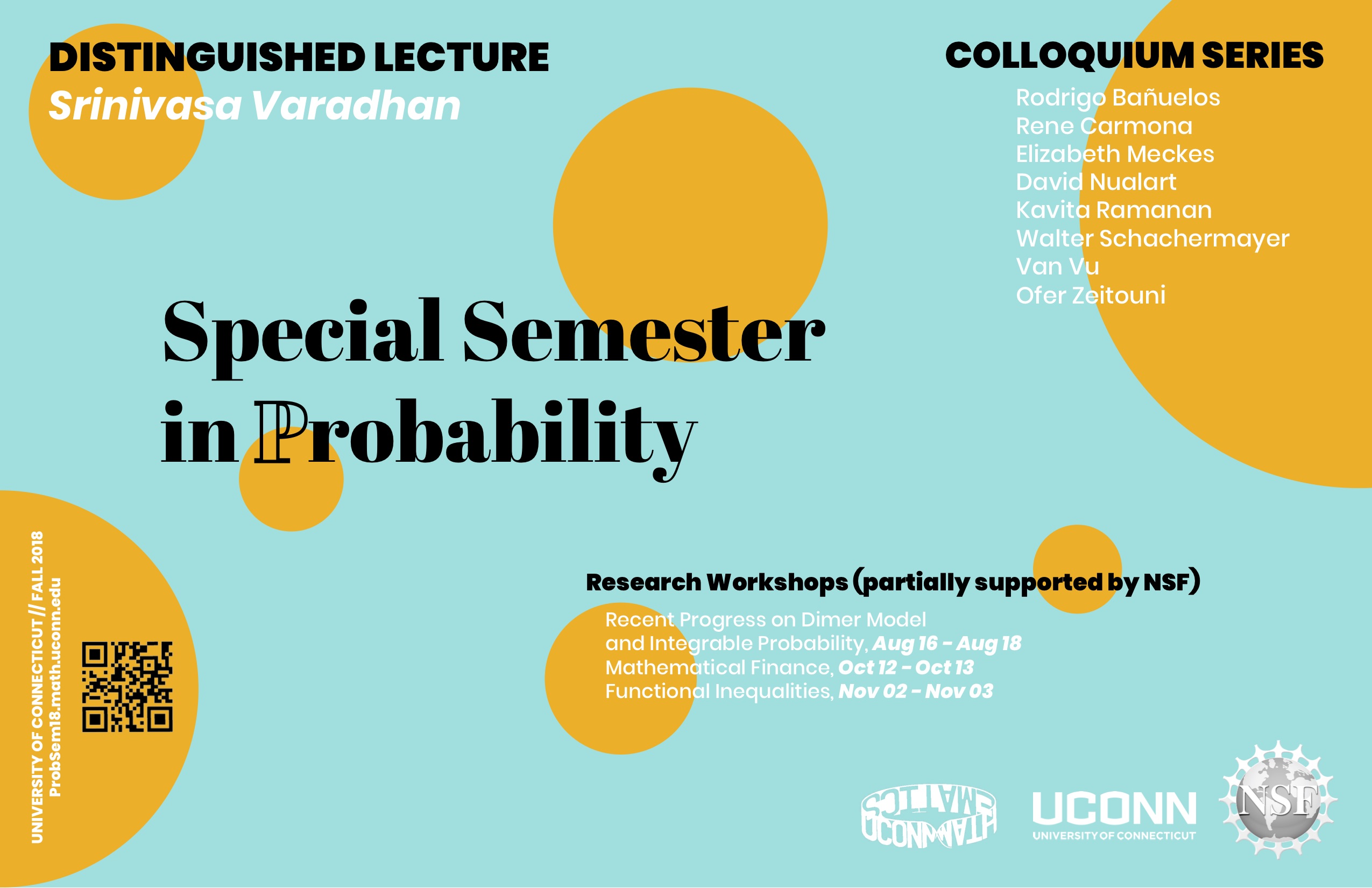
Special semester in Probability at Uconn

The Department of Mathematics at the University of Connecticut is designating Fall 2018 as a Special Semester in Probability.

Special lectures:

Srinivasa Varadhan, 9/13
Ofer Zeitouni, 9/20
Elizabeth Meckes, 9/27
Walter Schachermayer, 10/11
Rodrigo Banuelos, 10/18
David Nualart,  10/25
Kavita Ramanan, 11/1

Workshops:

Recent Progress on Dimer Model and Statistical Mechanics, Aug. 15-16

Financial mathematics, October 13

Functional inequalities in Probability, November 2-3


Posted in Uncategorized | Leave a comment

Geometric inequalities on sub-Riemannian manifolds

From January 15th to January 30th, I will have the great pleasure to visit the TIFR Centre For Applicable Mathematics in Bangalore, India. I will be lecturing on some aspects of geometric inequalities on sub-Riemannian manifolds.


Here is a preliminary version of the lecture notes: Bangalore.

The four lectures will mainly be divided into three parts:

  1. Sub-Laplacian comparison theorems
  2. Volume doubling properties and Poincare inequalities on sub-Riemannian manifolds
  3. Isoperimetric and Sobolev inequalities


A main theme in those topics is the use of a generalized curvature dimension condition which is valid for a large class of  hypoelliptic second-order differential operators.


Posted in Geometric inequalities on sub-Riemannian manifolds | Leave a comment

HW10. MA3160 Fall 2021 Due November 18

Exercise. Let (X,Y) have joint density f(x,y)=c e^{-x-2y} if x,y \ge 0 and 0 otherwise.

(a)  Find c that makes this f a joint pdf.

(b) Are X and Y independent ?

(c) Compute E(XY^2)

(d) Compute Var(X+Y)

Honors exercise.

Let X_1 be a an exponential random variable with parameter one  and  let X_2 be an exponential random variable with parameter 2. We assume that X_1 and X_2 are independent. Compute the density of the random variable Z=X_1+X_2,

Posted in MA3160 | Leave a comment

HW9. MA3160 Fall 2021, due 11/11

Exercise. The average waiting time for the commuter train is 15 minutes . What is the probability that Joe will wait for more than 10 minutes, given that he has already waited for 5 minutes ?

Exercise. Suppose that the length of a phone call in minutes is an exponential r.v with average length 8 minutes. What is the probability of your phone call being more than 10 minutes ?

Honors exercise.  A hospital is to be located along a road of infinite length. If the population density is exponentially distributed along the road, where should the station be located to minimize the expected distance to travel to the hospital? That is, find an a to minimize E|X − a|, where X is exponential with rate λ.

Posted in MA3160 | 1 Comment

HW8. MA3160 Fall 2021. Due 11/04/21

Exercise. 

About 10% of the population is left-handed. Use the normal distribution to

approximate the probability that in a class of 150 students,

(a) at least 25 of them are left-handed.

(b) between 15 and 20 are left-handed.

Honors Exercise.

Let X be a normal random variable with mean 0 and variance 1. Compute E(X^n), where n is an integer more than 1

Posted in MA3160 | Leave a comment

HW7. MA3160 Fall 2021, due October 28

Exercise.

Let X be a random variable with probability density function:

f(x) =cx(5−x) 0≤x≤5, 0 otherwise.

(a) What is the value of c?
(b) What is the cumulative distribution function of X ? That is, find F (x) = P (X ≤ x).

(c) Use your answer in part (b) to find P (2 ≤ X ≤ 3).

(d) What is E[X]?

(e) What is Var(X)?

Honor exercise.

Let X be a random variable with density function f(x)= ce^{-|x|}.

(a) What is the value of c ?

(b) Compute the density of the random variable Y=X^2

Posted in MA3160 | Leave a comment