
Gradient structures on metric measure spaces
This project grew out of curiosity both mathematical and about the use of the latest AI generative tools in mathematical research. It is by now well-established that the latest AI models are very efficient at problem solving in mathematics, but are they already good at theory building ? I was curious to test this on a possible theory that I had in mind for some time. This was not a shot in the dark since I had ideas from the beginning and since the “rank one” case of the theory was already quite well understood and developed in some of my previous works on the Vicsek set and local trees. There was therefore something concrete to extrapolate from. The main idea was to develop a finite rank gradient theory on a large class of metric spaces which might be fractals. This idea is of course not new, and the closest antecedent to the approach I had in mind is probably Hino’s theory of gradient and martingale dimension. However, Hino’s theory is based on Dirichlet forms and I was looking for a theory for every with a gradient essentially independent from .
The way models were used to develop the theory is described in the preface of the document. I think this took about 200 prompts, 40 hours on Astra 6.1, 20h on Sol 6.1 and 20h on Fable 5.1 and 5.2. My role in the project was like an architect, and I am relatively satisfied by the end result and learnt a lot. Though already useful I think, this a first draft which is not intended to be published for now since the document is almost entirely AI written. There will be further digestion of the material and some rewriting but I think the experience was quite productive, interesting and is illustrative of what future work might be for mathematicians. As AI systems become increasingly capable at problem solving and even theory building, one still choose the directions to pursue, advance mathematical knowledge and human understanding along the paths one judge relevant, and, above all, keep asking the right questions.
1. From the Vicsek set to higher rank spaces
With its intrinsic metric, the Vicsek set is a real tree. Fix a root and orient the arcs away from it. A Lipschitz function can be differentiated along each arc. If is length measure on the skeleton , then
The reference measure is the Hausdorff measure of dimension and gives zero mass to . In my work with Li Chen on the Vicsek set and with Li Chen and Meng Yang on local trees, we used this scalar derivative to develop Sobolev spaces with and .
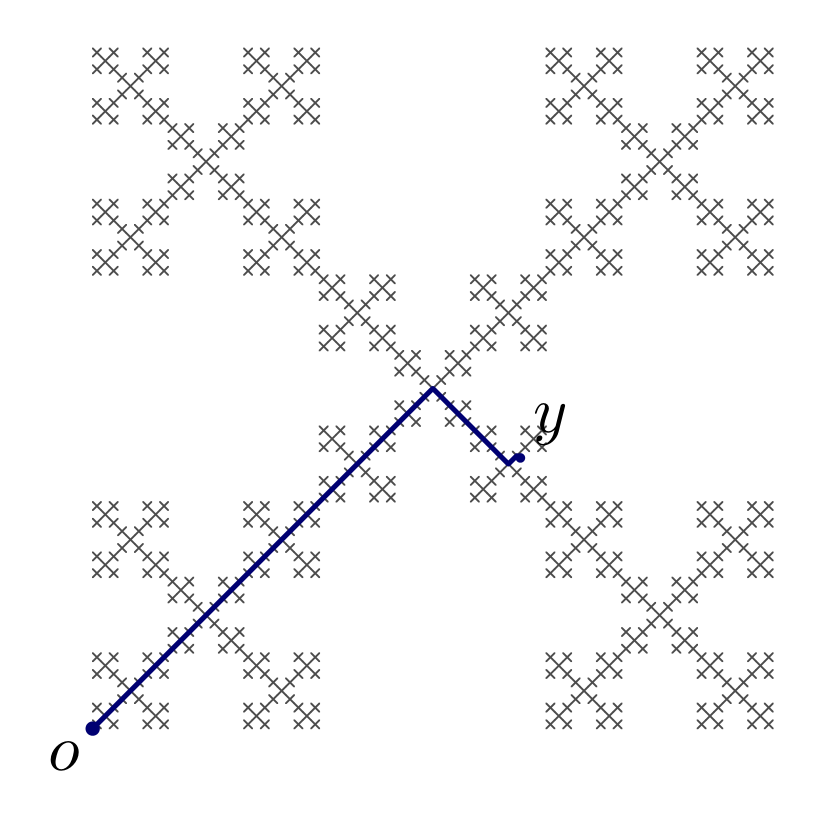
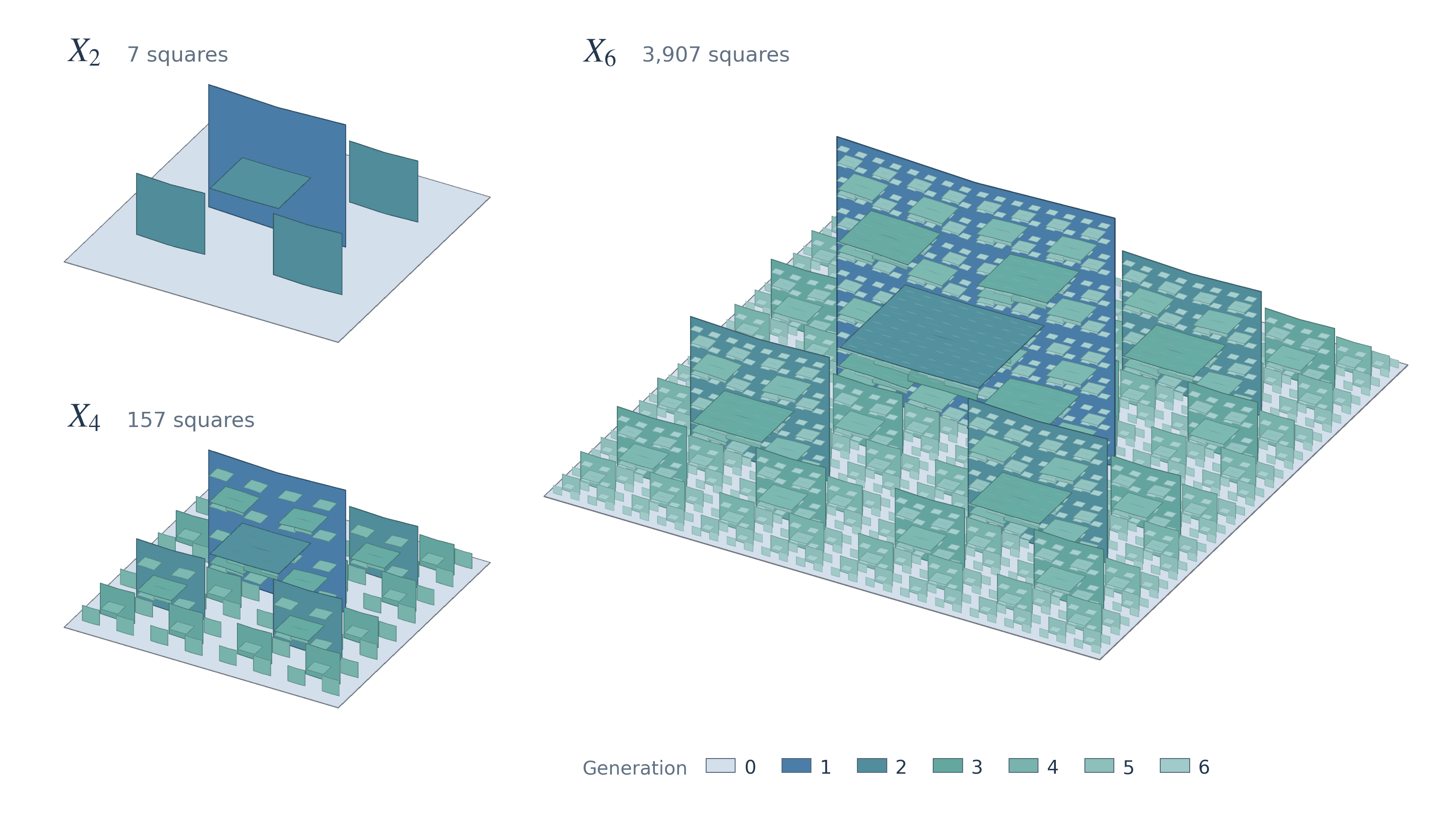
Having well understood the rank one geometry given by trees, products of trees were at first a natural place to look for higher rank examples. However, the natural product of two trees with singular length measures still has rank one ! Indeed, the two partial derivatives are carried by mutually singular measures, so only one direction is present at almost every point for the gradient measure. A first genuine higher example was obtained by the model Astra which I prompted to find a higher dimensional analogue to cable system limits. In the resulting tree of cubes, the ordinary -dimensional gradients on the pieces survive in the limit, and the measure carrying them is singular with respect to .
2. Gradient structures
More abstractly, a convenient and usable definition is the following. On a metric space , a gradient structure consists of a Borel set , a -finite measure carried by , and a linear map
Here is the smallest measurable field of subspaces of a fixed containing the gradients. The map satisfies the Leibniz rule and almost everywhere. It takes pointwise convergence of uniformly bounded, uniformly Lipschitz sequences to weak- convergence. The dimension of is the pointwise rank, and its -essential supremum is the rank .
The reference measure enters when we close the gradient. We view as an operator from to on the compactly supported Lipschitz functions whose gradients belong to the latter space. The structure is -admissible if this core is uniformly dense in and the operator is closable. The domain of its closure is then . For this gives a strongly local regular Dirichlet form. When the core gradients span the fibres, is the martingale dimension of the associated diffusion.
3. The rank theorem
On the tree of cubes, weak monotonicity at the critical Korevaar–Schoen exponent fails for . This rules out a common scale for the Poincaré inequality and the cutoff energy estimate which is usually assumed in the current literature in Dirichlet spaces. For the classical theory with a common scale, see Barlow, Bass and Kumagai and Grigor’yan, Hu and Lau.
I was surprised by this two-scale feature and spent quite some time to try to construct higher rank examples with the same scale. It turned out to be impossible. The rank theorem explains the obstruction. Suppose a -admissible gradient structure, with , has doubling reference measure and a core that spans the fibres. If the -Poincaré inequality and the cutoff energy bound hold at a common scale whose lower scaling exponent is greater than , as for with , then
At , a common scale of order strictly higher than therefore forces rank one for a nontrivial gradient structure. In particular, this applies when two-sided sub-Gaussian heat kernel estimates with walk dimension greater than two give the common Poincaré and capacity scale. The proof uses functions with independent gradients as coordinates and a capacity argument related to Hino’s work on martingale dimension.
4. Heat kernels with two scales
What heat kernel estimates can one obtain when the scales differ? In a geodesic, strongly local regular Dirichlet space with volume doubling, let be the scale in the Poincaré inequality and the scale in the cutoff Sobolev inequality in annuli. The latter controls cutoff energy weighted by the square of a test function. See Andres and Barlow.
With the Poincaré inequality on the same ball on both sides, the parabolic Harnack inequality on a cylinder of radius and time length takes the form
where and are earlier and later interior subcylinders. The first ratio comes from the Poincaré estimate inside the ball. The second comes from localizing the equation with a cutoff.
The two scales also enter the upper bound in different ways. With uniform volume growth and power scales , with , the small-time bound is
The Poincaré scale determines the prefactor in this bound, and the cutoff Sobolev scale determines the off-diagonal decay. The lower bounds involve both scales. When the scales agree, the estimates recover the usual two-sided bounds. At this stage, I don’t think the theory is complete and I believe we should be able to obtain cleaner results for the heat kernel estimates.
5. Self-improvement of Poincaré inequalities
I think that a feature of a good theory is that one can prove interesting theorems in it, so I tried to test this. Because the same gradient is defined at every exponent on the Lipschitz core where its energy is finite, several natural questions arise. In particular, the so-called self-improvement property of the Poincaré inequalities easily comes to mind. The question comes from the theorem of Keith and Zhong.
On a proper geodesic space with doubling reference measure, start with a -Poincaré inequality at the cutoff scale and a cutoff estimate at some exponent . One obtains an -Poincaré inequality with , with the gradient and the oscillation integrated over the same ball. Thus, if the scales match at , they also match at all exponents sufficiently close to from below under the standing cutoff condition. A set of small -measure can have infinite -measure, so the proof uses cutoff energy to control the cost of modifying a function on such a set. I believe some extensions might be possible in situations where the scales do not match.
6. Examples
What is a good theory without examples ?
- Manifolds, finite Riemannian gluings and spaces. Under the hypotheses in the draft, smooth or measurable Riemannian metrics, sub-Riemannian manifolds, finite Riemannian gluings and finite-dimensional spaces give and matching quadratic scales .
- Local trees. With uniform ball volume , the length derivative has rank one and the matching scale at exponent is .
- Cubical inverse limits of Laakso type. These realize each integer rank and each volume dimension , with and Gaussian scales.
- The harmonic Sierpiński gasket. The harmonic embedding gives a rank-one gradient and critical Korevaar–Schoen exponent for every finite . Ball volumes depend on the centre.
- Liouville Brownian motion. Here the Euclidean gradient has rank two, is planar Lebesgue measure, and is Gaussian multiplicative chaos with parameter . Almost surely, the gradient is closable exactly for among .
- The tree of cubes. The rank is , the reference measure is Ahlfors -regular with , and . The critical Korevaar–Schoen exponent is for each finite , and the two scales match precisely for .

