
Download
The purpose of these notes is to provide a new probabilistic approach to the Gauss-Bonnet-Chern theorem (and more generally to index theory). They correspond to a five hours course given at a Spring school in France (Mons) in June 2009.
The purpose of these notes is to provide a new probabilistic approach to the Gauss-Bonnet-Chern theorem (and more generally to index theory). They correspond to a five hours course given at a Spring school in France (Mons) in June 2009.
These notes are the basis of a course given at the Institut Henri Poincare in September 2014. We survey some recent results related to the geometric analysis of hypoelliptic diffusion operators on totally geodesic Riemannian foliations. We also give new applications to the study of hypocoercive estimates for Kolmogorov type operators.
In those lecture notes, we review some applications of heat semigroups methods in Riemannian and sub-Riemannian geometry. The notes contain parts of courses taught at Purdue University, Institut Henri Poincaré, Levico Summer School and Tata Institute.
Those are the notes corresponding to my book on stochastic flows. Most of them were written in 2003 during my stay as a postdoc at the Technical University of Vienna.
Those are the notes of a course on rough paths theory taught at Purdue University in Spring 2013. We develop the theory according to its founder Terry Lyons’ point of view and rely on the book by P. Friz and N. Victoir.
Those are lecture notes on stochastic differential equations driven by fractional Brownian motions. It only deals with the case 
Those notes correspond to a mini course given during the Finnish Summer School in Probability 2012.
Those are the lecture notes of the stochastic calculus course I have been teaching at the University of Toulouse (2003-2008) and then at Purdue University. Some parts of this book grew out of the lectures posted on this blog.
During my Phd thesis (completed in 2002 under the supervision of Marc Yor) I worked on applying stochastic calculus to mathematical finance. I quit doing research on mathematical finance soon after the thesis but was invited to deliver lectures at Princeton University in 2003 on the topics of modeling of anticipations on financial markets.
A published version might be found here.
After the general introduction to the theory of Caccioppoli sets that was presented in the previous post. I will now sketch some elements of the theory that was developed in our works:
Let 


The form 


Let 

As is well-known, 


We always assume 
For 


Definition: The space of bounded variation functions associated to the Dirichlet form 

A set 


The following can be deduced from M. Miranda Jr, D. Pallara, F. Paronetto, M. Preunkert, 2007. Assume that 
then 


Consider on the Sierpinski triangle 
where 
Then 

A set 
The space 

Then 
Therefore, 

Assume that 


In the case of Riemannian manifolds, the space 

The following can be deduced from the paper Two Characterization of BV Functions on Carnot Groups via the Heat Semigroup by M. Bramanti, M. Miranda Jr. & D. Pallara. Assume that
then 
Let
Theorem: (Weak Bakry-Emery estimates I)
Let
If there exists a constant 
Then, 
The theorem applies to 
Theorem: (Weak Bakry-Emery estimates II)
Let
where 
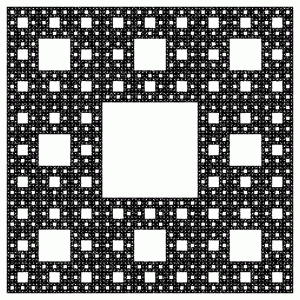
This applies to the unbounded Sierpinski triangle and their products and large classes of fractals or products of fractals. This is however a conjecture on the Sierpinski carpet.
-Sobolev inequality and isoperimetric inequalityLet
Theorem: Assume 


Then, if 
where 
Under the assumptions of this theorem, one therefore obtains the following general isoperimetric inequality for Caccioppoli sets in Dirichlet spaces
It generalizes the isoperimetric inequality which was known in Riemannian manifolds or Carnot groups (due to N. Varopoulos) but also applies to new situations like fractals.
In the next two posts, longer than usual, I will explain some ideas of recent works written in collaboration with Patricia Alonso-Ruiz, Li Chen, Luke Rogers, Nageswari Shanmugalingam and Alexander Teplyaev about the study of bounded variation functions in the context of Dirichlet spaces.
A basic motivating geometric question for those works was: What is the good mathematical structure on a space that allows to define an intuitively reasonable notion of perimeter for “good” sets ? The question is of course a little vague, but deeply thinking about it from different viewpoints is certainly fruitful and yields an interesting mathematical adventure.
In our works we argue that Dirichlet spaces provide a good framework in which we can define sets of finite perimeter and prove theorems generalizing in an elegant way classical results from the Euclidean space, like the classical isoperimetric inequality. A key guiding insight which comes from potential theory is to think of the perimeter of a set as a
Dido was, according to ancient Greek and Roman sources, the founder and first Queen of Carthage (in modern-day Tunisia).
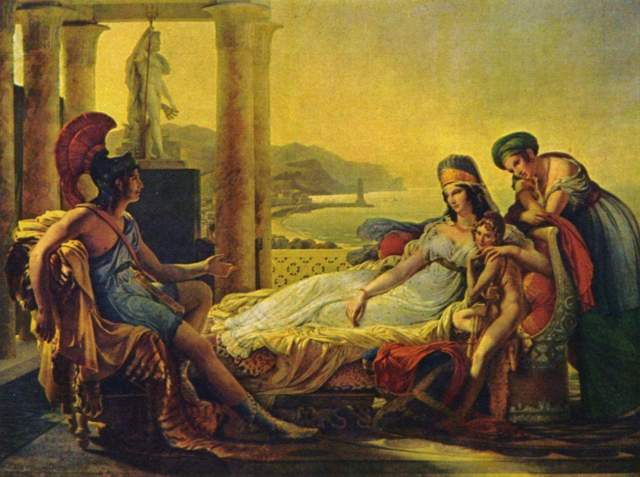
Aeneas recounting the Trojan War to Dido, a painting by Pierre-Narcisse Guérin.
The legend says that when Dido arrived in 814BC on the coast of Tunisia, she asked for a piece of land. Her request was satisfied provided that the land could be encompassed by an ox-hide. This land became Carthage and Dido became the queen. But:
What is the shape of the land chosen by Queen Dido ?
Mathematically, we can first simplify and rephrase this problem as:
In the Euclidean plane, what is the curve which encloses the maximum area 

This is the isoperimetric problem in the plane. If we restrict ourselves to smooth closed curves and understand the perimeter of a set as the length of its boundary, the problem can be solved using basic calculus: the method of Lagrange multipliers. As is intuitively clear, the curve which encloses the maximum area
So the city limits of Carthage formed a (half) circle. We can still visit today the ruins of Carthage, and a small museum there explains the isoperimetric story of Queen Dido.
As mathematicians, we like to formulate problems at different levels of generality and in a form that can be generalized to different settings. To formulate the isoperimetric problem in the n-dimensional Euclidean space
Our modern and current understanding of the notion of volume is largely based on the seminal works by H. Lebesgue (1901-1902): Nowadays, one understands volumes in the category of measure spaces.
The notion of perimeter is more elusive and can be understood from different viewpoints, yielding different generalizations. The Italian school in geometric measure theory played a major role in advancing the theory.
The first idea to define the perimeter of a Borel set 

and say that
A (somehow dual) definition for the perimeter of a set which coincides with the previous one is given by
This definition only requires a differential structure and a Riemannian metric to define the divergence of vector fields; it can therefore be extended to any Riemannian manifold.
If
where 
This characterization of sets of finite perimeter is far reaching, convenient to work with, and may actually serve as a definition in a large class of spaces. It only requires a heat semigroup, an object which is well defined in the category of Dirichlet spaces, and a length of gradient 
Given a subset
Then, 


This characterization of sets of finite perimeter is striking, it shows that the perimeter of a set can be understood using only a metric and a measure.
If
where 

This characterization of sets of finite perimeter, which is due to M. Ledoux for balls and in the general case to M Miranda Jr, D Pallara, F Paronetto & M Preunkert, 2007, only requires a heat semigroup. As noted above, heat semigroups are well-defined in Dirichlet spaces.
Thus, sets of finite perimeter may perfectly be well defined in any Dirichlet space and we do not need a gradient or a distance. This is the point of view we will take on the next post and will explain the associated theory. A key point is the understanding of the normalizing factor 






 Research and Lecture notes